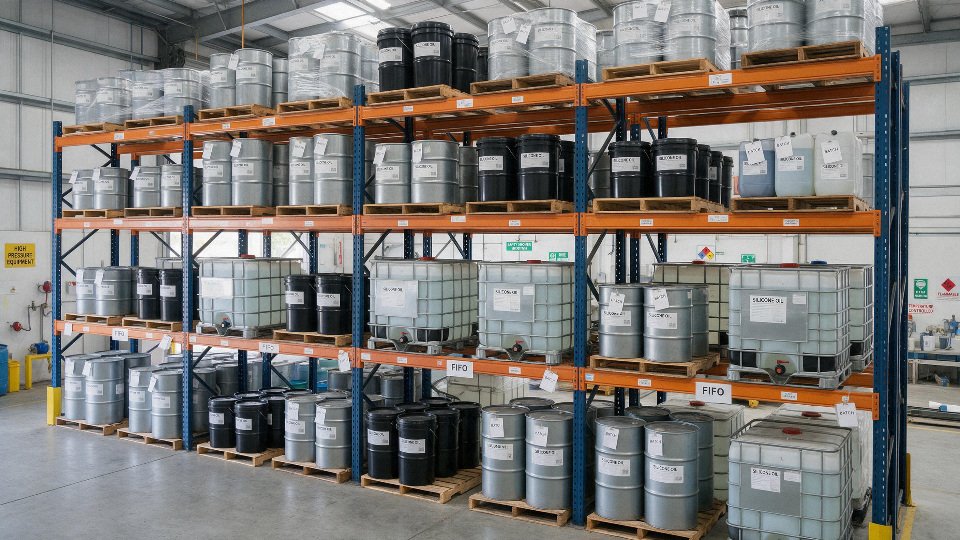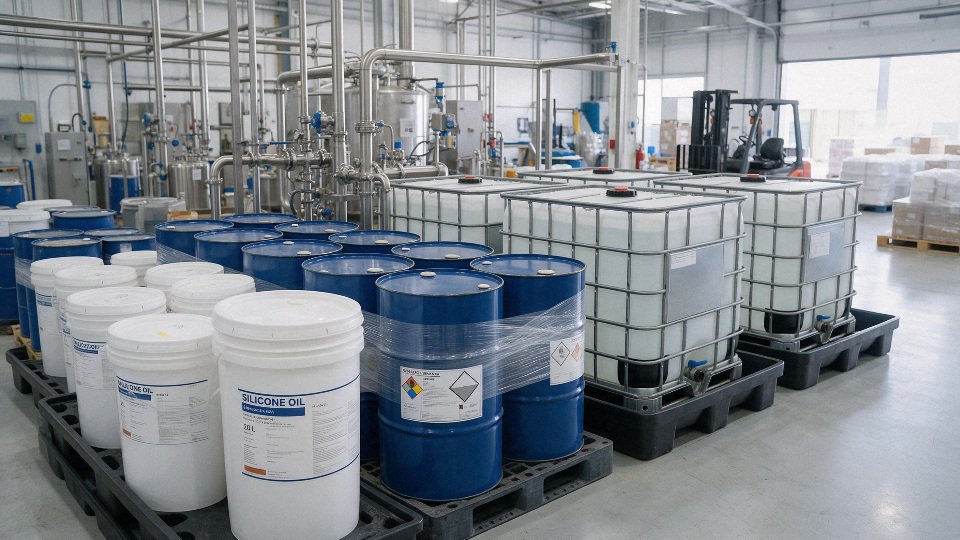
Silicone oil sits in that frustrating procurement category where the same chemical — same viscosity, same base polymer — can show up on three different quotes at wildly different prices, and nobody on the buying team can immediately explain why. Get the grade wrong and you’re either paying a pharmaceutical premium for a lubricant that wipes a conveyor chain, or you’re running food-contact equipment with an industrial fluid that fails your next audit. Either mistake has a real cost: downtime, rework, regulatory exposure, or just money left on the table every month.
Silicone oil (PDMS, 350 cSt) costs roughly USD 2.50–5.50 per kg in industrial bulk drums, depending on order volume, purity specification, and supplier region. Pharmaceutical- or USP/EP-grade fluid runs USD 15–35 per kg. Small retail quantities — 100 mL bottles — can reach USD 20–60 per liter, compared to USD 3–8 per liter for the equivalent bulk industrial purchase.
What most buyers don’t realize until they’ve done this a few times is that the grade ladder isn’t the only cost driver. Viscosity, packaging format, freight class, and even the time of year (silicone feedstock prices do move with broader chemical market cycles) all shift the final landed number more than most procurement models account for. This guide works through each of those levers so you can benchmark a quote before you sign it, not after.
How Silicone Oil Grade and Viscosity Drive the Base Price
Grade classification is the single biggest lever on silicone oil cost before you ever factor in shipping, packaging, or market timing. Two drums sitting side by side on a warehouse shelf might both be labeled “silicone oil 350 cSt,” yet one costs three times the other — because one was manufactured and certified for pharmaceutical injection device lubrication and the other was not.
The Main Commercial Grades and What Separates Them
Industrial-grade polydimethylsiloxane (PDMS) is the workhorse. It covers the widest viscosity range, carries the fewest documentation requirements, and represents the bulk of global silicone oil volume. Pricing in 2024 for common viscosities in drum quantities runs roughly USD 2.50–5.50/kg, though where you land in that band depends heavily on viscosity, order volume, and your supply region.
Cosmetic-grade dimethicone sits a step up. Suppliers must demonstrate low heavy-metal content, skin-safe formulation, and batch traceability — none of which is free. Expect a modest premium of 15–40% over industrial PDMS for comparable viscosities, depending on whether the supplier is running dedicated cosmetic lines or just adding testing to an industrial batch.
Pharmaceutical-grade silicone oil — certified to USP or EP monographs — is a different category entirely. Every lot requires release testing: identity, viscosity, refractive index, heavy metals, and often extractables and leachables depending on the application. That documentation overhead, plus tighter raw-material controls, pushes prices to roughly USD 15–35/kg. The 3x–6x premium over industrial grade is real and largely non-negotiable unless you are buying at serious scale.
Food-contact grade (FDA 21 CFR 178.3570) occupies a middle position. The regulatory threshold is achievable without full pharmaceutical rigor, but suppliers do need to maintain appropriate manufacturing records and limit viscosity to the approved range — 300 cSt to 1,000 cSt for most direct-contact applications. Pricing typically runs 30–80% above industrial grade for equivalent viscosity.
Electronic-grade silicone oil — used in transformer fluids, heat-transfer applications, and semiconductor-adjacent processes — requires ultra-low ionic contamination. That purity step adds cost in both distillation and quality control. Premiums vary but commonly run 50–120% over standard industrial PDMS.
Viscosity and Synthesis Complexity
The viscosity range for commercial silicone oils spans roughly 0.65 cSt (essentially volatile cyclic siloxanes) up to 1,000,000 cSt semi-solid gums. That range is not linear in cost.
Low-viscosity fluids (0.65–10 cSt) require shorter polymerization chains and are relatively straightforward to produce, but they are volatile and present inhalation concerns in manufacturing environments — handling and containment add process cost that shows up in price. Mid-range viscosities, 50–1,000 cSt, are the cheapest to manufacture per kilogram. This is the volume sweet spot for producers, and it shows in pricing. Very high viscosities — 60,000 cSt and above — require extended polymerization, tighter molecular-weight distribution control, and more intensive filtration. Pricing climbs noticeably above roughly 12,500 cSt and again above 100,000 cSt.
Standard 350 cSt PDMS is among the least expensive viscosity grades to produce, which is why it dominates industrial pricing benchmarks.True
350 cSt sits squarely in the mid-range polymerization sweet spot, requires no special chain-length control, and accounts for a large share of total production volume globally — all of which keeps unit cost lower relative to very low or very high viscosity grades.
Functional Modifications and Their Cost Impact
Plain dimethyl silicone oil is the cheapest baseline. Modify the backbone and you pay more — sometimes a little, sometimes a lot.
Phenyl silicone oil (methyl phenyl polysiloxane) substitutes phenyl groups for some methyl groups, which broadens the useful temperature range and improves radiation resistance. The synthesis is more involved, and phenyl-modified fluids typically run 40–90% above equivalent-viscosity PDMS.
Methyl hydrogen silicone oil carries reactive Si–H groups used as crosslinkers in release coatings and textile treatment. Synthesis is controlled carefully because of reactivity, and pricing usually runs 30–60% above standard PDMS.
Amino-modified silicone oils — the workhorse of textile softeners and hair-care conditioners — can command 60–200% premiums depending on the amine content and the modification process. High-amino-content variants used in fabric finishing sit at the expensive end of that range.
| Grade | Typical Viscosity Range | Indicative Price (USD/kg, bulk) | Primary Applications |
|---|---|---|---|
| Industrial PDMS | 10–100,000 cSt | 2.50–5.50 | Lubrication, release agents, hydraulic fluids |
| Cosmetic dimethicone | 5–350 cSt | 3.50–7.50 | Skin care, hair care, personal care |
| Pharmaceutical USP/EP | 20–1,000 cSt | 15–35 | Medical devices, injectable drug mfg |
| Food-contact (21 CFR 178.3570) | 300–1,000 cSt | 4.50–9.00 | Baking release, food processing equipment |
| Electronic/transformer grade | 50–10,000 cSt | 5.50–12 | Transformer insulation, heat transfer |
| Phenyl-modified | 50–5,000 cSt | 5.00–10 | High-temp lubrication, optics |
| Amino-modified | 100–10,000 cSt | 6.00–15+ | Textile softening, hair conditioners |
Prices shown are indicative for drum-quantity purchases in 2024; actual landed cost depends on order size, supplier region, and certification requirements.
Raw Material and Manufacturing Cost Breakdown Behind the Price Tag
Silicone oil doesn’t start its life as a fluid — it starts as quartz. Understanding that chain matters if you want to anticipate where prices are heading, rather than just reacting to the next supplier quote.
From Silicon Metal to PDMS: The Feedstock Chain
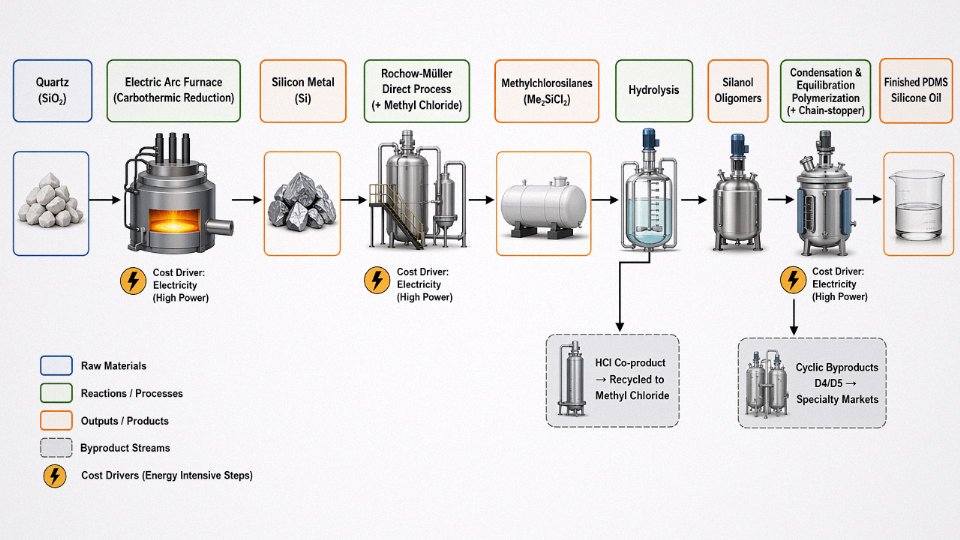
The process begins with carbothermic reduction of silicon dioxide (SiO₂) in electric arc furnaces, producing metallurgical-grade silicon metal. That step alone is energy-intensive enough that most silicon metal smelting happens where power is cheap — historically in China’s Yunnan and Sichuan provinces, Norway, and Brazil. Silicon metal spot prices have swung dramatically over the years, ranging roughly USD 1,200–3,500 per metric ton depending on energy market conditions, Chinese export policy, and seasonal hydropower availability (Yunnan smelters routinely curtail output in dry-season months when river levels drop — a detail that catches downstream buyers off guard every few years).
From silicon metal, producers react with methyl chloride (itself derived from methanol and hydrogen chloride) via the Rochow-Müller direct process to yield a mixture of methylchlorosilanes — primarily dimethyldichlorosilane (Me₂SiCl₂), with monofunctional and trifunctional species as co-products. The selectivity of this reaction, and how well the plant recovers and recycles the non-PDMS fractions, has an outsized effect on unit cost. A facility running at 80% dimethyldichlorosilane yield is operating in a fundamentally different cost position than one at 70%.
Hydrolysis of Me₂SiCl₂ generates hydrochloric acid as a co-product — ideally recovered and recycled back into methyl chloride synthesis, closing the chlorine loop. Plants that can’t close that loop effectively are either venting value or paying to dispose of acid, and both scenarios show up in their pricing. After hydrolysis, the resulting silanol oligomers undergo condensation and equilibration polymerization, with chain-stopping agents (typically hexamethyldisiloxane or trimethylsilanol) controlling the final molecular weight — and therefore viscosity. Tighter viscosity control requires tighter process discipline, more distillation passes, and more QC sampling. That’s part of why a precisely specified 350 cSt fluid costs more to manufacture than a broadly spec’d “medium viscosity” product.
Reactor Scale, Distillation, and Byproduct Economics
Cyclic siloxanes — primarily D4 (octamethylcyclotetrasiloxane) and D5 (decamethylcyclopentasiloxane) — form as inevitable byproducts during hydrolysis and polymerization. What a producer does with them matters. D4 and D5 have their own markets (personal care, specialty lubricants), so a plant with efficient distillation and an established sales channel for cyclics is recovering real value that subsidizes linear PDMS production. A smaller regional producer without those offtake agreements either blends cyclics back into lower-spec product or takes a loss on them. That’s a genuine structural cost disadvantage, not just a scale argument.
The top global silicone producers — Dow, Wacker Chemie, Shin-Etsu, Momentive, and Elkem — hold meaningful cost advantages over regional manufacturersTrue
Integrated feedstock positions, large-scale Rochow process reactors, closed chlorine loops, and byproduct recovery systems collectively give major producers an estimated 15%–35% cost advantage per kg of PDMS versus smaller regional players, based on published capacity and cost structure analyses in the silicones industry.
Scale matters in ways that aren’t obvious from the outside. A world-scale methylchlorosilane plant running 200,000+ metric tons per year amortizes its distillation infrastructure, catalyst costs, and quality lab expenses across an order of magnitude more product than a 10,000-ton regional facility. The energy cost per kilogram of finished PDMS at a large integrated site might run USD 0.30–0.70/kg; at a smaller toll-processing operation, that same line item can reach USD 1.20–2.00/kg depending on local electricity tariffs and reactor utilization.
Methanol and chlorine pricing add another layer of volatility. Both are petrochemical-adjacent commodities, so natural gas price spikes — the kind that hit European producers hard in 2021–2022 — flow through quickly. A procurement manager watching silicone oil quotes tick upward in Q4 of an energy-crisis year should be looking at European natural gas futures, not just calling their distributor for an explanation.
The practical takeaway: when a supplier quotes you a higher price, asking whether it’s feedstock-driven, energy-driven, or margin-driven is not an unreasonable question. The answer tells you whether to lock in volume now or wait.
Purchase Volume and Packaging: The Single Biggest Price Multiplier
If you’ve ever seen two buyers quote wildly different prices for chemically identical 350 cSt PDMS and wondered what’s going on, the answer is almost always packaging tier, not product quality. The spread is genuinely dramatic — roughly USD 45–55/kg for a retail 500 mL bottle, collapsing to somewhere in the USD 3.00–4.50/kg range for a full ISO tanker load. Same molecule, same viscosity, same supplier country of origin. That 12x–15x multiplier is packaging overhead, logistics amortization, and distributor margin stacked on top of each other.
The Volume Tiers and What They Actually Cost
At the small end — retail bottles from 100 mL to about 1 L — you’re paying for individual fill labor, label compliance, secondary cardboard, and the distributor’s catalog infrastructure. Expect USD 40–60/kg, sometimes more for specialty viscosities. Frankly, if your application consumes more than a few liters a month, buying at this tier is just burning money.
Pails (5–25 kg, typically UN-rated HDPE) are where small workshops and R&D facilities usually land. Unit prices drop to roughly USD 12–22/kg depending on viscosity and whether you’re buying from a regional distributor or direct from an importer. The 25 kg pail is a sweet spot for labs; for a production line running a few hundred kilograms a year, it’s already borderline inefficient.
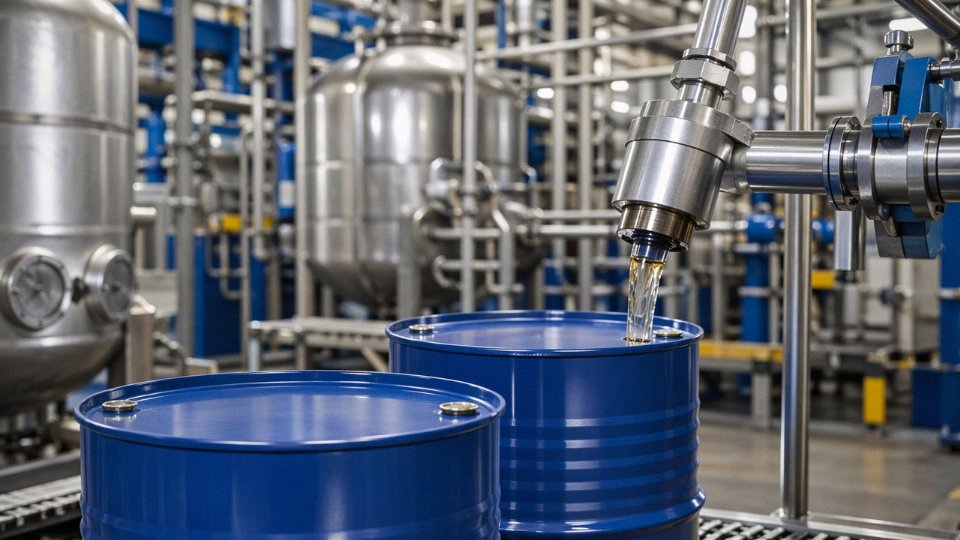
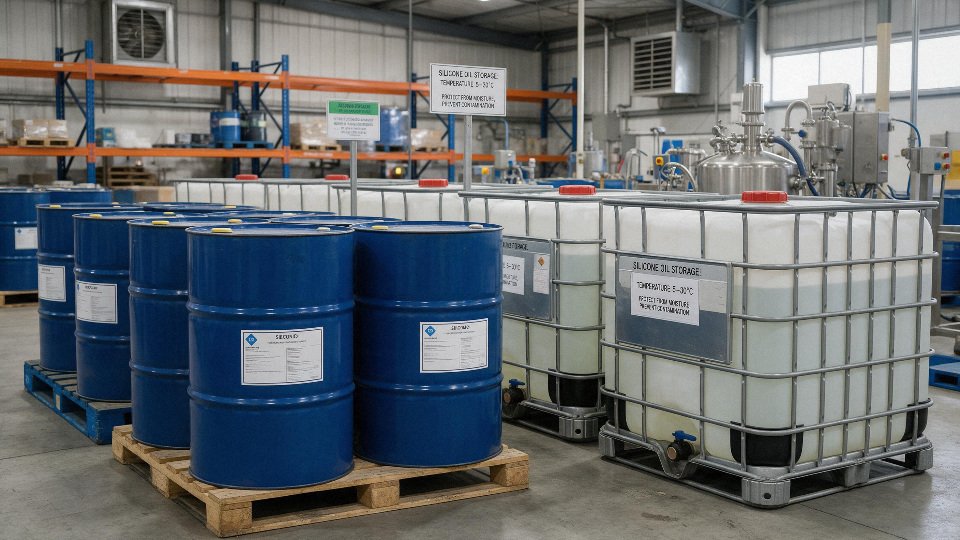
Standard 200 kg steel or HDPE drums are where most mid-size industrial buyers operate — and where the economics start making real sense. Delivered price for industrial-grade 350 cSt PDMS in drums typically runs USD 5.50–9.00/kg in North American and European markets (2024 basis), with Asian-market pricing roughly 20–35% lower depending on origin and import duty. The drum itself adds around USD 0.30–0.60/kg to the unit cost once you account for the container purchase or deposit, handling, and eventual disposal or return freight.
IBC totes at 1,000 kg push the delivered unit cost down to approximately USD 3.80–6.50/kg for the same industrial-grade product — the range depends heavily on whether the IBC is new or reconditioned, whether the supplier certifies it as clean-fill for your application, and your freight lane. Reconditioned IBCs can introduce contamination risk if prior contents weren’t compatible with silicone, so verify the cleaning certification. A tote that previously held a reactive solvent and wasn’t properly certified is a quality problem waiting to happen.
ISO tankers — 20,000 kg and up — are primarily relevant to compounders, large lubricant blenders, and contract manufacturers with dedicated storage. At this volume, effective unit price for commodity PDMS grades can reach USD 2.80–4.00/kg, though tanker cleaning and certification fees run USD 800–2,500 per load depending on prior product and regulatory requirements, which you need to fold back into your per-kg math.
For identical 350 cSt PDMS, unit price can differ by 15x or more based solely on purchase volume and container format, with no change in chemistry or specification.True
This reflects documented price tier structures in silicone oil distribution, where retail packaging overhead, fill labor, and multi-tier margins compound against bulk commodity pricing at tanker volume. The 15x figure represents the extreme ends of the range (retail bottle vs. ISO tanker) and is consistent with 2024 industrial pricing data.
Packaging Cost Is Not Trivial and Often Ignored
Buyers sometimes focus entirely on the per-kg product price and overlook what the container itself costs. HDPE drum procurement, IBC reconditioning, and tanker cleaning certification realistically add USD 0.10–0.80/kg depending on container type and reuse policy. For a buyer moving from drums to IBCs, that packaging delta can easily offset 30–40% of the unit-price saving if the logistics math isn’t done properly.
| Container Format | Typical Unit Qty | Indicative Price Range (Industrial 350 cSt, USD/kg) | Packaging Adder (USD/kg) |
|---|---|---|---|
| Retail bottle | 0.1–1 kg | 40–60 | N/A (included) |
| HDPE pail | 5–25 kg | 12–22 | 0.50–0.80 |
| Steel/HDPE drum | 200 kg | 5.50–9.00 | 0.30–0.60 |
| IBC tote | 1,000 kg | 3.80–6.50 | 0.15–0.40 |
| ISO tanker | 20,000 kg+ | 2.80–4.00 | 0.10–0.25 |
Ranges depend on region, viscosity grade, supplier tier, and freight lane. Asian ex-works pricing typically sits 20–35% below Western delivered prices before duties.
Where MOQ Negotiations and Blanket Orders Pay Off
If your annual consumption is too small to justify a full IBC but too large to tolerate drum pricing, the practical move is a blanket purchase order with scheduled releases. Most mid-tier distributors will lock a drum-equivalent price on a 6- or 12-month forward commitment, releasing 200 kg drums against the PO on a rolling basis. You get pricing close to the IBC tier without needing the tank storage capacity. In my experience, buyers who skip this conversation and just reorder drums spot are routinely leaving USD 0.80–1.50/kg on the table.
Consignment stocking is less common but worth asking about if your supplier has regional warehouse capacity and your consumption is predictable — they hold inventory at their facility, you draw against it and pay on consumption, and your working capital stays cleaner. Not every distributor offers it, and they’ll want volume commitment in return, but for a plant running continuous processes with 5–10 tonnes per year of silicone oil, it’s a legitimate option worth raising.
Geographic Sourcing and Logistics Costs: China, Europe, and North America Compared
Ex-works prices from Chinese producers — primarily clustered around Zhejiang, Jiangsu, and Guangdong provinces — typically run 20%–40% below equivalent industrial-grade material from Wacker (Germany), Elkem (Norway), or Momentive (US), depending on viscosity grade and order size. That gap is real and it is repeatable across multiple buying cycles. But ex-works is not landed cost, and the difference between those two numbers is where procurement decisions actually get made or get wrong.
What the Freight and Duty Math Actually Looks Like
Ocean freight for bulk silicone oil in ISO tanks or flexi-bags currently runs roughly USD 0.08–0.25 per kg, though this range swings hard with routing, container availability, and season — Q4 rate spikes heading into Chinese New Year have caught more than a few buyers short. LCL (less-than-container-load) shipments skew toward the upper end of that range per kg, sometimes higher. Air freight is rarely justified for silicone oil at commercial volumes; it pushes landed cost well past any price advantage.
US import duty falls under HTS heading 2931.90 for most PDMS-based silicone oils, with rates typically in the 3%–6% range depending on exact chemical classification — worth verifying with a customs broker because misclassification gets expensive fast. EU importers work under CN code 2931, with duties similarly in the 3%–6.5% band. Stack on insurance (usually 0.3%–0.8% of cargo value, depending on carrier and Incoterms), port handling, customs examination fees, and inland drayage, and you are routinely adding USD 0.30–0.70 per kg to the ex-works price before the material clears your receiving dock.
The full landed cost comparison for a mid-viscosity industrial grade might look roughly like this:
| Cost Component | China Origin (to US Gulf port) | European Origin (to US) | North American Domestic |
|---|---|---|---|
| Ex-works price (industrial, ~350 cSt) | USD 2.50–3.80/kg | USD 3.80–5.50/kg | USD 4.00–5.80/kg |
| Ocean freight + insurance | USD 0.25–0.55/kg | USD 0.15–0.35/kg | n/a or USD 0.05–0.15/kg truck |
| Import duty (US HTS 2931.90) | USD 0.10–0.25/kg | USD 0.12–0.28/kg | none |
| Port handling + drayage | USD 0.05–0.15/kg | USD 0.04–0.12/kg | minimal |
| Estimated landed cost | USD 3.00–4.75/kg | USD 4.10–6.25/kg | USD 4.05–5.95/kg |
Figures depend heavily on order volume, Incoterms negotiated, current spot freight rates, and exact HTS sub-heading. Use these as planning estimates, not budget commitments.
Regulatory Friction: The Hidden Cost Nobody Budgets Enough For
Importing into the EU triggers REACH compliance obligations. If your Chinese supplier is not already registered as an EU importer or does not have a designated Only Representative, that registration burden falls on you — pre-registration and substance evaluation costs can run USD 5,000–30,000 depending on tonnage band and whether you need new ecotoxicology data. That is a one-time cost, but it is not trivial for a new supply relationship.
US TSCA compliance is generally lower friction for PDMS, which is already on the active inventory, but certificate-of-analysis authentication, language translation, and notarized documentation can add two to three weeks to first-shipment timelines and several hundred dollars per lot if you need third-party verification. Some quality managers insist on it regardless. Pharmaceutical and food-contact grades add another layer — USP or EP compliance letters from a Chinese supplier need careful scrutiny, and third-party confirmatory testing at an accredited US or EU lab is not optional if you are making a regulated product.
Lead Time and Buffer Stock: The Risk That Shows Up as Downtime
Ocean transit from Chinese ports to US Gulf or East Coast runs 28–42 days in normal conditions; add 1–2 weeks for inland transit from supplier to port and port clearance delays, and a realistic planning horizon is 6–10 weeks. European producers shipping to North America are in a similar range — 4–6 weeks typical. Domestic North American supply is 1–2 weeks, sometimes less.
That 6–10 week lead time from Asia requires holding 8–14 weeks of buffer stock if you want any reasonable protection against shipping disruptions. During the 2020–2022 container crisis, lead times stretched well past 14 weeks on multiple lanes, and plants running lean inventory on silicone oil for transformer cooling or hydraulic damping systems faced real production impact. The carrying cost of that buffer stock — typically 15%–25% of inventory value annually when you include capital, warehouse, and obsolescence risk — partially offsets the ex-works price advantage from Asian sourcing. It does not eliminate the advantage, but buyers who ignore it are making the comparison dishonestly.
Chinese silicone oil producers consistently offer lower ex-works prices than European or North American equivalents for industrial gradesTrue
This is well-established across publicly reported spot pricing, distributor quotes, and procurement benchmarks. The 20–40% differential reflects genuine manufacturing cost differences including labor, energy, and scale. It narrows for specialty or high-purity grades where compliance costs and QC infrastructure matter more.
The practical answer for most mid-volume industrial buyers: Chinese sourcing pencils out for large, predictable orders of standard industrial grades where you can maintain adequate buffer stock and absorb compliance documentation work. For pharmaceutical grades, tight delivery schedules, or small order quantities, the landed cost gap shrinks considerably, and the regulatory overhead often tips the decision toward a domestic or European distributor.
Specialty and Certified Silicone Oil: Medical, Food, and Electronic Grade Price Premiums
Buyers in regulated industries already know that “silicone oil” on a spec sheet means almost nothing by itself. The chemistry — polydimethylsiloxane, usually 350 cSt or 1,000 cSt — is often identical between a drum sold to a textile mill and a vial used in an operating theater. What you are paying for, overwhelmingly, is documentation, testing infrastructure, and the manufacturing controls that let a regulator audit the batch record three years later.
Medical and Pharmaceutical Grade (USP/EP, ISO 10993)
Expect to pay roughly USD 15–35 per kg for pharmaceutical-grade PDMS in drum quantities, against USD 2.50–5.50 per kg for standard industrial material. That 3x–6x premium is not arbitrary. GMP facility certification, batch-specific endotoxin testing (LAL assay, typically required below 0.25 EU/mL for parenteral-contact applications), and full traceability back to raw siloxane monomer lots all add real cost. A single GMP audit cycle at a silicone oil plant can run into six figures annually; that gets amortized across a relatively small certified volume compared to commodity output.
In practice, the paperwork burden is almost as expensive as the chemistry. Suppliers must maintain retained samples, certificate of analysis per lot, and in many cases a Drug Master File (DMF) or equivalent with the relevant health authority. If your application involves a lubricated syringe plunger or a prefillable cartridge, your supplier’s DMF number is non-negotiable — and not every supplier that advertises “pharma grade” actually holds one. Worth verifying before issuing a purchase order.
Pharmaceutical-grade silicone oil typically requires endotoxin testing and GMP batch traceability, which are primary cost drivers behind its 3x–6x price premium over industrial grade.True
GMP certification, LAL endotoxin assays, retained sampling, and regulatory documentation (such as Drug Master Files) represent genuine recurring costs that specialty silicone oil manufacturers pass through to buyers. These are not marketing premiums — they are auditable requirements under FDA 21 CFR Part 211 and EU GMP Annex 1.
Food-Contact Grade (FDA 21 CFR, EU Regulation 10/2011)
Food-contact silicone oil typically lands at 1.5x–2.5x the industrial price, so somewhere in the USD 4–12 per kg range depending on viscosity and order size. Here is the thing: the base molecule is usually the same. A 350 cSt PDMS used as a release agent on baking equipment is chemically indistinguishable from a drum going to a hydraulic damper. The premium is almost entirely third-party compliance testing and documentation — migration testing per EN 1186 or equivalent, supplier declarations of conformity, and periodic re-testing when a raw material source changes.
This is one grade where buyers occasionally overpay unnecessarily. If you are buying food-contact silicone oil from a distributor who is re-labeling industrial stock with a CoC template, you carry the compliance liability. Get the supplier’s actual test reports, not just a declaration.
<
h3>Electronic and Semiconductor Grade (Low-Volatility, Ionic Contamination <1 ppm)
Electronic-grade silicone oil runs roughly 2x–4x industrial pricing, putting it in the USD 8–20 per kg range for most viscosities. The differentiators are low volatility (critical in sealed electronics where outgassing causes dendritic growth or lens fogging), ionic contamination held below 1 ppm — sometimes well below — and packaging in cleaned containers under controlled conditions. Ultra-filtration to remove particulates, lot-specific ICP-MS analysis for metal ions, and clean-room bottling account for most of the added cost. Volume matters here: semiconductor fabs buying in bulk can negotiate meaningfully; a small electronics contract manufacturer buying 20-liter pails largely takes the listed price.
Ophthalmologic Grade: Where Pricing Becomes a Different Conversation Entirely
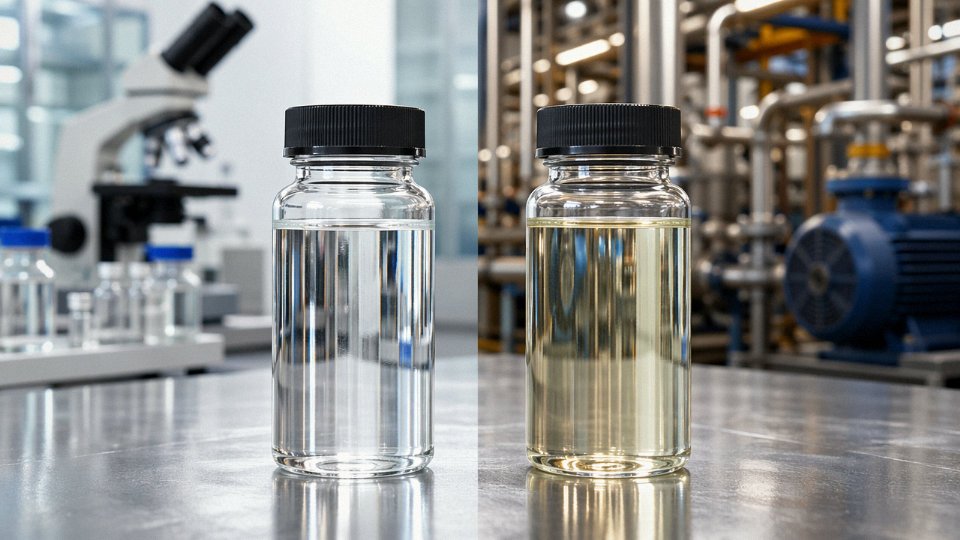
Intraocular silicone oil — used as a vitreous tamponade agent in retinal detachment surgery — sits at a completely different point on the price curve. A 10 mL vial of sterile 1,000 cSt or 5,000 cSt ophthalmologic silicone oil typically sells for USD 200–800, depending on supplier, market, and whether the product is distributed as a medical device or a pharmaceutical. That works out to USD 20,000–80,000 per liter. The same volume of industrial 1,000 cSt PDMS costs perhaps USD 0.003–0.008 at bulk pricing.
The cost structure behind that number: sterile filtration through 0.22 µm membranes validated for silicone oil (which resists many standard filter materials), aseptic fill in an ISO 5 cleanroom, 100% particle inspection, full biocompatibility testing per ISO 10993-1 through -10, device registration fees across multiple markets, and product liability insurance for an implantable device. Batch sizes are small — sometimes a few hundred units — so fixed costs per unit are severe. The sterilization validation alone, done properly, is a significant one-time investment that gets recovered over the product’s commercial life.
This is a market where the raw material cost is essentially rounding error in the final price. Procurement in this segment is about supplier qualification, regulatory standing, and supply security — not negotiating cents per kilogram.
Current Market Price Trends and What Will Move Silicone Oil Costs in 2025–2026
Anyone who was buying PDMS in 2021 remembers the pain. Spot prices for industrial 350 cSt silicone oil climbed past USD 10/kg in some markets — roughly double or triple what buyers had budgeted — driven by a combination of silicon metal shortages, chloromethane supply disruption, and pandemic-era logistics chaos that compressed every link in the silicone supply chain simultaneously. Plants that had been running on 30-day rolling spot orders suddenly found themselves on allocation. Some formulators substituted mineral oil where they could. Others simply paid the premium because they had no choice.
That spike normalized faster than most people expected. By late 2023, industrial-grade PDMS bulk pricing had retreated to the USD 3–5/kg range (drum quantities, depending on viscosity grade and supplier region), which is roughly where it sat pre-pandemic. Spot pricing in early-to-mid 2024 stayed relatively stable in that band, with Chinese export offers occasionally undercutting at the lower end of the range when domestic demand softened.
What Is Driving Demand Upward
The silicone market is not sitting still, though. Three demand vectors are adding real volume pressure heading into 2025–2026. Electric vehicle thermal management is probably the most discussed — dielectric silicone fluids and silicone-based thermal interface materials are specified in battery cooling systems, power electronics modules, and on-board charging units. As EV production scales globally, that pulls on the same PDMS intermediates used in industrial lubricant grades. Photovoltaic encapsulants — liquid silicone rubber and silicone gel systems used to protect solar cell assemblies — represent another growing sink for silicone feedstocks, tied directly to solar installation rates that most analysts still project to grow through 2026. Personal care is a quieter but persistent demand source; cyclomethicone and dimethicone variants in skincare and hair care formulations have a fairly inelastic demand base.
Industry estimates place overall silicone market volume growth at roughly 4–6% CAGR through the mid-2020s, though that figure depends heavily on EV ramp rates and solar subsidy policy in China and the EU. It is not a guarantee of price increases — supply additions can outrun demand — but it does mean the market has a structural consumption floor that did not exist a decade ago.
Supply-Side Capacity and the Regulatory Wrinkle
On the supply side, Wacker Chemie has been investing in silicone intermediate capacity at its Burghausen site, and Elkem has expanded its silicones division through its China-based operations. Chinese producers — who collectively control a substantial share of global silicone intermediate output — added capacity aggressively in 2022–2023, which is part of why prices normalized as quickly as they did. That capacity overhang is real and tends to act as a ceiling on how far prices can run during the next demand surge.
The regulatory angle is worth watching. EU restrictions on D4 and D5 cyclic siloxanes (under REACH) affect wash-off cosmetic formulations and create some byproduct economics pressure on producers whose process streams generate these cyclics. It does not directly constrain PDMS linear polymer supply, but it does change margin calculations for producers and adds compliance overhead that smaller European suppliers pass through in price.
Silicon metal spot prices are a reliable leading indicator for silicone oil price movements, typically leading PDMS price changes by 6–12 weeks.True
Silicon metal (Si metal) is the upstream feedstock for methyl chlorosilane synthesis, which is the primary chemical route to PDMS. When silicon metal prices rise on Metal Bulletin or equivalent indices, silicone monomer costs follow, and finished silicone oil prices adjust with a lag that typically reflects producer inventory burn-down and contract repricing cycles — usually 6 to 12 weeks in a normal market, though that lag compressed during the 2021 shortage.
Practical Guidance for Procurement Timing
If you are buying silicone oil in volumes above roughly 5–10 tonnes per year, monitoring silicon metal spot indices (Metal Bulletin publishes these; so does Asian Metal for Chinese-origin material) gives you a workable 6–12 week lead on where your silicone oil renewal pricing is likely to land. When silicon metal prices start climbing — typically in response to energy cost increases in smelting regions like Xinjiang or Yunnan in China, or Norwegian hydro-power pricing affecting Elkem — that is the signal to accelerate annual contract negotiations rather than wait.
In a stable or softening silicon metal market, spot buying or short-duration (quarterly) contracts often beat locking in annual fixed prices. In a tightening market, annual volume contracts with a price-adjustment clause tied to a silicon metal index give you both budget certainty and some upside protection without handing the supplier a blank check.
For 2025–2026 specifically: the base case is modest price increases in the 5–12% range off late-2024 levels, driven by demand growth outpacing the current capacity overhang. The risk scenario — another sharp spike above USD 7–8/kg for industrial grades — would require either a significant silicon metal supply disruption or a faster-than-expected EV production ramp concentrating demand on thermal fluid grades. Neither is the base case, but both are plausible enough that procurement teams with any meaningful silicone oil spend should have a contingency supplier identified and not rely on a single source.
How to Evaluate Total Cost of Ownership Beyond the Purchase Price
Purchase price is the number that shows up on the invoice. Total cost of ownership is the number that shows up on your P&L six months later, and the two are rarely the same.
The fastest way to learn this lesson is to let procurement optimize purely on unit price and then watch what happens downstream. A realistic scenario: a mid-volume cosmetics manufacturer switches from a qualified, pharma-adjacent silicone oil supplier to a cheaper industrial-grade alternative to save roughly USD 0.80–1.20/kg. The new oil passes initial QC. Stability testing at 40 °C/75% RH over twelve weeks reveals phase separation in the emulsion — a failure tied to trace contaminants or inconsistent silanol content in the lower-grade fluid. At that point you are looking at full batch disposal, reformulation work (typically 6–14 weeks for a topical product, depending on the complexity), regulatory re-notification if the formula change is substantive, and delayed launch. Conservative estimates put that kind of event at USD 15,000 on the low end for a small contract manufacturer; for a branded launch with retailer commitments already in place, USD 80,000 is not an exaggeration once you count lost shelf slots and expedited testing fees. The per-kilogram savings evaporate instantly.
Handling Loss Is Low, But Contamination Risk Is Not
One genuinely good property of PDMS-based silicone oil is that evaporative loss in open-drum storage is minimal — you are not losing meaningful product to volatilization the way you would with light mineral oils or some esters. Thermal stability is excellent; kept away from moisture ingress and strong acids, a sealed drum stored at ambient temperatures will hold specification for 18–24 months without significant degradation.
The contamination problem, though, is real. Silicone oil is famously difficult to clean off surfaces and equipment — a fact that works in your favor in lubrication, and against you if even a few parts-per-million of silicone cross-contaminate a non-silicone batch in a shared production line. Many paint and coatings plants ban silicone-containing materials from certain areas entirely for exactly this reason. If your facility runs mixed product families and your silicone oil handling procedures are loose, the cost of a single contaminated batch — disposal, cleaning validation, line downtime — can run USD 5,000–30,000 depending on batch size and product value. Dedicated transfer equipment and clear color-coded drum identification are cheap by comparison.
Viscosity Tolerance Is a Yield Lever, Not Just a Spec Checkbox
In automated dispensing lines and precision lubrication systems, lot-to-lot viscosity consistency has a direct, quantifiable effect on process yield. A supplier holding ±1% viscosity tolerance across lots versus one holding ±5% sounds like a minor specification difference. In practice, on a high-speed cosmetic filling line running 350 cSt oil as a phase ingredient, a 5% viscosity swing can shift droplet size distribution enough to push emulsion particle size out of specification. Yield losses of 2–4% per affected lot are common in these situations, and on a line running several thousand kilograms per week, that accumulates quickly. Tight-tolerance material typically commands a 10–20% price premium from reputable suppliers — but if it eliminates even one out-of-spec batch per quarter, it almost certainly pays for itself.
Documentation and Support Have a Real Cost Value
This one gets underestimated constantly. A complete technical data sheet, a current SDS aligned to GHS/REACH, and a supplier willing to provide a Certificate of Analysis with actual lot-specific test data rather than generic specification limits — these are not administrative niceties. For a regulated application (pharma, food contact, medical device), supplier qualification can take 4–12 weeks and requires documentation that cheaper distributors often cannot provide. If you have to chase an overseas supplier for a missing DMF reference or a corrected SDS, that delay has a cost. So does failing an audit because your silicone oil supplier’s documentation package was incomplete.
Choosing a lower-cost silicone oil supplier without accounting for documentation completeness, viscosity consistency, and contamination risk can produce total costs that exceed the savings by a factor of 10 or more in regulated manufacturing environments.True
Reformulation, batch disposal, qualification delays, and compliance failures each individually can reach costs far above typical per-kilogram price differences between industrial and qualified-grade suppliers, consistent with standard TCO analysis in chemical procurement.
The unit price tells you what you are paying today. The total cost of ownership tells you what you actually paid.
Proven Strategies to Reduce Silicone Oil Procurement Costs Without Compromising Quality
Most procurement teams leave real money on the table — not because they’re paying a bad spot price, but because they haven’t looked hard at the structural decisions that determine effective cost per kilogram. The tactics below don’t require squeezing your supplier into an unsustainable margin. They require doing the internal homework first.
Audit Your Grade Portfolio Before You Negotiate Anything
Walk through your bill of materials and list every silicone oil SKU you’re actually purchasing. In my experience, plants running three or four viscosity grades — say, 100 cSt, 350 cSt, and 500 cSt — are often doing so out of inertia rather than genuine formulation necessity. A qualified chemist or process engineer can frequently show that a single mid-range viscosity, blended on-site with a lower-viscosity diluent, covers two or three of those applications adequately.
The payoff is straightforward: instead of splitting annual volume across multiple SKUs and qualifying each separately, you consolidate into one grade at a higher annual tonnage. That single change can move you from a mid-tier price bracket into the next volume discount tier — typically a 10%–20% reduction per kilogram, depending on your supplier’s pricing structure and the grade involved. Fewer SKUs also means lower warehousing complexity, fewer quality release cycles, and reduced risk of a wrong-grade cross-contamination event on the floor.
Qualify a Second Source — Then Use It
Single-source dependency is the most common reason procurement teams accept prices they shouldn’t. Qualifying a second supplier is not primarily about switching; it’s about credible negotiation leverage. At annual contract renewal, a competitive quote from a qualified alternative — even if you have no intention of fully switching — puts discipline into the conversation.
A 5% unit price improvement on industrial silicone oil purchases can represent six-figure annual savings at volumes above roughly 200–300 tonnes per year.True
At 250 tonnes/year and a baseline price of USD 3.50/kg, a 5% reduction saves approximately USD 4,375 per tonne — roughly USD 43,750 annually. At higher volumes or higher-grade pricing, savings compound quickly into six figures.
The qualification process takes time — typically 3–6 months for industrial grades, longer for regulated applications — so start early, well before your current contract expires. Don’t wait until you’re in a supply crunch to discover whether a second supplier’s product actually performs in your process.
Switch Packaging Tier Where You Have the Storage to Do It
Moving from 25 kg pails to 200 kg drums is one of the simplest, fastest cost levers available. The product is identical. The per-kilogram savings typically run 15%–30%, depending on the supplier and grade. The only real questions are whether your storage area can accommodate drum handling equipment and whether your dispensing setup works with a drum pump and flow meter.
A typical scenario: a plant consuming roughly 2 tonnes per month switches from pails to drums and saves somewhere in the range of USD 800–1,500 per month with zero formulation change. That’s before accounting for the labor reduction in handling — fewer containers, fewer label checks, fewer disposal cycles.
Consider Toll Blending for Custom Viscosities
If your process requires a non-standard viscosity or a specific dilution, buying a pre-blended specialty product from a distributor usually carries a 2x–3x markup over the base fluid cost. A toll blender — a contract manufacturer who blends to your specification using bulk commodity PDMS as the feedstock — can dramatically reduce that premium. You supply the specification; they supply the mixing capacity. Setup costs and minimum batch sizes vary, but for volumes above roughly 5–10 tonnes per year, the economics almost always favor this route.
Lock In Pricing During Soft Raw Material Cycles
Silicon metal and methanol — the primary feedstocks upstream of PDMS production — move in identifiable cycles tied to energy costs and Chinese production capacity. When spot prices are soft and your supplier is receptive, a 12–24 month price-fixed supply agreement protects your budget against the next uptick. This isn’t speculation; it’s basic contract timing. The risk is being locked in if prices fall further, which is why a fixed-price-with-cap or index-linked-with-floor structure often makes more sense than a fully fixed contract over longer terms. Negotiate the structure, not just the number.
Frequently Asked Questions About Silicone Oil Pricing
What is the price of 350 cSt silicone oil per liter?
Most buyers think in kilograms, but a lot of specs and application datasheets quote volumes. The conversion matters: standard PDMS at 350 cSt has a density of roughly 0.97 g/mL, so one liter weighs about 0.97 kg. In practice, that’s close enough to a 1:1 ratio that rounding error won’t kill your budget estimate, but don’t ignore it on large orders.
Bulk industrial pricing (drums, 200 L or larger) typically runs USD 2.40–5.35 per liter once you apply that density factor to the per-kg price. Retail bottles — the kind sold through chemical distributors or lab suppliers in 100–500 mL packaging — commonly land between USD 20–60 per liter. The same molecule, wildly different price, driven entirely by packaging, lot size, and distribution margin.
Is silicone oil more expensive than mineral oil?
On a straight per-kilogram basis, yes — industrial-grade PDMS usually costs 3–6× more than a comparable mineral oil. But that framing is often misleading for engineers doing real application costing. Silicone oil operates usefully from roughly -50 °C to above 200 °C continuous service; most mineral oils top out around 90–120 °C before oxidation and viscosity breakdown become serious problems. In a heat-transfer bath running at 180 °C, mineral oil isn’t a cheaper alternative — it’s a fire hazard and a maintenance problem.
Change-out intervals also shift the math. In sealed dampers or long-life lubrication applications, silicone oil’s oxidative stability means you’re replacing fluid every few years versus every few months for mineral oil. Total fluid cost per operating hour often favors silicone, sometimes substantially.
Silicone oil lasts longer than mineral oil in high-temperature lubrication applications due to superior oxidative stabilityTrue
PDMS has a fully saturated siloxane backbone with no C-C bonds susceptible to oxidative chain scission, giving it substantially better thermal and oxidative stability than hydrocarbon-based mineral oils in documented tribology literature.
Why did silicone oil prices spike in 2021 and 2022?
Several things hit simultaneously. Silicone production depends on metallurgical silicon, which requires enormous amounts of electricity. In Yunnan Province, China — a major production region — the government imposed severe energy rationing starting in late 2020 and continuing through 2021, directly curtailing output from some of the largest silicone monomer producers in the world. At the same time, COVID-driven demand surges in personal protective equipment, medical devices, and construction sealants pulled hard on the same supply base. Silica fume availability tightened as a secondary constraint. The result was spot prices in some markets running 2–3× pre-pandemic levels through mid-2022. Things have largely normalized since, but buyers who lived through that period have — rightly — started keeping a bit more safety stock.
Can I buy food-grade silicone oil at the same price as industrial grade?
No, and you cannot substitute industrial grade in food-contact applications regardless of price. Food-grade silicone oil certified to FDA 21 CFR 178.3570 or equivalent typically carries a 40–100% premium over standard industrial PDMS, depending on volume and supplier. The premium covers testing, documentation, and tighter raw material controls. Using industrial-grade fluid in a food or beverage application is a regulatory violation, not a cost optimization.
What is the minimum order quantity from a Chinese manufacturer?
Direct factory MOQs generally run 1,000–5,000 kg, sometimes expressed as a minimum dollar value around USD 3,000–8,000. If your requirement is smaller, a trading company or distributor can usually accommodate 50–500 kg lots, but expect a 10–20% markup over factory pricing. For genuinely small volumes — lab quantities, prototype runs — domestic distributors in your own region will often be cheaper once you factor in freight and the paperwork burden of a small international shipment.
Does silicone oil price vary by season?
Mildly. Construction-sector demand for silicone sealants — which competes with silicone fluids for upstream monomer supply — tends to peak in spring and autumn in the Northern Hemisphere, occasionally nudging prices a few percent in tight market conditions. Personal care applications (silicone in hair and skin products) show a softer peak heading into summer. Neither effect is dramatic enough to base a procurement strategy around, but if you’re already planning a large purchase and the timing is flexible by a month or two, it’s worth watching spot quotes.
How do I get an accurate price quote?
Suppliers who quote without complete specifications are guessing, and you’ll pay for that ambiguity later — either in price adjustments or in receiving the wrong product. Give them: viscosity in cSt (and whether that’s at 25 °C — confirm this), grade and any certifications required (industrial, food-grade, USP, electronic), quantity in kilograms per order and estimated annual volume, packaging format (drums, IBCs, bulk tanker), delivery terms (EXW, FOB, CIF — be explicit), and your required lead time. If you need a Certificate of Analysis, SDS in a specific language, or batch traceability, say so upfront. Suppliers price risk into vague inquiries.