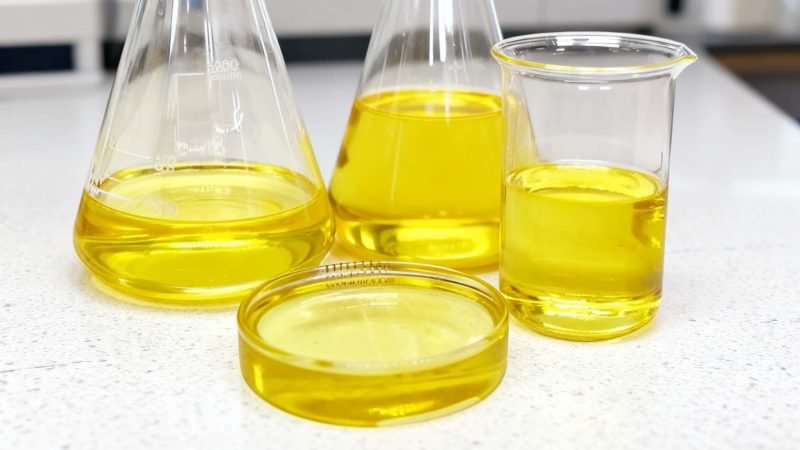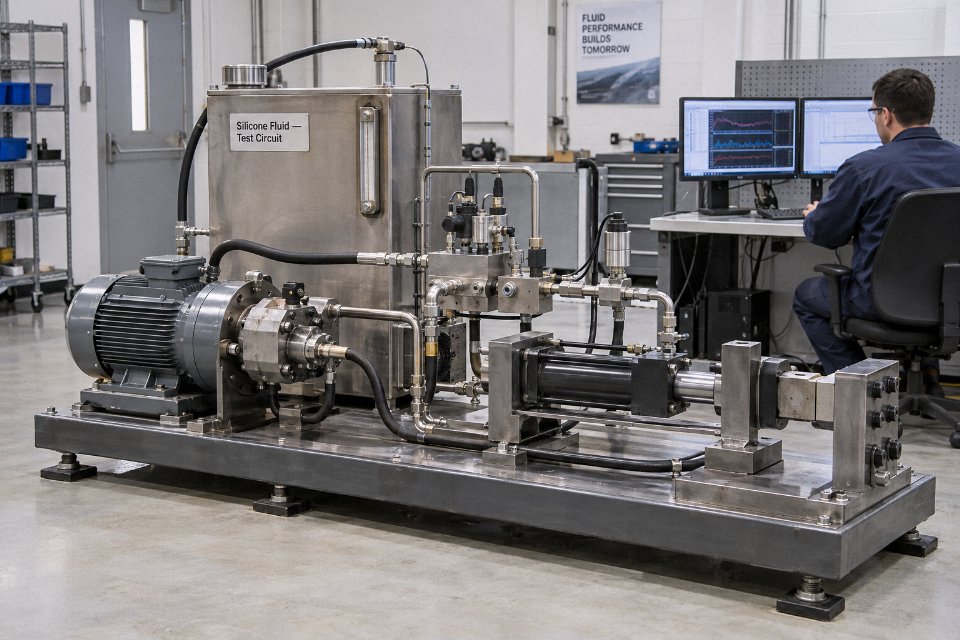
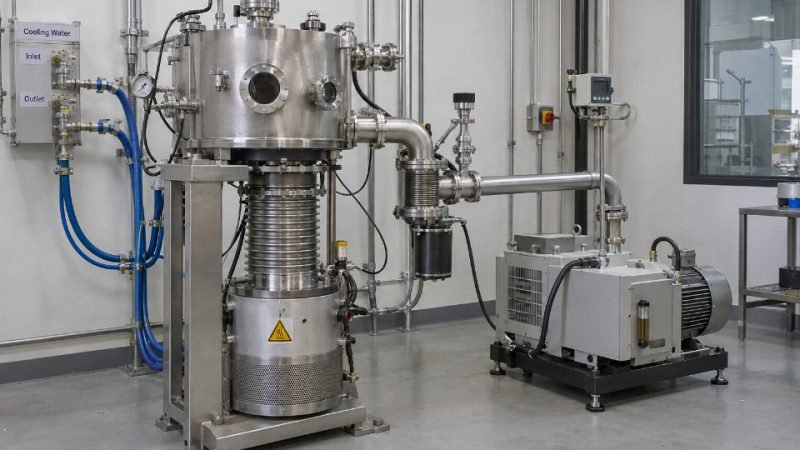
The wrong vacuum-pump fluid can leave a chamber slow to evacuate or contaminate parts that looked clean going in. That means lost production time, rejected work, and maintenance that a cheaper fluid purchase never justified. The starting point is matching the fluid to the pump architecture—not assuming that any oil labeled “silicone” will do.
Silicone oil is used as the working fluid in diffusion pumps because selected grades combine low vapor pressure with thermal stability. Heated fluid forms vapor jets that transfer momentum to gas molecules, moving them toward the backing pump. It is not a universal replacement for oil-sealed rotary-vane pump lubricant.
The distinction matters: a diffusion pump deliberately boils its working fluid, while an oil-sealed rotary-vane pump relies on oil for lubrication and sealing. Even within diffusion pumps, the lowest-vapor-pressure fluid is not automatically the best purchase. Its value depends on the pump’s approved operating conditions and how much fluid migration the process can tolerate.
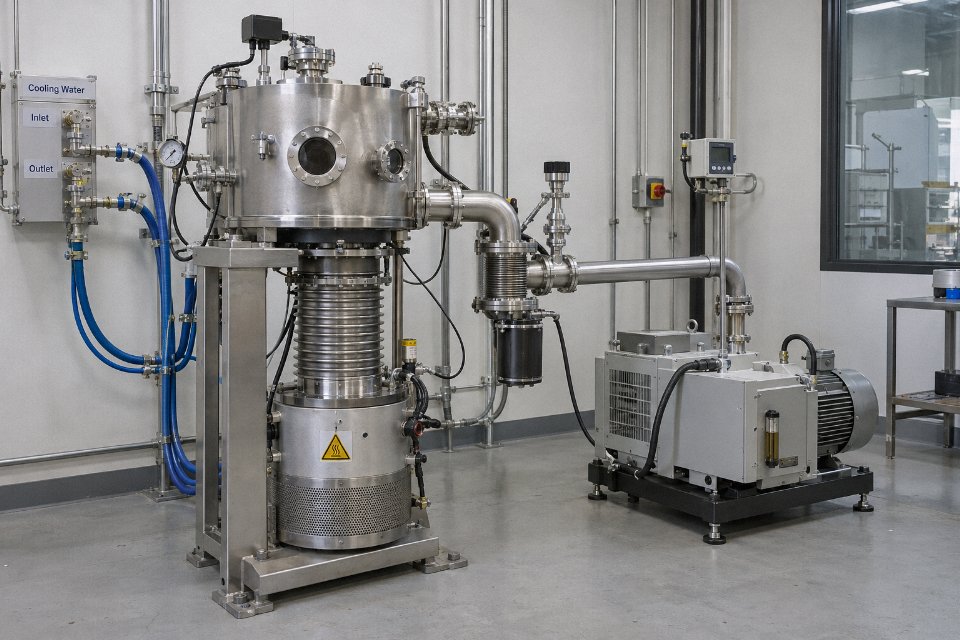
Pump architectures and fluid functions
The pump architecture determines what the fluid must do: generate vapor jets, seal moving clearances, or lubricate components isolated from the gas path. These are different duties, not interchangeable oil specifications. Start with the pump model and its approved-fluid list before comparing viscosity, purity, or price.
Diffusion pumps: a circulating working fluid
In a diffusion pump, the heated boiler vaporizes the working fluid. A jet assembly directs that vapor through downward-facing nozzles; the vapor jets transfer momentum to gas molecules entering from the chamber and drive them toward the backing connection. Vapor reaching the cooled wall condenses, then returns by gravity to the boiler.
The system diagram separates this internal circulation from the backing-pump oil circuit. On the chamber side, it identifies an optional inlet baffle; downstream, it places a foreline trap between the diffusion pump’s backing connection and the backing pump. These locations matter because each device intercepts contamination along a different transport path.
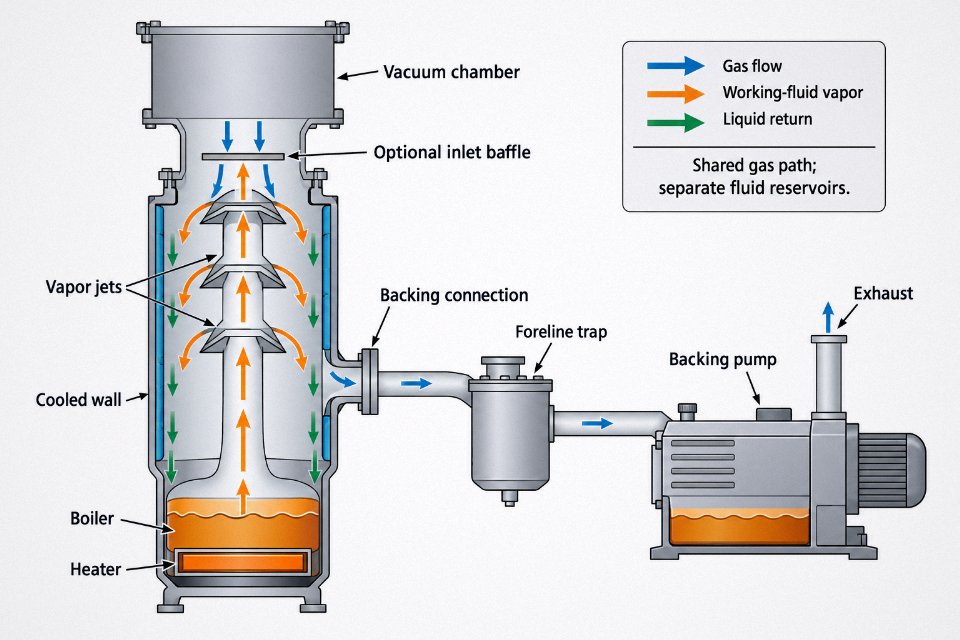
The jets compress gas toward the foreline, but they cannot discharge it directly against atmospheric pressure. A backing pump removes that gas and maintains the forepressure required for stable jet operation. If forepressure exceeds the selected diffusion pump’s limit, pumping performance can collapse even while the boiler remains hot. Cooling, heater operation, and backing conditions must therefore follow that model’s manual—not a generic startup recipe.
A diffusion pump and its backing pump share a gas path, not an oil reservoir. The diffusion fluid repeatedly boils and condenses; the backing-pump lubricant normally remains within a separate mechanical pumping system.
Mechanical pumps: lubricant, sealant, and heat-transfer medium
Oil-sealed rotary-vane and rotary-piston pumps use moving components to trap and compress gas:
- Rotary-vane pumps: Sliding vanes form changing-volume chambers. Oil lubricates contact surfaces and seals leakage paths around the vanes, rotor, and housing.
- Rotary-piston pumps: An eccentric-driven piston mechanism creates the pumping volumes. Oil lubricates the mechanism and seals its working clearances.
In both architectures, circulating oil also redistributes heat and carries captured contaminants toward the sump, filters, or other oil-management components where fitted. That contamination eventually changes fluid performance; topping up does not remove accumulated solvent or process residue.
Changing viscosity affects leakage, friction, circulation, and cold starting. A thicker fluid may improve clearance sealing yet increase drag or circulate poorly at startup. Consider a silicone formulation only with explicit pump-manufacturer approval for the model and service. Suitability as a diffusion fluid does not establish acceptable mechanical lubrication, seal compatibility, or exhaust-separation behavior.
Dry pumps, boosters, and turbomolecular pumps
These architectures do not use silicone diffusion fluid as their gas-pumping medium:
- Dry screw, dry scroll, and claw pumps: Mechanical displacement transports gas without an oil-sealed pumping chamber. Some designs still have isolated lubricated bearings or timing gearboxes; scroll designs may use replaceable tip seals.
- Roots pumps: Synchronized lobes move gas, usually as a booster with a backing pump. Timing gears and bearings may require lubrication outside the nominally dry gas path.
- Turbomolecular pumps: High-speed rotor stages transfer momentum to gas. Bearing arrangements vary, including lubricated and magnetic designs; any lubricant requirement is model-specific.
Contamination controls are not interchangeable
Select accessories by location and duty:
- Inlet baffle or cold trap: Limits migration toward the chamber. Improved vapor interception generally costs inlet conductance, reducing effective pumping speed.
- Foreline trap: Intercepts selected vapors or contamination between the pumps; trapping media and capacity must match the service.
- Exhaust mist separator: Captures entrained oil droplets discharged by an oil-sealed backing pump. It does not prevent inlet-side backstreaming.
Putting diffusion fluid into the backing pump—or generic lubricating silicone oil into the boiler—changes the fluid’s assigned function, not merely its brand. Neither substitution is justified without equipment-specific approval.
Silicone fluid properties and vacuum performance
A suitable silicone diffusion fluid combines low vapor pressure at cooled surfaces with sufficient vapor generation at the pump’s boiler temperature. That balance—not the word “silicone” or a viscosity grade—determines whether it can sustain effective vapor jets without adding an unacceptable fluid-vapor load to the vacuum system.
Molecular structure matters more than the silicone label
General-purpose polydimethylsiloxane (PDMS) oils and purpose-designed silicone diffusion fluids are not interchangeable specifications. Many established diffusion fluids contain phenyl-substituted siloxane molecules selected for their volatility and thermal behavior. General-purpose PDMS products cover broad molecular-weight and viscosity ranges; their suitability for lubrication or heat transfer does not establish suitability for a diffusion pump.
Molecular structure influences intermolecular attraction, vapor pressure, boiling behavior, and resistance to particular degradation pathways. Phenyl substitution can improve properties useful in diffusion service, but performance still depends on the specific molecular composition, purification, and operating conditions. “Phenyl silicone” is not a complete purchase specification either.
For replacement-fluid approval, establish:
- Product identity: exact manufacturer and grade, not simply “silicone oil” or a nominal viscosity.
- Pump compatibility: approval in the current pump documentation or written confirmation from the pump supplier.
- Property evidence: vapor-pressure data versus temperature, relevant thermal characteristics, and composition or volatile-content controls where available.
A matching viscosity is useful identification information. It is not proof of equivalent vacuum performance.
Low vapor pressure helps at cold surfaces—but the boiler needs vapor
Equilibrium vapor pressure describes the pressure of vapor in equilibrium with its liquid at a stated temperature. Near cooled pump surfaces, lower fluid vapor pressure reduces the fluid’s own vapor contribution. It helps limit contamination and attainable pressure, but does not account for every route by which fluid molecules reach the chamber.
Representative 704-type and 705-type fluids are commonly differentiated by their room-temperature vapor pressures. A defensible numerical comparison must identify the exact commercial products, measurement temperature, and manufacturer’s stated measurement method or data basis. Without current, verified datasheets, attaching a precise value to either type would imply more certainty than the grade designation supports.
At the hot end, the requirements change:
- Vapor generation: boiler temperature must produce enough vapor mass flow for the installed jet assembly.
- Jet formation: vapor expands through the nozzles and transfers momentum to gas molecules moving toward the backing connection.
- Condensation: cooled walls remove heat and condense the working vapor.
- Return: condensate must drain back reliably to replenish the boiler.
Insufficient heater input can weaken the jets; excessive heat can increase degradation risk. Poor cooling interferes with condensation and raises local fluid vapor pressure. Check actual cooling flow and inlet temperature during production—not just whether a hose feels cool.
The lowest room-temperature vapor pressure is not automatically the best match for a given pump. A fluid requiring different boiler conditions may deliver inadequate vapor flow with the existing heater and jet geometry. The benefit can also be offset by a restrictive inlet baffle or trap: less backstreaming, but lower effective pumping speed at the chamber. The preferred choice flips when contamination control matters more than pumpdown time, provided the pump supports that fluid.
Stability depends on what the fluid actually experiences
Thermal stability is conditional, not a universal maximum-temperature claim. A fluid operating successfully under vacuum can behave differently during overheating or exposure to hot air. Reactive process gases and process deposits introduce further uncertainty.
The consequential operating exposures are:
- Overheating or poor heat transfer: incorrect charge quantity, deposits, or heater-control faults can create local temperatures not represented by an external temperature reading.
- Oxygen exposure while hot: venting or a backing failure can expose hot fluid to oxidizing conditions. Follow the pump’s specified shutdown and cooling sequence.
- Reactive gases and contamination: process chemicals may attack the fluid or produce deposits; entrained solvents can change its volatility and boiling behavior.
- Repeated thermal cycling: cycling alone does not prove deterioration, but repeated operation with air ingress or contaminated fluid can progressively change the working charge.
Molecular-weight distribution matters here. A small volatile fraction can contribute disproportionately to vapor transport even when bulk viscosity remains within its nominal range. Degradation can generate lighter species; heavier residues can alter boiling and foul heat-transfer surfaces.
This explains why a pump may recover pressure poorly after a process excursion although the drained fluid still looks acceptable. Appearance and viscosity are screening checks, not complete condition assessments. Apply the pump supplier’s fluid-change criteria and investigate the contamination source before treating a refill as the repair.
Separate fluid properties from system performance
A low-vapor-pressure fluid cannot compensate for a leaking chamber or an overloaded backing pump. Use each performance quantity for the question it actually answers.
| Quantity | What it establishes | What it does not establish |
|---|---|---|
| Fluid vapor pressure | Equilibrium volatility at a stated temperature | Achievable chamber pressure |
| Measured ultimate pressure | Limiting pressure under stated test conditions | Pressure during production gas load |
| Pumping speed | Volumetric removal rate for a specified gas and pressure range | Effective speed through restrictive pipework |
| Compression behavior | Ability to maintain a pressure ratio under specified conditions | Immunity to excessive forepressure |
| Process pressure | Operating balance of gas load and effective pumping | Fluid quality by itself |
For a simple steady-state estimate, pressure attributable to throughput is approximately gas load divided by effective pumping speed. Conductance losses reduce that effective speed; leaks and outgassing increase the load. Cooling and backing performance can change pump behavior, while gauge location, gas sensitivity, and measurement range affect the reported result.
A purchasing comparison therefore needs temperature-dependent fluid-property data alongside pump curves for the proposed fluid. Require the stated gas, cooling conditions, heater configuration, backing conditions, and measurement arrangement. If the supplier cannot connect the fluid claim to the selected pump’s operating envelope, “better vacuum” remains an unverified claim—not a procurement advantage.
Silicone fluids and competing vacuum fluids
Fluid selection starts with the pump’s approved chemistry, not the lowest vapor-pressure figure in a supplier’s brochure. A diffusion fluid must sustain a controlled vapor-jet cycle; a mechanical-pump lubricant must lubricate, seal, and survive contact with the process gas. Comparing their prices without separating those duties produces a misleading purchasing decision.
Diffusion fluids: compare the operating window, not just ultimate vacuum
The following comparison is conditional on approval for the actual pump model. Even within one chemical family, viscosity, boiling behavior, and formulation can change the operating requirements.
| Fluid family | Conditional application fit | Disqualifying conditions or major checks |
|---|---|---|
| Purpose-designed silicone diffusion fluid | High-vacuum service where the specified grade meets pressure and cleanliness requirements | Silicon-bearing contamination is unacceptable; pump lacks approval for the grade |
| Hydrocarbon diffusion fluid | Approved diffusion pumps where acquisition cost and process compatibility favor the selected product | Vapor pressure, thermal stability, or response to air exposure cannot meet duty |
| Polyphenyl ether diffusion fluid | Specialized service supported by current pump and fluid documentation | Required startup, temperature, handling, or contamination controls cannot be maintained |
| Mineral oil, PAO, ester, or other synthetic mechanical-pump fluid | Lubrication and sealing in the mechanical pumps for which it is approved | Proposed use as a diffusion fluid without explicit approval |
| PFPE fluid | Selected chemically demanding or oxygen-service duties in specifically approved equipment | Inadequate conversion cleanliness, incompatible materials, or uncontrolled decomposition hazards |
For silicone versus hydrocarbon diffusion fluids, assess these differences:
- Vapor pressure and temperature: Compare identified products at stated temperatures and documented operating conditions. Neither family has one universal vapor pressure or boiler temperature. Lower room-temperature vapor pressure does not automatically mean lower heater demand.
- Oxidation and upset tolerance: Many purpose-designed silicone fluids offer better resistance to oxidative degradation than conventional hydrocarbon diffusion oils. That is not permission to vent a hot pump. Air exposure can still damage fluid and leave deposits; formulation and exposure severity matter.
- Contamination consequences: Silicone carryover can compromise silicon-sensitive coating, analytical, or surface-treatment work. Hydrocarbon carryover creates a different organic contamination burden, potentially including carbonaceous deposits under energetic processing.
- Maintenance and supply: Evaluate residue removal, approved cleaning methods, replacement lead time, and consistent grade availability. A cheaper, locally stocked hydrocarbon fluid may be economical in a tolerant process; expensive chamber cleaning can reverse that calculation immediately.
Representative 704-type and 705-type silicone fluids occupy different performance positions. A 705-type product is generally intended for lower-vapor-pressure, deeper-vacuum duty; a 704-type product may be adequate where that additional performance is unnecessary. The lower-volatility choice can require a different boiler operating temperature and warm-up behavior, subject to pump design.
“704-type” and “705-type” are family descriptions, not universal interchangeability approvals. Confirm the exact manufacturer’s composition description, viscosity, vapor-pressure measurement temperature and method, recommended operating conditions, and pump approval. Without current product datasheets, assigning numerical vapor pressures would imply more precision than is justified. Fluid vapor pressure also remains distinct from achievable chamber pressure.
Polyphenyl ethers are a separate, non-silicone diffusion-fluid option where current documentation supports them. Their thermal and oxidative characteristics can justify specialized use, but handling is grade-dependent: verify room-temperature viscosity or solidification behavior, any warming procedure, operating temperature, and cleaning solvent compatibility. Do not transfer silicone-fluid startup instructions to them.
Mechanical-pump fluids have a different comparison basis
Within an approved rotary-vane or other lubricated mechanical pump, the meaningful comparison is lubricant performance under the actual gas load:
- Mineral oils: Often economical and readily available, but oxidation, deposit formation, and service life depend heavily on refining quality, additives, temperature, and contamination.
- Polyalphaolefins (PAOs): Can offer favorable viscosity-temperature behavior and oxidation resistance compared with some mineral formulations. Seal compatibility and additive suitability still require confirmation.
- Esters: May provide useful lubricity and solvency, but moisture sensitivity and compatibility with seals, coatings, and process chemicals vary by ester chemistry.
- Other synthetics: Polyglycols and specialty formulations require their own approval checks; “synthetic” says little about miscibility or suitability.
These fluids are not substitutes for diffusion working fluids. Nor should lubricant approved for a dry pump’s gearbox be assumed suitable for its process-contact components.
PFPE requires an equipment-and-process decision
PFPE fluids can be appropriate for selected reactive-gas or oxygen-service applications, but chemical resistance alone does not establish safety. The complete pump configuration, cleanliness specification, wetted materials, temperature limits, and service procedure must be approved for the intended duty.
Conversion requires particular care:
- Remove incompatible residual lubricant and contamination to the specified cleanliness level; draining alone is generally insufficient.
- Check seals, coatings, filters, and other wetted components against equipment and fluid documentation.
- Assess abnormal-temperature and reactive-contact conditions. Severe overheating or contact with certain reactive materials can generate hazardous decomposition products, potentially including hydrogen fluoride and other toxic fluorinated compounds.
PFPE’s purchase cost and conversion burden can be substantial. In the right duty, avoiding chemical attack or an unacceptable lubricant reaction outweighs those costs; in ordinary service, that premium may buy no useful benefit.
Count conversion and contamination in ownership cost
Changing chemistry may require dismantling and cleaning rather than a simple drain-and-fill. Residual fluid can undermine the new charge’s properties, while different viscosity or volatility can require manufacturer-authorized adjustments to heating, cooling, startup, or shutdown conditions.
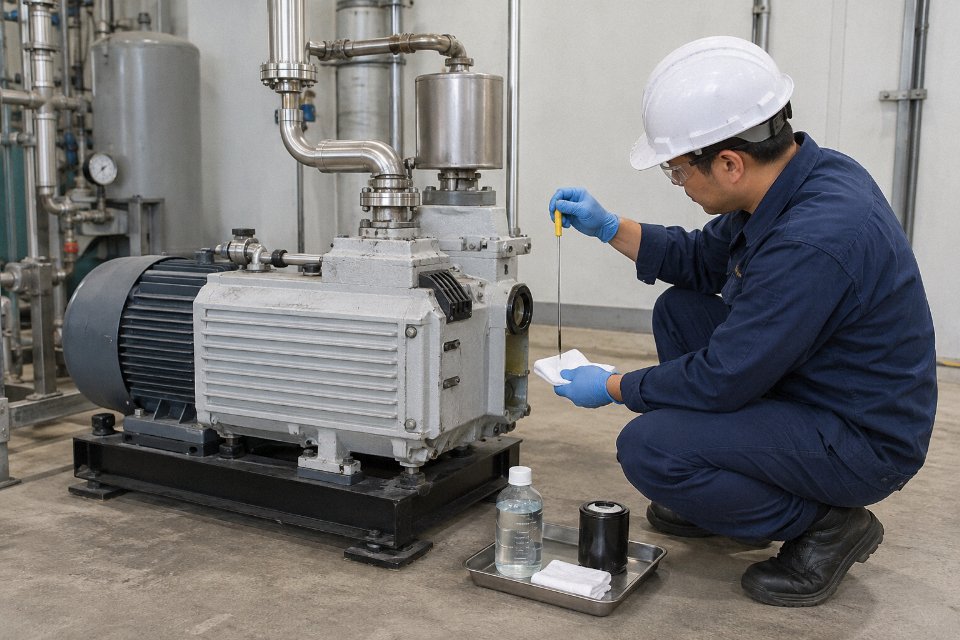
Build the cost comparison around:
- Fluid consumption, usable life, and replacement availability.
- Heater energy, cooling demand, and warm-up time.
- Cleaning labor, planned downtime, and restart qualification.
- Waste characterization and disposal under applicable requirements.
- Chamber contamination, rejected product, and lost production capacity.
- Seal changes, conversion work, and manufacturer authorization.
The best vacuum property is not necessarily the best production choice. If trace silicon invalidates the product, or conversion takes longer than the available shutdown, an otherwise attractive silicone fluid is the wrong selection. Resolve those constraints before negotiating price per kilogram.
Process compatibility and contamination limits
Silicone diffusion fluid fits a process only when both the gas load and allowable contamination are compatible with the complete pumping system. Low fluid vapor pressure helps, but does not establish product cleanliness: suitability depends on backstreaming control, operating cycles, substrate sensitivity, and evidence from the actual process.
Match the application to its operating need
- General high-vacuum laboratories: A practical option for evacuation where trace silicone does not compromise experiments. Shared chambers need extra scrutiny; one user’s heated sample can contaminate the next user’s measurement.
- Selected vacuum furnaces and heat-treatment systems: Suitable where the original design accommodates diffusion pumping and the charge’s outgassing is manageable. Binders, quench residues, and furnace deposits can change that assessment.
- Vacuum metallizing and coating equipment: Established designs may use diffusion pumps effectively, but acceptable chamber pressure does not prove acceptable film adhesion or optical performance.
- Other industrial diffusion-pumped systems: Retaining the specified fluid family can avoid unnecessary redesign, provided current products, chemistry, and cleanliness requirements remain within the qualified envelope.
Follow contamination to the product
Fluid vapor can migrate toward the chamber, while entrained droplets, splashing, or contamination released from deposited films create additional transport paths. Startup, excessive forepressure, cooling problems, and premature venting can aggravate migration; check operating limits and sequencing against the pump manual.
Deposits on substrates may impair bonding, wetting, or coating adhesion. Chamber-wall films become contamination reservoirs, analytical instruments may show additional background signals, and optical surfaces can lose transmission or acquire scatter. Material transferred downstream may also interfere with painting or assembly.
Semiconductor-related processing, precision optics, surface analysis, and adhesion-critical work require process-specific contamination qualification—not a blanket declaration that silicone fluid is suitable. Qualification should use representative cycles and appropriate witness samples, surface measurements, analytical backgrounds, or adhesion tests against defined acceptance limits.
Screen the incoming process load
- Condensable water and solvents: Establish quantities and release rates; condensation can foul traps and fluid, while solvent compatibility and flammability need separate review.
- Particulates and aerosols: Intercept dust, droplets, and coating overspray before they reach pump internals, where deposits can disrupt operation or degrade the charge.
- Corrosive or chemically reactive gases: Verify compatibility with the fluid, pump materials, seals, backing equipment, and exhaust treatment.
- Oxygen-rich, oxidizing, or flammable mixtures: Require a dedicated safety assessment and explicit equipment-supplier approval. Fluid selection alone does not make these duties safe.
Control migration—or change the pumping approach
Baffles and cold traps intercept migrating vapor; shielding limits direct deposition and overspray. They also reduce inlet conductance, potentially increasing pumpdown time, and require cleaning or regeneration before accumulated material becomes a secondary source. Correct cooling, backing pressure, heater sequencing, and venting discipline remain essential.
These measures cannot guarantee a silicone-free process. Validated dry or turbomolecular configurations deserve preference where contamination budgets are exceptionally restrictive, chemistry is unsuitable, exposure cycles are frequent, or oil management is operationally unacceptable. Qualification must include backing-pump arrangements and the complete gas path, not just the high-vacuum pump’s nameplate.
Fluid specifications and supplier qualification
A purchase order for “silicone vacuum oil” leaves too much unresolved. Build the buying specification around the installed pump and its process, then define the evidence needed to accept each delivery. A familiar fluid designation or matching viscosity is not, by itself, an acceptance criterion.
Establish the application and property requirements
- Identify the equipment and duty. Record the pump manufacturer, model, approved fluid designation, and required charge from the current manual. Include process gases and expected condensable carryover, target operating pressure, gas throughput, duty cycle, and allowable contamination. State where pressure is measured; an unloaded pump-inlet reading is not equivalent to chamber pressure during production.
- Request a defined property set. Require chemical identity or a controlled composition description, viscosity at a stated temperature, density with its measurement temperature, vapor-pressure data, recommended operating range, and volatility or distillation information where available. Identify test methods and distinguish typical values from guaranteed release limits. Vapor-pressure data should include temperature, method, and the basis for any extrapolation.
Resolve information gaps before ordering. If proprietary composition limits disclosure, agree on a controlled product identifier and sufficient analytical evidence to detect meaningful changes. The supplier’s recommended operating range does not override the pump manual.
Separate product control from safety documentation
Request the following as separate deliverables; they answer different questions:
- Current technical data sheet: Product properties, revision date, and the distinction between typical values and specifications.
- Current safety data sheet: Handling, exposure, storage, and disposal information applicable to the supplied product and destination.
- Batch certificate of analysis: Actual results against agreed release limits, using identified methods. A sheet repeating catalog values is not equivalent.
- Traceability and storage information: Lot identification linking the container to manufacturing and release records, plus shelf-life or retest guidance and storage conditions.
- Applicable regulatory declarations: Destination- and use-specific declarations, with their scope identified. An SDS is not blanket regulatory clearance.
Control vacuum-specific quality risks
A single purity percentage can conceal the fraction that matters most. Low-boiling material can evolve during heat-up, increasing gas load and delaying stable operation even when bulk viscosity remains acceptable.
Agree on application-relevant controls:
- Light fractions and moisture: Use suitable volatility or chromatographic methods and a validated moisture method where warranted. Confirm that the method can resolve the contamination level of concern.
- Particulates and cross-contamination: Specify relevant cleanliness checks and controls on shared blending, transfer, and filling equipment. Filtration alone will not remove dissolved foreign fluids.
- Lot variation: Compare acceptance-critical properties across initial qualification lots and retain a baseline sample. Investigate shifts within specification if pump behavior changes.
- Handling integrity: Verify container compatibility, packaging cleanliness, seal integrity, storage conditions, and sample-retention arrangements. Include repacking and distributor handling, not just factory filling.
The practical trade-off is testing cost versus interruption risk. Routine screening can be lighter for a stable, qualified supply, while a sensitive process or changed manufacturing route warrants tighter controls. Numerical limits need application evidence; no universal moisture or particle threshold suits every vacuum installation.
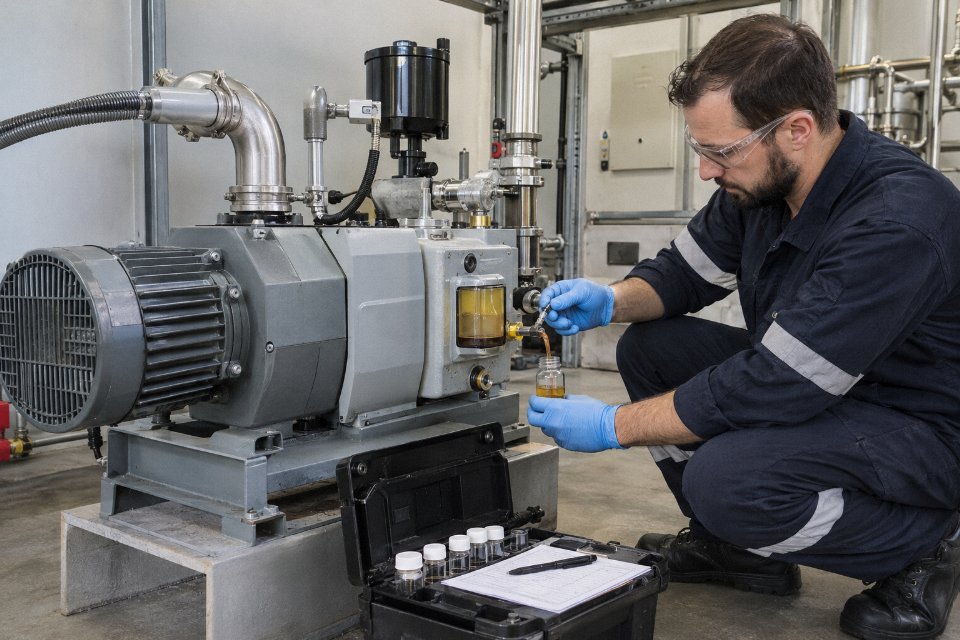
Qualify equivalents through controlled testing
- Compare documented composition and properties. Check the proposed substitute against the approved fluid, including volatility behavior—not viscosity alone. Obtain pump-manufacturer acceptance where required.
- Run a controlled trial. Follow the manual’s changeover procedure and record charge, cleaning, cooling conditions, backing performance, and instrument configuration. Compare pump-down, stable pressure, process recovery, and contamination against predefined acceptance criteria.
- Set release and escalation rules. Define who approves substitution, how suspect stock is quarantined, and what evidence triggers rejection. Require advance change notification and a documented route for investigating an off-specification lot, supported by retained samples.
Successful testing qualifies the fluid for the evaluated operating envelope, not every process using the same pump.
Evaluate SiliconChemicals against the same evidence
SiliconChemicals’ stated organosilicon production capabilities, access to China’s industrial clusters, integrated supply chain, and international supply experience are relevant procurement considerations—not proof of vacuum-service suitability. Verify them through:
- Manufacturing and quality documentation identifying responsibility for the offered grade.
- Traceable samples and responsive technical answers to application-specific questions.
- Confirmed packaging, shipping documentation, lead times, and investigation capability.
The procurement outcome should be a complete specification and qualification plan with accountable acceptance criteria. Supplier scale and a broad silicone portfolio cannot replace that work.
Operating controls and failure diagnosis
Use the selected diffusion pump’s manual to build a one-page operating sheet. Record its approved fluid, charge quantity, heater rating, cooling requirements, maximum forepressure, crossover conditions, shutdown sequence, and fluid-change criteria. These are model-specific limits—not settings to borrow from a similar-looking pump.
Pre-start checks
Complete these checks before enabling heat, including after maintenance or a fluid change:
- Fluid and charge: Verify the product and batch against the approved specification. Confirm charge by the prescribed method; do not top up an unidentified charge or assume different silicone fluids can be mixed.
- Chamber and foreline: Check seals, connections, traps, drains, and accessible passages. Remove condensate or deposits using approved procedures. Confirm that trapped process residues can be handled safely.
- Backing equipment: Check lubricant condition where applicable, exhaust restrictions, separator condition, and pumping readiness. Confirm adequate backing vacuum at the relevant location—not merely at the backing-pump inlet.
- Cooling: Establish the specified flow and inlet temperature. Inspect hoses, strainers, returns, and leak points. A running circulation pump does not prove flow through the diffusion-pump jacket.
- Heater and electrical system: Inspect connections, grounding, heater attachment, and protection devices under the appropriate electrical isolation procedure.
- Valves, gauges, and interlocks: Verify valve positions and gauge suitability, range, and service status. Test cooling-loss, overtemperature, pressure, and valve permissives by the manufacturer’s approved method; never bypass them to complete startup.
Startup, running, and shutdown
- Establish backing vacuum and cooling. Verify both against the operating sheet before enabling the heater.
- Apply the specified heater input. Allow the prescribed warmup and stabilization period. Elapsed time alone is not proof of readiness.
- Connect the chamber only within the permitted crossover conditions. The roughing arrangement must bring the chamber to the specified condition without overloading the diffusion pump or backing system.
- Record a stable baseline. Capture chamber pressure, forepressure, cooling conditions, heater input, and process state for later comparison.
During operation, control the load rather than watching chamber pressure alone:
- Gas load and forepressure: Track process admission, outgassing, and backing pressure against the permitted envelope. Excess forepressure can disrupt vapor-jet pumping and sharply reduce performance.
- Cooling performance: Monitor inlet temperature and flow, plus outlet temperature where specified. Warm or restricted cooling impairs vapor condensation, increasing vapor migration and potentially causing overheating.
- Heater input and fluid inventory: Compare electrical input with the specified rating. Check fluid level only where an approved measurement provision exists; do not open a hot pump to investigate.
- Pressure trends: Compare equivalent process stages. A pressure increase following a new material load suggests a different investigation from deterioration during an unchanged, isolated-system test.
More heater power is not a legitimate shortcut to higher throughput: it increases vapor generation and thermal duty without correcting inadequate backing or cooling. Conversely, reducing power can weaken pumping. These relationships support diagnosis, but the permissible adjustment range remains the manufacturer’s—not the operator’s estimate.
For normal shutdown:
- Isolate the chamber and process feeds as specified.
- Switch off heating.
- Maintain required backing and cooling throughout cooldown.
- Vent only at the manufacturer-permitted stage and with the specified vent medium.
Emergency shutdown may require a different sequence. Follow the documented response for the actual fault, particularly cooling failure or accidental air admission.
Symptom-to-cause checks
Use pressure readings from known instrument locations. A dirty or unsuitable gauge can send maintenance in the wrong direction.
| Symptom | Likely causes | Discriminating checks |
|---|---|---|
| Cannot reach expected pressure | Leak, outgassing, contaminated fluid, gauge error | Compare approved isolated-system tests; leak-test appropriately; cross-check instrumentation and process history. |
| Slow pumpdown | Wet load, restricted conductance, dirty jets, inadequate backing | Compare empty-chamber performance; inspect passages during shutdown; check backing performance independently. |
| Rising forepressure | Excess gas load, degraded backing pump, restricted exhaust or foreline | Correlate with process admission; check backing lubricant, traps, restrictions, and exhaust condition. |
| Unstable pumping | Variable load, intermittent cooling, heater-control fault, incorrect charge | Trend pressures alongside cooling and electrical input; verify charge records and controls. |
| Excessive backstreaming | Inadequate cooling, unsuitable or mixed fluid, contaminated trap or baffle, operation outside limits | Inspect collection surfaces and trap condition; verify fluid identity, temperatures, and operating history. |
| Loss of cooling | Blockage, supply failure, closed valve, failed flow indication | Execute the prescribed protective response; verify actual flow before investigating restart. |
| Abnormal heater behavior | Supply fault, loose connection, failed element, faulty sensor or controller | Isolate electrically; have qualified personnel check against the wiring diagram and specified ratings. |
| Visible fluid changes | Process carryover, oxidation, thermal damage, particulate contamination | Review exposure history and pressure behavior; inspect deposits and obtain appropriate fluid analysis. |
Fluid condition, maintenance, and safe return to service
Darkening alone does not establish that a charge has failed. Equally, apparently clear fluid may contain volatile fractions or dissolved process contaminants that impair vacuum performance. Combine appearance with operating history, pressure recovery, deposits, and supplier-recommended analysis; color is evidence, not an acceptance test.
Schedule maintenance from manufacturer requirements, process exposure, and condition trends:
- Establish the trigger: Investigate persistent baseline deterioration, confirmed contamination, abnormal deposits, or a significant overheating or air-admission event. Apply the manual’s replacement criteria rather than inventing a universal service interval.
- Cool, isolate, and assess residues: Follow lockout procedures and verify safe temperature and pressure. Process-derived toxicity, corrosivity, or flammability may govern the work more strongly than the original fluid’s safety data.
- Drain and clean: Use approved collection methods, compatible cleaning agents, and the specified disassembly procedure. Clean jets, passages, and traps where required; remove cleaning residues and dry thoroughly.
- Refill under control: Use identified, approved fluid and the prescribed charge. Segregate waste according to its actual contamination and applicable requirements.
- Verify the baseline: Check leak tightness, interlocks, cooling, heater operation, pumpdown, and stable pressure before releasing the system to production.
Hot surfaces and fluid remain hazardous after heater shutdown. Electrical diagnosis belongs to qualified personnel, and accidental air admission to a hot pump requires the manufacturer’s response procedure. Do not improvise hot-fluid recovery or attempt unapproved in-place regeneration.
Frequently asked questions
Can ordinary silicone oil be used in a vacuum pump?
Do not use general-purpose silicone oil unless it meets the pump’s approved fluid specification. Matching viscosity is insufficient: volatile content, thermal behavior, and contamination can affect operation. A release-agent or heat-transfer grade has no demonstrated suitability merely because its label says “silicone oil.”
Can silicone diffusion fluid replace rotary-vane pump oil?
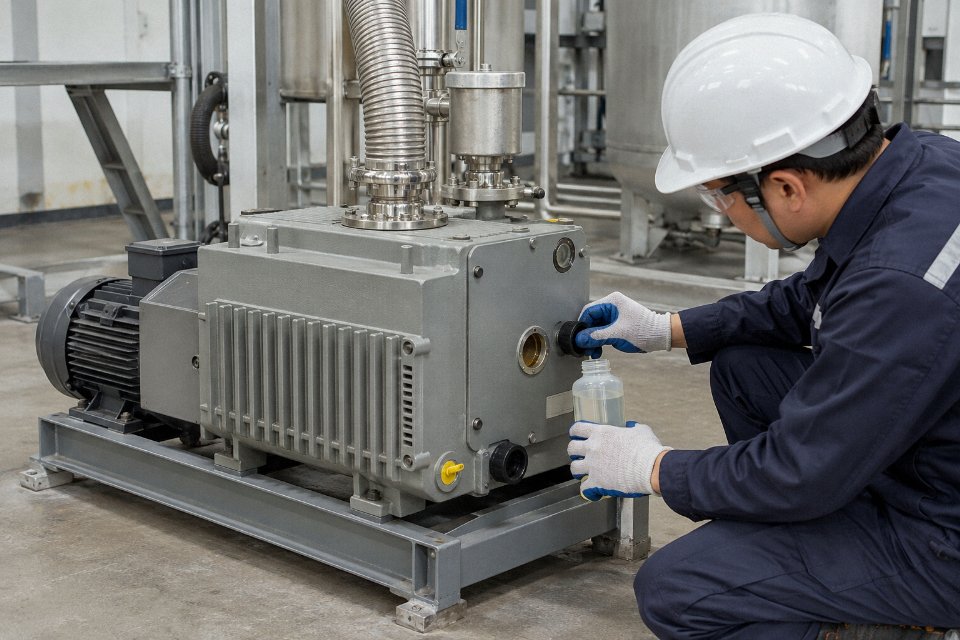
No—not as a direct substitute. Diffusion fluid generates vapor jets; rotary-vane oil must lubricate moving parts, seal clearances, and manage heat. A silicone-based mechanical-pump formulation is acceptable only with explicit approval for that pump and duty.
Is 705-type fluid always better than 704-type fluid?
No. A 705-type fluid’s lower nominal vapor pressure may benefit a suitably configured high-vacuum system, but it does not guarantee better production performance. Check these decision points:
- Pump approval and required heater operating conditions.
- Process cleanliness and target pressure.
- Fluid cost against a demonstrated operating benefit.
Does silicone oil eliminate backstreaming?
No. Silicone diffusion fluid can still migrate toward the chamber. Relevant controls include:
- Correct fluid selection and operation within the pump’s documented limits.
- Properly designed inlet baffles or traps, where required.
- Clean inlet surfaces and maintained cooling.
Baffles can reduce vapor migration but also restrict pumping conductance; their benefit depends on the installation.
How often should silicone diffusion fluid be changed?
There is no defensible universal calendar interval. Base replacement on the pump manual and service evidence:
- Process exposure and suspected chemical contamination.
- Pressure or pump-down deterioration after other faults are excluded.
- Deposits or changes in fluid condition requiring investigation.
Do not assume darkening alone proves failure—or that clear fluid remains serviceable.
Can different silicone diffusion fluids be mixed?
Avoid mixing unless the pump manufacturer and fluid supplier specifically authorize the combination. Mixed charges may have uncertain volatility and operating behavior. For a grade change, follow the documented draining, cleaning, and refill procedure; topping up is not a controlled conversion.
Is silicone diffusion fluid safe for oxygen service?
Silicone chemistry is not oxygen-service approval. Safe use requires a validated combination of equipment, fluid compatibility, cleanliness, and operating conditions. Obtain documented suitability for the actual oxygen concentration, pressure, temperature, and exposure conditions; do not infer approval from a generic chemical-resistance chart.
What pressure can a silicone diffusion pump achieve?
Fluid vapor pressure is not achievable chamber pressure. Use documented performance for the complete configuration, checking:
- Pump model, approved fluid, and backing arrangement.
- Baffles, traps, and connecting conductance.
- Chamber gas load, leaks, outgassing, and gauge conditions.
A fluid datasheet alone cannot establish the pressure your installed system will reach.
Pump-fluid verification before purchase
Choose a purpose-designed silicone diffusion fluid only when the pump manufacturer approves it and its performance, process compatibility, contamination profile, and operating requirements fit the application. A favorable datasheet is not enough: the proposed grade must satisfy both the equipment requirements and the process acceptance criteria.
Use that rule to select one of three outcomes:
- Retain the currently approved fluid when it meets requirements and there is no demonstrated technical or purchasing reason to change. A lower unit price alone rarely justifies introducing an unqualified fluid.
- Qualify a documented alternative when its specification and supporting evidence justify testing. Record baseline pumpdown, operating pressure, and contamination results; then compare under equivalent conditions using a manufacturer-approved changeover procedure. Residual old fluid can obscure the result.
- Reassess the pumping approach when silicone carryover or process chemistry is unacceptable. Changing silicone grades does not necessarily remove the underlying incompatibility.
Provide a minimum inquiry package:
- Equipment: pump make and model, current fluid designation, and any manufacturer restrictions.
- Process: gases and vapors, including condensable or reactive constituents.
- Performance: pressure and gas-throughput targets, duty cycle, and operating temperatures.
- Cleanliness: contamination limits and the method used to verify them.
- Supply: destination-country documentation requirements, estimated purchasing volume, and delivery schedule.
Send this package to SiliconChemicals to request a documented fluid-suitability review, available technical and safety data, a sample-based qualification proposal, and a quotation against the agreed specification. Confirm the available documentation and qualification support before scheduling a trial.
Supplier recommendations support selection; pump-manufacturer requirements, site safety procedures, and application testing determine final acceptance.