In many industries—from cosmetics and textiles to electronics, lubricants, and medical devices—silicone oil is one of the most versatile specialty fluids available. However, many engineers, buyers, and product developers quickly discover that the term silicone oil is not a single material but rather a large family of organosilicon polymers with different chemical structures, viscosities, and functional modifications. Choosing the wrong type of silicone oil can lead to poor lubrication performance, incompatibility with formulations, reduced thermal stability, or failure in critical industrial processes.
Silicone oils are classified into multiple types based on chemical structure, functional modification, viscosity range, and application performance. The most common categories include polydimethylsiloxane (PDMS), phenyl silicone oil, amino silicone oil, hydroxyl silicone oil, epoxy silicone oil, fluorosilicone oil, and specialty modified silicone oils. Each type provides unique properties such as improved thermal stability, surface activity, lubricity, or compatibility with organic systems, making them suitable for different industrial and commercial applications.
To fully understand silicone oil classification, it is necessary to examine the chemical structure, functional groups, molecular architecture, viscosity variations, and application-driven modifications that define each silicone oil category. Once these distinctions are clear, selecting the right silicone oil becomes significantly easier for industrial buyers and formulation engineers.
All silicone oils are chemically identical and differ only in viscosity.False
Silicone oils vary not only in viscosity but also in chemical structure and functional groups such as phenyl, amino, epoxy, or fluorinated modifications.
Most silicone oils are based on polydimethylsiloxane (PDMS) polymer backbones.True
The majority of commercial silicone oils use PDMS chains with Si-O-Si repeating structures as the base polymer backbone.
Understanding the Fundamental Structure of [Silicone Oils](https://siliconchemicals.com/silicone-oil/)
Before discussing silicone oil types, it is important to understand the basic molecular framework that defines silicone fluids. Most silicone oils are based on a repeating siloxane backbone, which consists of alternating silicon and oxygen atoms.
Basic Molecular Formula
Silicone oil polymers typically follow this repeating structure:
–[Si(R₂)–O]ₙ–
Where:
- Si represents silicon atoms
- O represents oxygen atoms
- R represents organic side groups such as methyl, phenyl, or amino
- n represents the polymer chain length
This structure produces several key characteristics:
• extremely flexible polymer chains
• low surface tension
• high thermal stability
• excellent dielectric properties
• hydrophobic behavior
The type of silicone oil is determined primarily by which organic groups are attached to the silicon atoms and how long the polymer chains are.
Core Chemical Characteristics of [Silicone Oils](https://siliconchemicals.com/silicone-oil/)
| Chemical Feature | Effect on Properties |
|---|---|
| Si–O backbone | High flexibility and stability |
| Organic side groups | Determine compatibility and polarity |
| Polymer chain length | Determines viscosity |
| Functional groups | Provide special performance features |
Because of this modular chemistry, silicone oils can be engineered for very specific industrial roles.
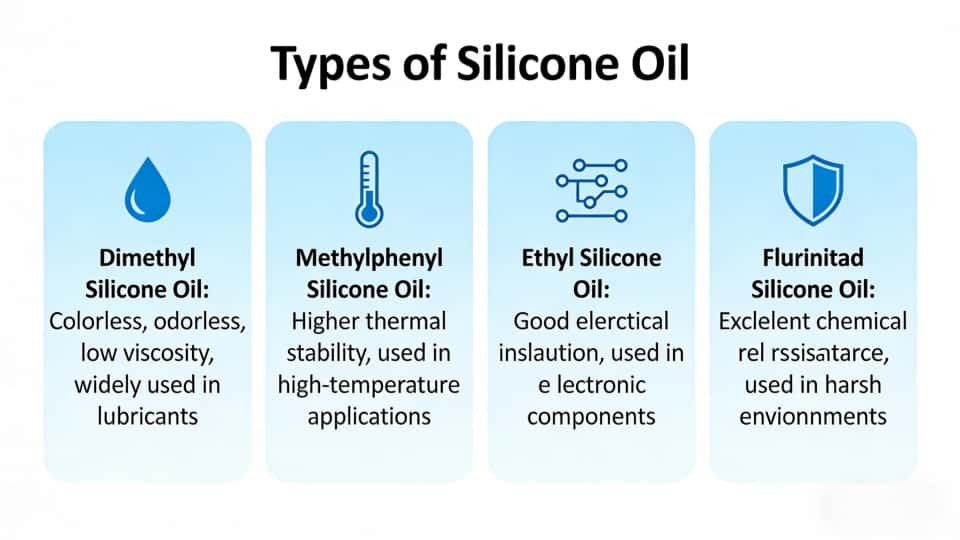 types of silicone oil (2)
Classification of Silicone Oils by Chemical Structure
One of the most important classification systems categorizes silicone oils based on the organic groups attached to silicon atoms.
Major Structural Types of Silicone Oil
| Silicone Oil Type | Main Functional Group | Key Properties | Typical Applications |
|---|---|---|---|
| Dimethyl Silicone Oil | –CH₃ | Excellent stability, lubrication | Cosmetics, lubricants |
| Phenyl Silicone Oil | –C₆H₅ | High temperature resistance | Aerospace, electronics |
| Amino Silicone Oil | –NH₂ | Reactive, softening effect | Textile finishing |
| Hydroxyl Silicone Oil | –OH | Reactive intermediate | Silicone rubber production |
| Epoxy Silicone Oil | Epoxy groups | Adhesion improvement | Coatings, sealants |
| Fluorosilicone Oil | –CF₃ | Chemical resistance | Aviation, fuel systems |
| Alkyl Modified Silicone Oil | Long-chain alkyl | Improved compatibility | Lubricants |
Each of these categories offers unique performance characteristics tailored for different industrial processes.
Dimethyl Silicone Oil (PDMS): The Most Common Silicone Fluid
Dimethyl silicone oil, also known as polydimethylsiloxane (PDMS), is the most widely produced silicone oil globally. It consists of methyl groups attached to the silicon atoms in the siloxane backbone.
Key Properties
| Property | Performance |
|---|---|
| Thermal stability | up to 250°C |
| Low volatility | excellent |
| Surface tension | very low |
| Water repellency | excellent |
| Electrical insulation | high |
Typical Viscosity Range
PDMS fluids are available in an extremely wide viscosity range.
| Viscosity Grade | Typical Use |
|---|---|
| 5–50 cSt | Cosmetics and personal care |
| 100–1000 cSt | Industrial lubricants |
| 1000–10000 cSt | Damping fluids |
| >100000 cSt | Specialty lubricants |
Major Applications
• personal care products
• cosmetic formulations
• lubricants
• antifoaming agents
• electrical insulating fluids
Because of its chemical inertness and stability, PDMS forms the backbone of the global silicone oil industry.
Phenyl Silicone Oil: High-Temperature Performance Fluids
Phenyl silicone oil contains phenyl (aromatic) groups attached to the siloxane backbone. These aromatic rings significantly improve performance at extreme temperatures.
Key Advantages
• improved oxidative stability
• enhanced radiation resistance
• excellent low-temperature flexibility
• better refractive index
Typical Operating Temperature
| Property | Value |
|---|---|
| Low temperature | -70°C |
| High temperature | 300°C |
Major Applications
- aerospace lubricants
- heat transfer fluids
- optical equipment
- aviation electronics
- high-temperature damping systems
Phenyl silicone oil is widely used in extreme environment applications.
Amino Silicone Oil: Textile Softening and Surface Modification
Amino silicone oil contains amine functional groups, which provide reactive interaction with fibers and surfaces.
Key Benefits
• improved softness
• enhanced fabric smoothness
• better durability
• improved elasticity
Applications
| Industry | Use |
|---|---|
| Textile | Fabric finishing |
| Leather | Surface treatment |
| Personal care | Hair conditioning |
| Paper | Surface modification |
Amino silicone oils are essential materials in textile finishing chemistry.
Hydroxyl Silicone Oil: Reactive Silicone Intermediate
Hydroxyl silicone oil contains terminal hydroxyl groups, making it highly reactive and useful as a precursor for silicone elastomers and sealants.
Chemical Role
Hydroxyl groups enable crosslinking reactions.
Industrial Uses
| Application | Function |
|---|---|
| Silicone rubber | Polymer precursor |
| Sealants | Crosslinking agent |
| Adhesives | Reactive component |
| RTV silicone | Base polymer |
Hydroxyl silicone oil plays a critical role in silicone polymer manufacturing.
Fluorosilicone Oil: Chemical Resistance Specialists
Fluorosilicone oils incorporate fluorinated groups into the siloxane backbone.
Unique Advantages
• resistance to fuels and solvents
• chemical stability
• extreme temperature tolerance
Major Applications
| Industry | Use |
|---|---|
| Aviation | Fuel-resistant lubricants |
| Automotive | Fuel system seals |
| Chemical industry | Corrosion-resistant lubricants |
Fluorosilicone oils are widely used in aggressive chemical environments.
Classification of Silicone Oil by Viscosity
Another important classification is based on viscosity level.
Viscosity Classification Table
| Category | Viscosity Range (cSt) | Application |
|---|---|---|
| Low viscosity | 0.65–50 | Cosmetics, release agents |
| Medium viscosity | 100–1000 | Lubricants |
| High viscosity | 10000–100000 | Dampers |
| Ultra-high viscosity | >1000000 | Specialty industrial fluids |
Viscosity strongly affects flow behavior, lubrication performance, and surface spreading.
Specialty Modified Silicone Oils
Modern industrial formulations often use chemically modified silicone oils designed for specific performance characteristics.
Advanced Functional Types
| Type | Key Feature |
|---|---|
| Polyether silicone oil | Surfactant behavior |
| Alkyl modified silicone oil | Organic compatibility |
| Silicone polyether copolymer | Emulsification |
| Reactive silicone fluids | Crosslinking ability |
These advanced formulations allow silicone oils to function in complex industrial systems such as coatings, foams, and emulsions.
Industrial Market Distribution of Silicone Oil Types
| Silicone Oil Category | Market Share |
|---|---|
| Dimethyl silicone oil | ~70% |
| Amino silicone oil | ~10% |
| Phenyl silicone oil | ~8% |
| Fluorosilicone oil | ~5% |
| Specialty modified oils | ~7% |
The dominance of PDMS reflects its wide compatibility and low production cost.
How to Choose the Right Silicone Oil
Selecting the correct silicone oil depends on several factors:
Key Selection Criteria
• operating temperature range
• viscosity requirement
• compatibility with other materials
• chemical resistance
• electrical properties
• regulatory requirements
Example Selection Guide
| Application | Recommended Type |
|---|---|
| Cosmetics | Low viscosity PDMS |
| Textile finishing | Amino silicone oil |
| High-temperature lubrication | Phenyl silicone oil |
| Chemical resistance | Fluorosilicone oil |
Understanding these criteria helps engineers select the optimal silicone fluid for their application.
Conclusion
Silicone oils represent a large and versatile family of organosilicon fluids, each engineered for specific industrial and commercial uses. From the widely used dimethyl silicone oils (PDMS) to specialized materials such as phenyl silicone oils, amino silicone oils, hydroxyl silicone oils, and fluorosilicone oils, these fluids deliver exceptional performance in lubrication, heat transfer, textiles, cosmetics, and advanced engineering applications. Their versatility arises from the flexible siloxane backbone and the ability to modify side groups to tailor physical and chemical properties.
Understanding the different types of silicone oil enables manufacturers, engineers, and buyers to select materials that provide optimal performance, stability, and compatibility for their specific applications.
Talk With the Silicone Fluid Specialists at [Silicon Chemicals](https://siliconchemicals.com/)
If you are sourcing high-quality silicone oils or specialty organosilicon fluids, working with experienced chemical suppliers can ensure reliable performance and consistent product quality.
At Silicon Chemicals, we provide a wide range of silicone oils including PDMS fluids, functional silicone oils, phenyl silicone oils, amino silicone oils, and other specialty silicone materials designed for industrial, cosmetic, and technical applications.
If you need assistance choosing the right silicone oil grade, viscosity, or formulation for your project, our team is ready to help. Contact Silicon Chemicals to discuss your requirements and discover the best silicone solutions for your application.