Choosing the wrong silicone oil can quietly create expensive problems: unstable process performance, surface defects, poor lubrication, foam control failure, incompatibility with your formulation, customer complaints, and even rework across an entire production batch. Many buyers focus only on price or viscosity, but in practice silicone oil selection is a multi-variable technical decision involving molecular structure, viscosity range, volatility, thermal stability, interfacial behavior, compatibility, purity, regulatory fit, and application method. The good news is that once you understand how silicone oils are actually differentiated in real industrial use, selecting the right grade becomes much more systematic, predictable, and commercially efficient.
The right silicone oil is chosen by matching its chemistry and performance profile to your process requirements, not by viscosity alone. In most cases, buyers should evaluate at least nine factors together: silicone type, viscosity, functional modification, thermal range, volatility, compatibility with the substrate or formulation, surface tension behavior, safety/regulatory needs, and packaging/supply consistency. A low-viscosity dimethyl silicone oil may be ideal for release, spreading, and light lubrication, while a high-viscosity grade may be better for damping, dielectric insulation, defoaming carriers, or long-lasting film formation. Functional silicone oils such as amino, phenyl, hydroxyl, vinyl, epoxy, or polyether modified grades are usually selected when adhesion, softness, reactivity, emulsifiability, or thermal performance must be engineered rather than assumed.
If you are comparing silicone oil grades for cosmetics, textiles, personal care, industrial lubrication, release agents, antifoams, electronics, plastics, coatings, or specialty formulations, the most effective approach is to work backward from the end-use failure risks. That means asking what the oil must actually do under real operating conditions: spread, lubricate, insulate, carry additives, reduce foam, improve hand feel, protect surfaces, resist heat, release molds, or react into a network. Once that practical performance target is clear, the selection process becomes far more accurate and far less dependent on guesswork.
The best silicone oil can be chosen based on viscosity alone.False
Viscosity is important, but silicone oil selection also depends on chemical structure, volatility, compatibility, thermal stability, surface behavior, regulatory fit, and the actual end-use process conditions.
Why [Silicone Oil](https://siliconchemicals.com/silicone-oil/) Selection Is More Complex Than Most Buyers Expect
From a manufacturer’s perspective, one of the most common mistakes in the market is treating all silicone oils as interchangeable transparent liquids. They are not. The term “silicone oil” is broad and usually refers to a family of organopolysiloxane fluids with different backbone structures, side groups, chain lengths, functional groups, terminal groups, and formulation behavior. Two products may both be called silicone oil and still perform very differently in the same customer process. One may spread beautifully but evaporate too fast. Another may deliver excellent softness but cause yellowing at high temperature. Another may provide stable lubrication yet separate from the base formulation after storage. Another may emulsify easily in water while another resists emulsification completely.
In industrial procurement, selection errors usually happen because the buyer starts from a product name instead of a performance profile. For example, a customer may request “350 cSt silicone oil” without clarifying whether the actual requirement is dielectric insulation, mold release, textile softness, cosmetic slip, antifoam carrier, or thermal transfer stability. That single number tells only part of the story. Viscosity can help narrow the field, but it cannot reveal whether the oil has amino functionality, whether it contains phenyl groups for improved low-temperature performance, whether it is food-contact suitable, whether it has acceptable volatility, whether it will bloom on a plastic surface, whether it can be emulsified into water, or whether it will interact negatively with surfactants, resins, elastomers, or pigments.
A more reliable way to understand silicone oil selection is to think in layers. The first layer is base chemistry: dimethyl, methyl hydrogen, phenyl modified, amino modified, hydroxyl terminated, vinyl terminated, polyether modified, and so on. The second layer is physical profile: viscosity, refractive index, density, flash point, pour point, volatility, and thermal stability. The third layer is formulation behavior: compatibility, emulsifiability, spreading, lubricity, defoaming efficiency, reactivity, and surface migration. The fourth layer is commercial practicality: packaging size, consistency between batches, documentation, regulatory support, lead time, and cost-performance balance. Good buyers and good suppliers make decisions across all four layers.
What Silicone Oil Actually Is in Technical Terms
Silicone oil is generally an organosilicon fluid built on a siloxane backbone composed of repeating Si–O units with organic groups attached to the silicon atoms. This Si–O backbone is one of the core reasons silicone oils behave differently from hydrocarbon oils. The bond geometry and bond energy contribute to flexibility, thermal stability, low surface tension, hydrophobicity, and relatively stable viscosity across a broad temperature range. In commercial markets, the most common silicone oil is polydimethylsiloxane, often abbreviated as PDMS, where methyl groups dominate the structure. However, many industrially valuable silicone oils are modified versions of this basic platform.
Dimethyl silicone oil is the most widely used because it offers a very balanced combination of low surface tension, lubricity, thermal resistance, water repellency, electrical insulation, and chemical inertness. It is often the first material considered for general-purpose uses such as release agents, polishes, personal care intermediates, damping fluids, dielectric fluids, defoaming carriers, and lubricant additives. But once more specialized performance is needed, modified silicone oils become more relevant. Amino silicone oil is often chosen for textile softening and hair care because amino groups can improve substantivity and softness. Phenyl silicone oil is used when better radiation resistance, higher refractive index, improved low-temperature fluidity, or elevated heat resistance is required. Polyether modified silicone oil is widely used as a surfactant, wetting agent, agricultural adjuvant, or foam-control material because it introduces controlled hydrophilicity. Hydroxyl and vinyl terminated silicone oils become important when downstream reactivity is needed in RTV systems, elastomer manufacture, coatings, or crosslinkable formulations.
This is why the question “How to choose the right silicone oil?” cannot be answered with a single grade recommendation. The better answer is that the right silicone oil is the one whose structure and performance window fit your exact process conditions, substrate, equipment, and downstream expectations.
The Core Selection Logic: Start With Function, Then Match Chemistry
Before comparing datasheets, define the silicone oil’s job in your system. This is the anchor for every technical decision that follows. In real-world procurement and formulation practice, silicone oils usually serve one or more of the following functions: lubrication, release, antifoaming, damping, dielectric insulation, heat transfer, softness modification, hydrophobicity, slip enhancement, leveling, gloss control, anti-blocking, wetting, spreading, additive carrying, or reactivity. Each function favors a different combination of chemical type and physical properties.
If the goal is light lubrication or smooth surface feel, low-to-medium viscosity dimethyl silicone oil may be sufficient. If the goal is durable film formation and longer retention on the substrate, a higher-viscosity grade may be more appropriate. If the goal is softness and smooth hand in textiles, amino modified silicone oils are often preferred because they provide both lubricity and affinity to fiber surfaces. If the goal is to control foam in aqueous systems, the right answer may not be a neat silicone oil at all, but a specially engineered silicone-based antifoam or emulsion system where spreading coefficient, insolubility, carrier selection, and particle balance matter more than pure fluid viscosity. If the goal is thermal stability under extreme conditions, phenyl-containing silicone oils may outperform standard dimethyl grades. If emulsification into water is essential, polyether modified silicone oils or emulsifiable silicone oils should be evaluated instead of ordinary hydrophobic fluids.
This functional-first logic reduces selection mistakes because it forces the buyer to define success in measurable terms. Instead of saying, “I need silicone oil,” say, “I need a silicone fluid that keeps viscosity stable from -20°C to 180°C, does not separate in a solventborne coating, and improves slip without crater formation.” Or, “I need a silicone oil that can be emulsified into water, deposit on polyester-cotton blends, and improve softness without excessive yellowing.” Or, “I need a low-volatility fluid for cosmetic shine and spreadability with acceptable sensory profile and formulation compatibility.” These are selection statements. They give the supplier a real basis for matching the grade.
The Main Types of Silicone Oil You May Need to Compare
The table below gives a practical overview of the most common silicone oil categories and how they are usually selected in industry.
| Silicone oil type | Typical structure feature | Main strengths | Typical limitations | Common applications | Selection clue |
|---|---|---|---|---|---|
| Dimethyl silicone oil | PDMS backbone with methyl groups | General-purpose, hydrophobic, lubricious, thermally stable, electrically insulating | Poor compatibility with some organic systems, not inherently reactive | Lubricants, release agents, dielectric fluids, personal care intermediates, polishes | Best starting point for broad industrial use |
| Amino silicone oil | PDMS with amino functional groups | Excellent softness, substantivity, conditioning, surface affinity | May yellow under heat, can affect formulation stability, requires careful emulsification | Textile softeners, hair care, fiber treatment | Choose when softness and adhesion to substrate matter |
| Phenyl silicone oil | Phenyl-modified siloxane | Better high/low temperature performance, higher refractive index, improved radiation resistance | Higher cost, sometimes different compatibility profile | High-temperature fluids, optical uses, specialty lubricants | Choose for extreme temperature or optical needs |
| Hydroxyl silicone oil | Terminal hydroxyl groups | Reactive intermediate, useful in condensation-curing systems | Not always suitable as final standalone fluid | RTV rubber, sealants, silicone synthesis | Choose when downstream reaction is required |
| Vinyl silicone oil | Vinyl functional groups | Crosslinkable, reactive in addition-curing systems | Requires controlled use with catalyst systems | Silicone rubber, coatings, specialty formulations | Choose for addition-curing or reactive formulations |
| Methyl hydrogen silicone oil | Si-H functional groups | Reactivity, water repellency, crosslinking utility | Reactive handling required, not general-purpose fluid | Waterproofing, silicone synthesis, crosslinking | Choose for hydrophobing or reactive systems |
| Polyether modified silicone oil | Silicone backbone with polyether segments | Emulsifiable, wetting, leveling, spreading, controlled hydrophilicity | Can foam or destabilize systems if poorly matched | Agricultural adjuvants, coatings, cleaners, cosmetic emulsions | Choose when water compatibility or superspreading is needed |
| Epoxy modified silicone oil | Epoxy functionality | Better adhesion promotion and reactivity | More application-specific | Coatings, specialty additives | Choose when adhesion/reactive modification is a priority |
From a buying standpoint, this table already reveals an important rule: never compare only one property across unlike silicone oil families. A 1000 cSt dimethyl silicone oil and a 1000 cSt amino silicone oil may have similar nominal viscosity, yet their deposition behavior, compatibility, and performance outcomes can be radically different.
Viscosity: Important, But Never the Whole Story
Viscosity is usually the first parameter customers mention because it is easy to quantify and easy to compare across suppliers. Common commercial grades include 5 cSt, 10 cSt, 20 cSt, 50 cSt, 100 cSt, 350 cSt, 500 cSt, 1000 cSt, 12500 cSt, 60000 cSt, and much higher. In practice, viscosity affects flow, spreadability, film thickness, migration tendency, lubricity retention, damping behavior, antifoam performance, and process handling.
Low-viscosity silicone oils usually offer faster spreading, lighter feel, easier pumping, thinner film formation, and sometimes better wetting. They are frequently used where rapid coverage, low residue, or easier formulation incorporation is needed. However, they may have higher volatility, lower retention, and shorter-lasting lubrication or gloss. Medium-viscosity grades often provide a better balance between mobility and durability, making them widely used in release agents, surface modifiers, and personal care formulations. High-viscosity grades tend to remain on the surface longer, provide more persistent lubrication, contribute to damping or thick film effects, and reduce evaporation-related loss, but they are harder to process, harder to emulsify, and may create application defects if the system requires fast leveling or low residue.
A practical rule is that viscosity should be chosen according to the physical behavior required at the point of use, not the number most often seen in the market. For instance, in mold release, a lower viscosity may help the silicone spread uniformly across complex surfaces, while in a damping device, a higher and more stable viscosity may be essential for predictable mechanical response. In textile finishing, the neat viscosity of the active silicone oil matters less than the behavior of the emulsified system on the fabric and the final handle after curing. In cosmetics, the apparent elegance of a formulation depends not only on the cSt value but also on volatility, blend composition, and the sensory architecture of the complete system.
The following table provides a practical interpretation of common viscosity ranges.
| Viscosity range | General flow behavior | Typical advantages | Typical concerns | Typical uses |
|---|---|---|---|---|
| 2–20 cSt | Very mobile, light, fast-spreading | Easy application, low drag, thin films | Higher volatility, lower persistence | Polishes, light release, cosmetic intermediates, blending fluids |
| 20–100 cSt | Light to medium fluidity | Balanced spread and retention | May still migrate in some systems | Surface treatment, light lubrication, additives |
| 100–500 cSt | Medium-bodied fluid | Good general-purpose industrial range | Can affect feel or residue if overused | Release agents, polishes, processing aids |
| 500–5000 cSt | Thick fluid | Better durability, stronger lubricating film | Harder pumping and mixing | Damping, specialty lubrication, long-lasting films |
| 5000 cSt and above | Very thick | Strong persistence, controlled movement | Difficult handling, may require heating or dilution | Damping, greases, specialty industrial applications |
Volatility and Flash Point: Critical for Stability, Safety, and Long-Term Performance
Many users underestimate volatility when selecting silicone oil, especially in high-temperature, open-system, coating, textile, personal care, or electronics applications. Two fluids may look identical in the drum and have similar viscosity at room temperature, but one may lose mass faster under heat, leading to drift in performance, odor issues, deposit changes, formulation concentration shift, or shorter service life.
Low-viscosity silicone fluids are often more volatile. This can be advantageous in some specialty formulations where rapid evaporation or lighter residue is desired, but it can also be a problem where persistence matters. In mold release, excessive volatility may lead to inconsistent release over repeated cycles. In dielectric or thermal applications, fluid loss may affect system reliability. In personal care, volatility influences sensory feel, drying profile, and regulatory positioning. In industrial processing, flash point also becomes important for storage, transportation, and workplace handling.
A disciplined buyer should ask for volatility data, weight loss at temperature, flash point, and recommended operating temperature. This is especially important when silicone oil will be used in closed systems, heated reactors, ovens, heated rollers, high-speed textile lines, electronics environments, or cosmetic products exposed to repeated use conditions. Good selection is not simply about whether the oil survives at a stated temperature, but whether it maintains acceptable mass and performance over the expected duration.
Temperature Range: Why Silicone Oils Are Often Chosen Over Hydrocarbon Oils
One reason silicone oils are popular across industries is their relatively stable performance over a wide temperature range compared with many mineral oils or organic fluids. They generally maintain fluidity at lower temperatures and show better thermal stability at higher temperatures, depending on structure. However, “good temperature resistance” is not a universal guarantee; it is a family characteristic with meaningful grade-to-grade variation.
Dimethyl silicone oils often perform very well in moderate to elevated temperature environments, but phenyl modified silicone oils may be preferred when even broader thermal tolerance, better low-temperature fluidity, or improved high-temperature oxidative behavior is required. The real selection question is not whether silicone oil is heat-resistant in general, but whether the chosen grade remains stable enough under the user’s actual thermal cycle, oxygen exposure, shear, and residence time.
For example, an oil used in a briefly heated industrial process may only need short-term thermal robustness. A fluid used continuously in a heat-transfer or insulation environment may need long-term thermal-oxidative stability and low deposit formation. A textile or coating additive may see heat during curing and also interact with catalysts or substrates that change its behavior. A damping fluid in outdoor equipment must maintain predictable viscosity from winter startup to summer operation. These are different temperature problems, and they often require different silicone oil types.
Compatibility: The Hidden Factor Behind Many Field Failures
Compatibility is one of the most important—and most frequently neglected—selection criteria. Silicone oils are famous for low surface tension and hydrophobicity, but these same features can create formulation and process challenges if the oil is used in a system where it does not blend, anchor, or disperse correctly. Incompatible silicone oils can separate, cause haze, form floating layers, create surface craters, reduce recoatability, destabilize emulsions, impair adhesion, or migrate unpredictably.
In hydrocarbon or solvent-based systems, compatibility may vary depending on solvent polarity, resin chemistry, silicone structure, and additive package. In water-based systems, ordinary dimethyl silicone oils are inherently hydrophobic and generally require emulsification or modification to function effectively. In textile softening, the emulsion design is often as important as the silicone oil itself. In coatings, too much surface activity can cause defects instead of benefits. In cosmetics, sensory feel and phase behavior depend heavily on the complete formulation environment. In plastics processing, silicone oil migration can be beneficial for slip but problematic for printability or downstream bonding.
A robust compatibility check should include not only visual blending tests but also storage stability, thermal exposure, substrate wetting, cure interaction, and performance after aging. Small-scale trials are essential. Suppliers that understand application engineering will usually ask what else is in the system before recommending a grade, because a technically good silicone oil can still be the wrong choice in the wrong formulation matrix.
Functional Modification: When Standard PDMS Is Not Enough
Many industrial users begin with standard dimethyl silicone oil because it is versatile and cost-effective. But in more demanding applications, modified silicone oils often provide better performance because they are engineered to solve specific problems. Understanding when to shift from standard PDMS to a modified silicone oil can save significant time and formulation cost.
Amino silicone oils are the classic example. In textile finishing and hair conditioning, ordinary PDMS can improve slip, but amino-functional silicone oils usually offer superior softness, smoother hand, better deposition, and greater conditioning because the amino groups improve interaction with substrates. However, amino silicone oils also require careful control because excessive amino content or poor emulsion design can lead to yellowing, instability, tackiness, or shade changes.
Polyether modified silicone oils are another major class. By introducing polyether chains, the fluid becomes partly hydrophilic, which can dramatically change its behavior in waterborne systems. These materials are selected when emulsifiability, wetting, leveling, or superspreading is required. They are common in agricultural adjuvants, cleaners, coating additives, polyurethane foam stabilizers, and specialty personal care or industrial systems. But they also require application-specific optimization because the wrong hydrophilic-lipophilic balance can cause excessive foam, insufficient surface activity, or instability.
Phenyl modified silicone oils are chosen for different reasons. The phenyl group changes the optical and thermal profile of the oil, often improving performance under extreme thermal conditions and raising refractive index. This makes them attractive in high-temperature lubrication, specialty dielectric applications, optical formulations, and niche industrial environments.
Reactive silicone oils such as hydroxyl, vinyl, or methyl hydrogen grades are less about stand-alone fluid performance and more about what they become in a cured or reacted system. These are selected not because the buyer wants “a silicone oil” in the everyday sense, but because the buyer needs a functional intermediate in rubber, coating, sealant, water-repellent, or crosslinking chemistry.
How to Match Silicone Oil to Specific End Uses
Below is a practical decision matrix that aligns common end uses with the types of silicone oils most often considered.
| End use | Main performance goal | Silicone oil types commonly considered | Key selection concerns |
|---|---|---|---|
| Textile softener | Softness, smoothness, sewability, drape | Amino silicone oil, emulsified modified silicone oil | Yellowing, emulsion stability, shade change, hand feel |
| Hair care and conditioners | Slip, shine, conditioning, combability | Amino silicone oil, dimethicone blends, specialty modified silicones | Sensory feel, deposition, wash-off balance, formulation stability |
| Mold release | Easy release, film uniformity, low residue | Low to medium viscosity dimethyl silicone oil, specialty release formulations | Transfer, residue buildup, recoatability, volatility |
| Antifoam/defoamer | Foam knockdown and control | Silicone-based antifoam systems, dimethyl silicone oil as component | Compatibility, persistence, overuse effects, emulsion design |
| Electrical insulation | Dielectric performance, thermal stability | Dimethyl or phenyl silicone oil | Dielectric strength, moisture behavior, thermal aging |
| Lubrication | Low friction, non-reactivity, broad temperature use | Dimethyl silicone oil, specialty blends | Load conditions, retention, material compatibility |
| Damping fluid | Stable resistance to motion | High-viscosity dimethyl silicone oil | Viscosity consistency over temperature, long-term stability |
| Polishes and surface care | Gloss, water repellency, smooth touch | Low to medium viscosity dimethyl silicone oil | Smearing, durability, substrate compatibility |
| Coatings additive | Slip, leveling, anti-blocking, mar resistance | Modified silicone oils, polyether silicones, epoxy silicones | Craters, adhesion issues, recoatability |
| Agricultural adjuvant | Wetting, spreading, deposition | Polyether modified silicone oil | Crop safety, spreading efficiency, tank-mix stability |
| Rubber and sealant production | Reactive intermediate | Hydroxyl silicone oil, vinyl silicone oil, methyl hydrogen silicone oil | Functionality level, reactivity control, catalyst interaction |
This table also highlights a useful commercial insight: the right silicone oil is often application-specific enough that suppliers should ideally understand the process, not just sell a fluid by viscosity grade.
Purity, Appearance, and Trace Components: Why Quality Consistency Matters
For many customers, especially in cosmetics, electronics, personal care, pharmaceuticals-adjacent processing, premium textiles, coatings, and specialty industrial formulations, purity matters almost as much as core performance. Trace volatiles, residual catalysts, odor, haze, gel particles, moisture, acidity, or inconsistent molecular distribution can all create real downstream issues.
A silicone oil that appears technically acceptable on paper may still cause customer complaints if odor is too strong, if clarity changes over time, if emulsion stability varies from batch to batch, or if trace reactive residues affect catalysts or formulation stability. In high-value applications, quality consistency is not a luxury; it is part of the product’s real performance profile. This is why serious buyers usually ask for a certificate of analysis, typical property range, batch consistency data, and sometimes application-specific screening.
For export business and global B2B supply, this point is even more important. The cheapest drum may not be the lowest-cost choice if inconsistency increases complaint rates, requalification work, inventory risk, or production downtime. Good silicone oil sourcing should evaluate not only the product itself but also the supplier’s process control, documentation quality, and responsiveness to technical questions.
Regulatory and Application Compliance: Do Not Leave This Until the End
The right silicone oil for one industry may be completely unsuitable for another because regulatory or compliance requirements differ. Cosmetic applications may require INCI alignment, sensory compatibility, impurity control, and regional market acceptability. Food-related uses may require specific compliance frameworks depending on jurisdiction and final exposure scenario. Textile and industrial customers may ask for REACH-related support, RoHS-related statements, SVHC awareness, or documentation on restricted substances. Electronics customers may care about volatility, outgassing, dielectric properties, or contamination risk. Medical or pharma-adjacent uses can require an entirely different qualification pathway.
This means compliance cannot be treated as a final paperwork step after technical selection. It must be integrated into the selection decision. A fluid that performs beautifully but cannot be supported with the necessary documentation is not the right product for that customer. Good procurement teams therefore shortlist only those grades that satisfy both technical and documentary requirements from the beginning.
A Practical Buyer’s Checklist for Choosing the Right Silicone Oil
The table below can be used as a working procurement and formulation checklist before final selection.
| Question | Why it matters | What to ask supplier | Common mistake to avoid |
|---|---|---|---|
| What function must the silicone oil perform? | Defines the true selection logic | Ask for grade recommendation by end use, not only by viscosity | Starting from product name instead of application need |
| What viscosity range is required in use? | Affects flow, spreading, damping, retention | Ask for viscosity at standard temperature and viscosity-temperature behavior | Choosing the most common grade without process matching |
| Is standard dimethyl silicone oil enough? | Modified grades may perform much better | Ask whether amino, phenyl, polyether, hydroxyl, vinyl, or other modifications are relevant | Assuming PDMS fits every application |
| What is the operating temperature range? | Determines stability and fluidity needs | Ask for recommended service temperature, volatility, flash point | Ignoring thermal aging and long-term exposure |
| Does the oil need to mix or emulsify with other materials? | Compatibility affects stability and defects | Ask for compatibility guidance and trial suggestions | Overlooking phase separation and surface defects |
| Is low volatility important? | Prevents evaporation loss and drift | Ask for volatile content and weight loss data | Focusing only on room-temperature properties |
| Are there substrate interactions? | Influences adhesion, feel, migration, and appearance | Ask for performance on specific substrates | Testing only in blank systems, not on real substrate |
| Are compliance documents needed? | Regulatory fit can be decisive | Ask for TDS, COA, SDS, compliance statements | Checking documentation too late |
| What packaging and supply stability are needed? | Affects operations and commercial risk | Ask for pack sizes, MOQ, lead time, batch consistency | Buying technically suitable material with unstable supply |
Cost-Performance: Why the Cheapest Silicone Oil Is Often the Most Expensive Decision
In industrial sourcing, price pressure is real, but unit price alone is a poor decision metric. Silicone oil creates value through functional efficiency, reduced defect rate, better process stability, longer service life, and lower total formulation cost. A lower-priced grade can become more expensive if it requires a higher dosage, causes rework, produces inconsistent finish, reduces equipment life, or generates customer claims.
For example, a cheaper low-viscosity fluid may need more frequent reapplication in a release or lubrication system. A lower-grade amino silicone emulsion may reduce textile softness consistency and increase shade variation or yellowing risk. A non-optimized silicone additive in coating may reduce coefficient of friction but introduce craters, forcing reformulation. A low-quality oil used in personal care may create odor or instability that harms brand perception. When seen through total cost of ownership, the right silicone oil often saves more money than it costs.
A useful procurement method is to compare not just price per kilogram, but cost per successful production run, cost per treated unit, defect reduction value, service interval extension, and inventory risk. Industrial users who track these metrics usually make more stable supplier decisions and avoid false economies.
Typical Selection Scenarios and What Usually Works Best
For general industrial lubrication and release
A standard dimethyl silicone oil is often the first candidate because it is hydrophobic, lubricious, and thermally stable across a useful operating range. For easy spreading and low residue, lower viscosity grades are often preferred. For longer-lasting film and persistence, medium or higher viscosity grades may be better. The real choice depends on cycle time, substrate roughness, temperature, and residue tolerance.
For textile softening and fabric finishing
Amino silicone oil or a well-designed amino silicone emulsion is usually preferred over standard dimethyl silicone oil when the goal is premium softness, smoothness, and drape. Selection should consider fiber type, yellowing sensitivity, ionic compatibility, curing conditions, and whether a fluffy, silky, waxy, or elastic hand is desired.
For water-based formulations
Standard hydrophobic silicone oil may not be suitable unless it is emulsified correctly. Polyether modified silicone oils or emulsifiable silicone systems are often more practical when wetting, spreading, or water compatibility is required. Storage stability and foam profile must be checked carefully.
For high-temperature or specialty dielectric uses
Phenyl modified silicone oils may be worth evaluating because they often offer better low-temperature fluidity and enhanced high-temperature performance compared with purely dimethyl systems. Long-term aging and electrical data should be reviewed, not only initial specs.
For personal care and cosmetics
Selection should consider not only viscosity, but sensory profile, spreadability, gloss, volatility, clarity, odor, formulation compatibility, and the positioning of the final product. Cosmetic-grade requirements may be stricter than industrial-grade assumptions.
For reactive silicone systems
Hydroxyl, vinyl, or methyl hydrogen silicone oils should be chosen based on desired cure mechanism, functionality, and compatibility with catalyst and resin system. These are technical intermediates and should not be selected as though they were general-purpose fluids.
How to Test Silicone Oil Before Full-Scale Purchase
No matter how good a datasheet looks, the final choice should be confirmed by controlled trial. As a manufacturer or supplier, we strongly recommend a staged evaluation process rather than immediate bulk commitment. This reduces risk and improves technical fit.
Begin with a clear definition of success. Identify which parameters actually matter: slip, gloss, foam suppression, softness, viscosity stability, release force, dielectric behavior, thermal loss, surface appearance, sensory feel, or cure performance. Then run a small-scale screening across two to five candidate grades. Use the real formulation or process conditions whenever possible, not a simplified laboratory shortcut that fails to capture field variables.
The test plan should include initial performance, storage stability, aging behavior, and side effects. In a coating, for example, look not only at leveling improvement but also recoatability and crater risk. In textiles, measure not only softness but also color change, emulsion stability, and sewing performance. In release applications, test repeated cycles rather than one-time release. In thermal use, check weight loss and fluid condition after exposure. In personal care, assess both immediate feel and long-term formulation stability.
This trial-based approach is one of the fastest ways to identify the right silicone oil with confidence.
A Simple Technical Workflow for Buyers
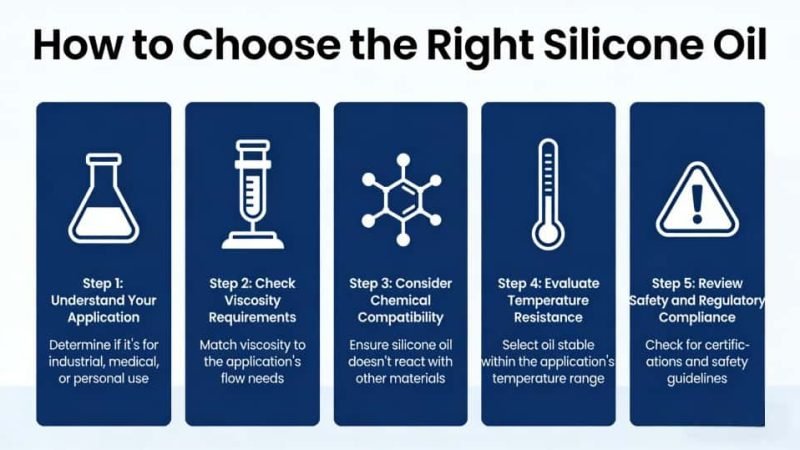
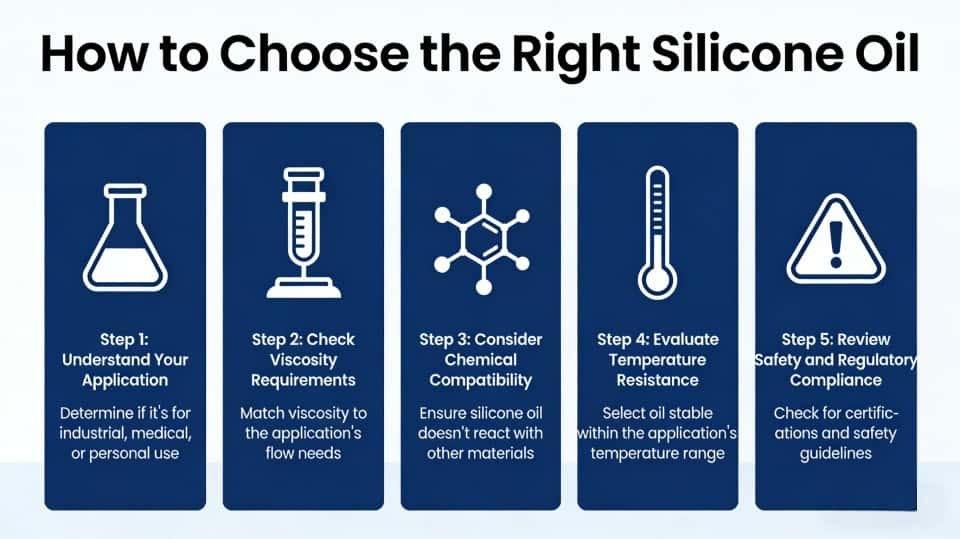
Although silicone oil selection can become highly specialized, the process can still be handled systematically. Start by identifying the end-use role of the oil. Next, define the operating conditions: temperature, system polarity, application method, substrate, and whether the fluid must remain inert or become reactive. Then narrow the chemistry family: dimethyl, amino, phenyl, polyether, hydroxyl, vinyl, or another functional type. After that, choose a practical viscosity window and evaluate volatility, compatibility, and compliance. Finally, confirm by application testing before scale-up.
That sequence is much more reliable than starting with a random common grade and hoping it works. Buyers who adopt this logic usually reach a more stable technical-commercial outcome, especially when working with multiple product lines or export markets.
Common Mistakes When Choosing Silicone Oil
One recurring mistake is choosing by price alone. This often leads to underperformance, especially where quality consistency or substrate interaction matters. Another is choosing only by viscosity, which ignores chemistry and application-specific behavior. A third is neglecting compatibility tests, particularly in water-based, resin-rich, or multi-additive systems. A fourth is assuming that a silicone oil successful in one industry will automatically transfer to another. A fifth is ignoring volatility and thermal aging, which can distort long-term results. A sixth is selecting a reactive or modified grade without understanding side effects such as yellowing, adhesion change, or formulation instability. A seventh is failing to verify documentation, which can stop a project even when technical performance looks acceptable.
From a supplier perspective, the best customers are not those who request the cheapest silicone oil, but those who provide enough application detail to make the right match. That is how long-term cooperation usually begins: with better technical selection at the start.
Case-Based Comparison: How the “Right” Silicone Oil Changes by Industry
To make the selection logic more concrete, consider the following cross-industry examples.
A textile finisher wants a premium soft hand on polyester-cotton fabric with low yellowing and stable emulsion performance. A standard 350 cSt dimethyl silicone oil may improve slip somewhat, but an amino silicone microemulsion or carefully selected amino-modified silicone softener will usually provide a much stronger hand effect. Here, the right choice is driven by substrate affinity and handle, not by generic silicone fluid identity.
A manufacturer of precision molds needs a release aid that spreads evenly and leaves minimal buildup during repeated cycles. A low-to-medium viscosity dimethyl silicone oil may work well, but only if volatility, transfer behavior, and substrate residue are acceptable. If post-painting or bonding follows, overuse of silicone may create downstream issues, so dosage and purity matter.
A cosmetic formulator wants shine and slip in a serum. The choice may depend on desired sensorial profile, volatility, and compatibility with the rest of the emulsion or anhydrous base. Here, a purely industrial mindset would fail; elegance and formulation architecture matter as much as lubrication.
An electrical equipment application demands stable dielectric behavior and thermal reliability. In that case, ordinary low-cost fluid substitution is risky. The correct choice may favor a more controlled dimethyl or phenyl silicone fluid with validated electrical and thermal properties.
These examples show that silicone oil selection is not a commodity decision. It is a performance engineering decision.
Technical Comparison Chart: Selection Priorities by Application
| Application | Most important property | Secondary property | Often preferred type | Main warning |
|---|---|---|---|---|
| Textiles | Softness and substantivity | Emulsion stability | Amino silicone oil | Yellowing and shade change |
| Hair care | Sensory slip and conditioning | Formulation compatibility | Amino or specialty cosmetic silicone | Build-up and feel balance |
| Mold release | Uniform spreading | Residue control | Low/medium viscosity dimethyl silicone oil | Excess transfer |
| Antifoam | Fast foam knockdown | Persistence | Silicone-based defoamer system | Overdosing can hurt process |
| Damping | Stable viscosity | Temperature response | High-viscosity dimethyl silicone oil | Ignore viscosity-temperature curve at your peril |
| Coatings | Slip and leveling | Recoatability | Modified silicone additive | Cratering or adhesion loss |
| Agriculture | Superspreading | Tank compatibility | Polyether modified silicone oil | Crop sensitivity and dosage |
| Electrical | Dielectric reliability | Thermal aging | Controlled dimethyl/phenyl silicone fluid | Substituting generic grade without validation |
| Reactive systems | Functionality | Cure compatibility | Hydroxyl/vinyl/methyl hydrogen silicone oils | Wrong functional balance can ruin cure |
How Suppliers Should Present Silicone Oil Options to Buyers
A professional silicone oil supplier should not simply send a viscosity list. A better supplier presents grades according to application families, explains what each chemistry is designed to do, identifies likely risks, and recommends testing paths. For example, instead of saying only “we offer 50 cSt, 100 cSt, 350 cSt, and 1000 cSt,” the supplier should explain which grades are more suitable for release, which are better for lubricity retention, which are better for damping, which are reactive intermediates, and which are better for emulsification or softness.
The best supplier communication usually includes a technical data sheet, safety data sheet, typical application guidance, recommended storage conditions, available packaging, and trial support. In export markets, commercial professionalism also includes clear labeling, consistent batch control, transparent lead times, and readiness to discuss documentation requirements.
What to Ask Before You Buy in Bulk
Before placing a full order, ask the following practical questions. Is this a standard dimethyl silicone oil or a modified silicone oil? What is the exact viscosity specification and allowable tolerance? What is the volatile content or evaporation behavior? Is it intended for direct use or as an intermediate? Does it require emulsification? What substrates has it been used on successfully? What are the recommended temperature limits? What packaging options are available? Can the supplier provide a sample and technical recommendation based on my process? What compliance documents can be supported? How stable is batch-to-batch quality?
The answers to these questions reveal not only whether the product is suitable, but also whether the supplier is capable of supporting serious industrial applications.
Choosing the Right Packaging and Supply Format
Packaging affects more than logistics. It also affects handling efficiency, contamination risk, storage stability, and purchasing flexibility. Small users may prefer sample bottles, pails, or 25 kg drums for development work. Industrial users often choose 200 kg drums or IBC totes for production use. For very high-purity or specialty applications, packaging cleanliness and seal integrity can be critical. In hot climates or long shipping routes, storage and transport conditions should also be considered, especially for emulsions or specialty modified fluids.
A supplier that offers multiple packaging formats can support both trial and scale-up more efficiently. This is often valuable for OEM brands, contract formulators, and global distributors who want to validate the same grade before expanding purchase volumes.
Final Selection Framework: The Most Reliable Way to Choose
If you want the shortest technically correct answer, it is this: define the job, define the environment, define the chemistry family, define the viscosity range, confirm compatibility, confirm compliance, and then validate through trial. That is the most dependable path to choosing the right silicone oil.
In commercial reality, the “right” silicone oil is rarely the most generic one and rarely the one with the lowest quoted price. It is the one that solves the user’s problem most efficiently, consistently, and safely over time. For some buyers, that will be a standard dimethyl silicone oil in a common viscosity grade. For others, it will be a phenyl silicone oil for thermal stability, an amino silicone oil for softness, a polyether modified silicone oil for wetting, or a reactive silicone oil for crosslinking chemistry. The exact answer changes with the application, but the selection logic remains the same.
A disciplined buyer does not ask only, “What viscosity do I need?” The better question is, “What must this silicone oil do in my real process, under my real conditions, without causing new problems?” Once you ask the right question, selecting the right silicone oil becomes much easier.
The Bottom Line
Silicone oil selection is not difficult because silicone oils are confusing by nature; it is difficult because too many decisions are made from incomplete criteria. When you move from a one-dimensional approach to a structured evaluation of function, chemistry, viscosity, volatility, compatibility, temperature, compliance, and supply reliability, the process becomes more precise. That precision matters. It reduces trial-and-error, improves product performance, lowers hidden cost, and helps you build a better final product for your own customers.
Let’s Talk About the Right Grade for Your Application
If you are comparing silicone oil grades for textiles, cosmetics, release agents, lubricants, defoamers, coatings, electronics, or specialty formulations, Silicon Chemicals can help you narrow the options quickly and practically. Share your application, viscosity target, operating temperature, formulation system, and any compliance requirements, and we can recommend suitable silicone oil types, sample options, and packaging formats for evaluation. The fastest way to avoid a costly wrong choice is to match the chemistry correctly from the start.