Selecting the right silane is critical in industries such as plastics, rubber, adhesives, coatings, composites, electronics, and construction materials. Many engineers and buyers know that “silane coupling agents improve bonding,” but the problem is that silane chemistry includes dozens of different structures—each designed for a specific function. Using the wrong silane leads to poor adhesion, weak composite interfaces, or product failure. Fortunately, understanding a real example of a widely used silane makes it much easier to identify the correct material for your application.
In this article, I will introduce a clear and practical example of a silane, explain why it is widely used, and show how it works at the molecular level so you can apply it correctly in your production processes.
An example of a silane is γ-aminopropyltriethoxysilane (commonly known as APTES). This organofunctional silane contains an amine group for bonding with organic polymers and three hydrolyzable ethoxy groups that react with inorganic surfaces such as glass, metals, and minerals. It is one of the most widely used silane coupling agents for improving adhesion, modifying surfaces, and enhancing composite strength.
Understanding this example helps manufacturers, engineers, and buyers distinguish silanes in real-world applications. Keep reading to learn why this specific silane is so important in industry.
Silane chemistry has many variations, so using APTES as a model helps clarify how silanes function and how to select them.
APTES is a silicone, not a silane.False
APTES is an organofunctional silane coupling agent. Silicone is a polymer made of Si–O–Si chains, while APTES is a small reactive silane molecule used for surface modification and adhesion promotion.
What Exactly Is APTES and Why Is It a Good Example?
γ-Aminopropyltriethoxysilane (APTES) is commonly represented as:
H₂N–(CH₂)₃–Si(OC₂H₅)₃
This structure provides two essential functionalities:
- Amine group (H₂N–): bonds with organic polymers such as epoxy, polyurethane, and phenolic resins
- Triethoxysilane group (Si–(OC₂H₅)₃): hydrolyzes to form silanol (Si–OH), which bonds to inorganic surfaces
- Propyl chain: acts as the molecular “bridge” between two different materials
This dual-reactive nature is what makes APTES an excellent example of how silane coupling agents work.
Basic Properties of APTES
| Category | Description |
|---|---|
| Chemical Name | γ-Aminopropyltriethoxysilane |
| Abbreviation | APTES |
| CAS Number | 919-30-2 |
| Functional Group | Primary amine |
| Hydrolyzable Groups | Three ethoxy groups |
| Purity | Typically 98–99% industrial grade |
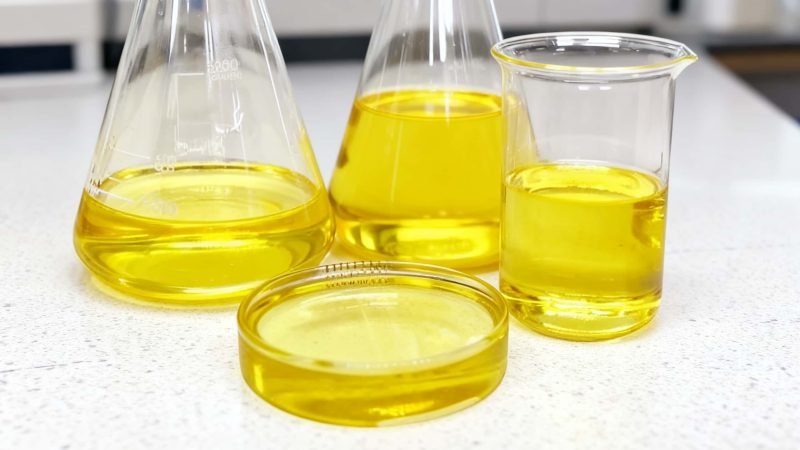
| Form | Clear to pale-yellow liquid |
APTES is widely used in chemical manufacturing, advanced materials, composites, nanotechnology, and coating formulations.
Why APTES Is the Ideal Representative Silane Example
APTES demonstrates nearly all the key characteristics of silane behavior:
- Hydrolysis: breaks ethoxy groups to form silanol
- Condensation: forms strong Si–O–Si bonds with surfaces
- Functional reactivity: amine group reacts with resin systems
- Surface modification ability: improves hydrophilicity or hydrophobicity depending on the system
- Coupling between organic and inorganic phases
This is why APTES is used in countless textbooks, laboratories, and industrial processes as the “model silane.”
How APTES Works Chemically (Step-by-Step Mechanism)
Simplified Reaction Pathway
| Step | Reaction Description | Result |
|---|---|---|
| 1. Hydrolysis | Si–(OC₂H₅)₃ → Si–OH + ethanol | Forms silanol groups |
| 2. Condensation with surface | Si–OH + Surface–OH → Si–O–Surface | Covalent bonding |
| 3. Organic reaction | Amine group reacts with epoxies or resins | Strong polymer network bonding |
This two-sided chemistry is exactly what makes silanes essential in composite production.
Structural Diagram
   H2N–(CH2)3–Si–(OC2H5)3
              |
            Surface
After hydrolysis and condensation, a stable Si–O–Si network forms on the substrate.
Industrial Applications of APTES
Table: APTES in Different Industries
| Industry | Application | Function |
|---|---|---|
| Composites | Glass fiber treatment | Improves epoxy/glass adhesion |
| Rubber | [Silica](https://siliconchemicals.com/silica/) reinforcement | Increases tensile & tear strength |
| Coatings | Metal primer additive | Enhances corrosion resistance |
| Electronics | Wafer surface modification | Improves layer adhesion |
| Nanotechnology | Nanoparticle functionalization | Controls surface charge |
| Adhesives | Crosslinking agent | Improves bonding to metals |
APTES is especially valued for strengthening the interface between epoxy resins and glass fiber—one of the most critical interactions in composite manufacturing.
Comparison: APTES vs. Other Common Silanes
To understand why APTES is a standout example, compare it with other typical silanes:
| Silane Name | Abbreviation | Functional Group | Typical Use |
|---|---|---|---|
| Aminopropyltriethoxysilane | APTES | –NH₂ | Epoxy, polyurethane, composite bonding |
| Vinyltriethoxysilane | VTES | –CH=CH₂ | Polymer grafting, crosslinking |
| Epoxy-functional silane | GPTMS | Epoxy | Adhesives, coatings |
| Methacryloxypropyltrimethoxysilane | KH-570 | Methacrylate | Acrylic resins, composites |
APTES is the most universal because the amine group is compatible with many resin systems.
Case Study: How APTES Improves Glass Fiber–Epoxy Bonding
An epoxy composite without silane often shows:
- Weak interfacial adhesion
- Poor mechanical strength
- Moisture-sensitive bonding
- Early delamination
Adding 0.2–0.8% APTES treatment improves:
| Property | Improvement |
|---|---|
| Tensile strength | +20–40% |
| Interlaminar shear strength | +25–60% |
| Moisture resistance | Significantly improved |
Such enhancements explain why APTES is used in aerospace, automotive, and marine composites.
Practical Selection Guide: When Should You Choose APTES?
Use APTES when you need:
- Better adhesion between epoxy and glass fiber
- Surface modification of [silica](https://siliconchemicals.com/silica/), quartz, or metals
- Strong bonding between polymer and inorganic filler
- Improved mechanical strength in rubber
- Enhanced dispersion of nanoparticles
Do not use APTES if:
- Your polymer is not reactive with amine groups
- You need hydrophobic treatment (use alkyl silanes instead)
- You are working with acidic systems that will neutralize amines
Summary: Why APTES Is the Best Example of a Silane
APTES perfectly demonstrates:
- What a silane molecule looks like
- How it reacts with surfaces
- How it couples organic polymers and inorganic fillers
- Why silanes are essential in modern materials science
It is a textbook example of a silane coupling agent that benefits nearly every major industrial sector.
Need Help Choosing the Right Silane for Your Application?
Silicon Chemical supplies professional-grade silane coupling agents, surface modifiers, and specialty organosilicon materials for industrial users worldwide.
If you need to select the correct silane type—or require technical data, formulations, or sample support—contact us anytime.
Silicon Chemical
Website: www.siliconchemicals.com
Email: Inquiry@siliconchemicals.com