Silicone oil and synthetic oil are often confused—especially in industrial procurement, lubrication engineering, and chemical sourcing. Many buyers assume that because silicone oil is man-made, it must be just another type of synthetic oil. This misunderstanding can lead to serious consequences: incorrect material selection, equipment failure, compatibility issues, and even safety risks in high-temperature or sensitive environments. If you’re selecting fluids for lubrication, insulation, damping, or chemical processing, choosing the wrong type can cost both performance and money. The good news is that once you clearly understand the differences in chemistry, structure, and application, the decision becomes straightforward and highly strategic.
No, silicone oil is not the same as synthetic oil. Silicone oil is a specific type of synthetic fluid based on silicon-oxygen (Si–O) backbone chemistry (typically polydimethylsiloxane, PDMS), whereas “synthetic oil” is a broader category that includes artificially engineered oils such as polyalphaolefins (PAO), esters, and synthetic hydrocarbons. While all silicone oils are synthetic, not all synthetic oils are silicone oils. They differ fundamentally in molecular structure, thermal behavior, lubrication characteristics, compatibility, and industrial applications.
If you want to make the right technical and commercial decision, you need to go far beyond this basic distinction. The real value lies in understanding how these fluids behave in real-world systems, where they outperform each other, and how to choose between them based on engineering constraints, regulatory requirements, and lifecycle costs.
Silicone oil is just another type of synthetic lubricant similar to PAO oils.False
Silicone oil has a completely different silicon-oxygen backbone, giving it unique thermal stability, low surface tension, and dielectric properties unlike hydrocarbon-based synthetic oils.
Understanding the Fundamental Chemistry: Why Structure Defines Everything
At the core of the difference lies molecular architecture. Silicone oil is built on a silicon-oxygen backbone (Si–O–Si), whereas conventional synthetic oils are carbon-based hydrocarbons (C–C chains). This difference is not cosmetic—it fundamentally determines how the fluid behaves under stress, temperature, pressure, and chemical exposure.
Silicone oils, especially polydimethylsiloxane (PDMS), exhibit a flexible chain structure with high bond energy in the Si–O linkage. This results in extraordinary thermal stability and resistance to oxidation. In contrast, synthetic oils such as PAO or ester oils rely on carbon-carbon bonds, which, while engineered for performance, still degrade more readily under extreme conditions.
Key Molecular Differences Table
| Property | [Silicone Oil](https://siliconchemicals.com/silicone-oil/) (PDMS) | Synthetic Oil (PAO / Ester) |
|---|---|---|
| Backbone Structure | Si–O–Si | C–C |
| Bond Energy | Very high | Moderate |
| Polarity | Low (non-polar) | Varies (PAO low, ester high) |
| Thermal Stability | Excellent (>200°C continuous) | Good (~150–180°C typical) |
| Oxidation Resistance | Outstanding | Moderate to good |
| Surface Tension | Extremely low | Higher |
| Volatility | Very low | Moderate |
This table highlights a crucial insight: silicone oil is not just “another synthetic oil”—it is a fundamentally different class of fluid engineered for entirely different performance domains.
Performance Characteristics: Where Each Fluid Excels
When evaluating silicone oil versus synthetic oil, performance characteristics must be analyzed in multiple dimensions: temperature stability, lubrication efficiency, dielectric strength, volatility, and environmental resistance.
Silicone oil is often selected in applications where extreme temperature stability and chemical inertness are required. It remains stable across a wide temperature range, typically from -50°C to +200°C or even higher depending on formulation. This makes it ideal for electronics, aerospace, and high-temperature damping systems.
Synthetic oils, particularly PAO and esters, are optimized for lubrication performance. They provide superior load-bearing capacity, better film strength, and improved friction reduction compared to silicone oils. This is why they dominate in automotive engines, gear systems, and industrial machinery.
Performance Comparison Table
| Performance Metric | Silicone Oil | Synthetic Oil |
|---|---|---|
| High-Temperature Stability | Excellent | Good |
| Low-Temperature Fluidity | Excellent | Good |
| Lubrication (Load Bearing) | Poor to Moderate | Excellent |
| Oxidation Resistance | Excellent | Good |
| Electrical Insulation | Outstanding | Limited |
| Compatibility with Materials | Selective | Broad |
| Cost | Higher (specialty) | Moderate |
From a procurement perspective, this means the selection is not about which is “better,” but which is fit for purpose.
Application Domains: Real Industrial Use Cases
Understanding application scenarios is where the distinction becomes most practical. Silicone oil is rarely used where synthetic oil dominates—and vice versa.
Silicone Oil Applications
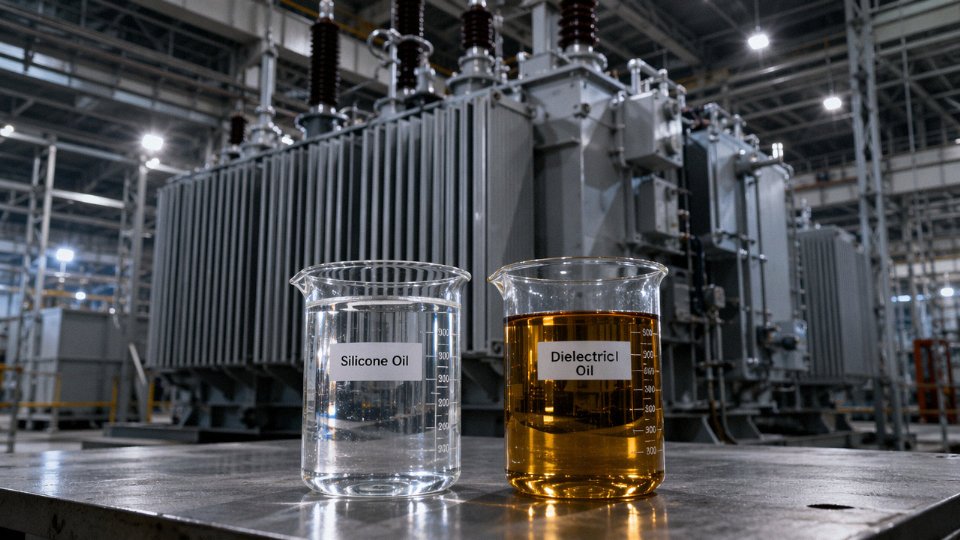
- Electrical insulation fluids (transformers, capacitors)
- Damping fluids (automotive dashpots, precision instruments)
- Heat transfer fluids in specialty systems
- Cosmetics and personal care formulations
- Release agents in molding processes
- Medical-grade lubricants
Synthetic Oil Applications
- Automotive engine oils
- Gear oils and transmission fluids
- Hydraulic systems
- Industrial compressors
- Turbines and heavy machinery
Application Suitability Matrix
| Application Type | Silicone Oil Suitability | Synthetic Oil Suitability |
|---|---|---|
| Engine Lubrication | Not suitable | Highly suitable |
| Electronics Cooling | Highly suitable | Limited |
| High-Load Gears | Not suitable | Excellent |
| Cosmetic Formulations | Excellent | Not suitable |
| Vacuum Systems | Excellent | Limited |
| Food-Grade Lubrication | Select grades | Select grades |
The takeaway is clear: silicone oil is a functional fluid, while synthetic oil is primarily a performance lubricant.
Material Compatibility and Chemical Behavior
One of the most overlooked aspects in fluid selection is compatibility with materials such as plastics, elastomers, and metals.
Silicone oil is chemically inert and does not react with most substances. However, it can swell certain elastomers and is not always compatible with hydrocarbon-based seals. Synthetic oils, particularly esters, can be more aggressive but offer better lubrication compatibility across mechanical systems.
Compatibility Comparison Table
| Material Type | Silicone Oil | Synthetic Oil |
|---|---|---|
| Metals | Excellent | Excellent |
| Plastics | Generally safe | Varies |
| Elastomers | Selective compatibility | Broad compatibility |
| Paints/Coatings | Can cause defects | Generally stable |
This is especially critical in industries like automotive and electronics, where seal integrity and material stability directly impact system reliability.
Cost vs Value: Strategic Procurement Perspective
From a cost standpoint, silicone oil is typically more expensive than standard synthetic oils. However, focusing only on unit price is a mistake. The real metric should be total cost of ownership (TCO).
Silicone oil offers:
- Longer service life
- Lower maintenance frequency
- Stability in extreme conditions
- Reduced system failure risk
Synthetic oils offer:
- Lower upfront cost
- Superior lubrication performance
- Broad availability
- Easier system integration
Cost-Benefit Analysis Table
| Factor | Silicone Oil | Synthetic Oil |
|---|---|---|
| Initial Cost | High | Moderate |
| Maintenance Cost | Low | Moderate |
| Lifespan | Long | Medium |
| Performance in Extreme Conditions | Superior | Moderate |
| Overall ROI (specific applications) | High | High |
This means silicone oil is often the better choice in high-value, sensitive systems, while synthetic oil dominates in high-load, high-volume industrial environments.
Partial Conclusion: The Strategic Answer
At a professional level, the question is not “Are they the same?” but “Which one aligns with your system requirements?”
Silicone oil and synthetic oil belong to different functional categories. Silicone oil is a specialty fluid engineered for stability, insulation, and chemical inertness. Synthetic oil is a performance lubricant optimized for friction reduction and mechanical efficiency.
Choosing between them requires:
- Understanding operating conditions (temperature, load, environment)
- Evaluating material compatibility
- Considering lifecycle cost
- Matching fluid properties to functional requirements
In the next part, we will go significantly deeper into selection strategies, viscosity engineering, industry-specific case studies, regulatory considerations, and how to choose the exact grade of silicone oil or synthetic oil for your application—this is where most procurement decisions succeed or fail.
Advanced Selection Strategy: How to Choose Between Silicone Oil and Synthetic Oil in Real Engineering Systems
When procurement decisions move from theory to execution, the distinction between silicone oil and synthetic oil becomes a multidimensional engineering problem. It is no longer about definitions—it is about aligning fluid behavior with system demands, regulatory constraints, and long-term operational stability. In real industrial environments, fluid selection must integrate thermal dynamics, tribology, material compatibility, environmental exposure, and lifecycle economics into one unified decision framework. A misalignment in any one of these factors can compromise the entire system, leading to performance degradation, unexpected downtime, or even catastrophic failure in high-value equipment.
A structured selection methodology begins with identifying the dominant operating variable. In some systems, temperature is the primary constraint; in others, it is load-bearing capacity, chemical exposure, or electrical insulation requirements. Silicone oil excels when thermal stability, dielectric properties, and chemical inertness are critical. Synthetic oils dominate when mechanical lubrication, shear stability, and friction reduction under load are required. The complexity arises in hybrid systems, where both thermal and mechanical demands coexist, requiring nuanced decision-making.
Engineering Selection Matrix
| Selection Criteria | Preferred Fluid Type | Reason |
|---|---|---|
| Continuous temperature > 180°C | Silicone Oil | Superior thermal stability |
| High mechanical load / friction | Synthetic Oil | Better lubricity and film strength |
| Electrical insulation required | Silicone Oil | High dielectric strength |
| Compatibility with seals and gaskets | Synthetic Oil | Better elastomer compatibility |
| Exposure to chemicals / oxidation | Silicone Oil | Inert and stable |
| Cost-sensitive applications | Synthetic Oil | Lower cost |
This matrix should not be used in isolation but as a foundational decision tool. Advanced users typically overlay this with application-specific data such as viscosity requirements, volatility limits, and regulatory compliance constraints.
Viscosity Engineering: The Most Critical Yet Misunderstood Parameter
Viscosity is arguably the most important parameter in fluid selection, yet it is frequently misunderstood or oversimplified. Both silicone oils and synthetic oils are available across a wide viscosity range, typically measured in centistokes (cSt) at 25°C. However, their viscosity-temperature behavior differs significantly.
Silicone oil exhibits a very low viscosity-temperature coefficient, meaning its viscosity remains relatively stable across temperature changes. This makes it ideal for precision damping systems, optical equipment, and aerospace applications where consistent performance is required under fluctuating conditions.
Synthetic oils, particularly PAO and esters, show more variation in viscosity with temperature but offer superior load-bearing characteristics. This makes them ideal for engines, gearboxes, and hydraulic systems.
Viscosity Comparison Table
| Property | Silicone Oil | Synthetic Oil |
|---|---|---|
| Viscosity Stability vs Temperature | Excellent | Moderate |
| Shear Stability | High | Very high |
| Load-Carrying Capacity | Low | High |
| Available Viscosity Range | 0.65 – 1,000,000 cSt | Broad (engine-specific grades) |
Practical Viscosity Selection Guidelines
- Low viscosity (1–50 cSt): Used in heat transfer, electronics cooling, and coatings
- Medium viscosity (100–1,000 cSt): Damping fluids, general lubrication
- High viscosity (>10,000 cSt): Shock absorption, sealing, specialty applications
A key insight: silicone oil maintains consistent viscosity under extreme conditions, while synthetic oil provides stronger mechanical protection under load.
Industry-Specific Case Studies: Where the Decision Truly Matters
Case Study 1: Automotive Engine Lubrication
In automotive engines, synthetic oil (PAO or ester-based) is the clear choice. Engines operate under high mechanical stress, requiring strong lubricating films to prevent metal-to-metal contact. Silicone oil lacks the necessary load-bearing capacity and would fail in this environment.
Case Study 2: Electronics Cooling and Insulation
Silicone oil is widely used in electronics due to its dielectric properties and thermal stability. It prevents electrical discharge while efficiently transferring heat. Synthetic oils cannot match this combination of properties.
Case Study 3: Precision Damping Systems
In applications such as camera lenses, automotive dashboards, and aerospace instruments, silicone oil is preferred due to its stable viscosity and smooth damping characteristics.
Case Study 4: Industrial Gear Systems
Synthetic oils dominate due to their superior friction reduction and load-bearing capabilities. Silicone oil is unsuitable for such applications.
Case Study Comparison Table
| Industry | Preferred Fluid | Key Reason |
|---|---|---|
| Automotive | Synthetic Oil | Load-bearing lubrication |
| Electronics | Silicone Oil | Insulation + thermal stability |
| Aerospace | Silicone Oil | Extreme temperature stability |
| Heavy Machinery | Synthetic Oil | Mechanical performance |
| Medical Devices | Silicone Oil | Biocompatibility |
These real-world cases demonstrate that the two fluids are not interchangeable—they serve fundamentally different engineering purposes.
Regulatory and Safety Considerations
Regulatory compliance is a critical factor in fluid selection, especially in industries such as food processing, pharmaceuticals, and electronics manufacturing.
Silicone oils are often available in FDA-approved grades and medical-grade formulations compliant with USP and ISO standards. Their chemical inertness and low toxicity make them suitable for sensitive applications.
Synthetic oils, depending on their composition, may require more stringent handling and disposal procedures. Some ester-based oils can be biodegradable, which is advantageous in environmentally sensitive applications.
Compliance Overview Table
| Regulation | Silicone Oil | Synthetic Oil |
|---|---|---|
| FDA (Food Grade) | Available | Available (limited) |
| REACH | Compliant | Compliant |
| RoHS | Compliant | Compliant |
| Biodegradability | Low | Moderate (esters) |
| Toxicity | Very low | Varies |
Understanding these factors is essential for global procurement, especially when exporting to regions with strict environmental and safety regulations.
Common Mistakes Buyers Make (And How to Avoid Them)
Even experienced buyers often make critical errors when selecting between silicone oil and synthetic oil. These mistakes usually stem from oversimplification or lack of technical understanding.
Common Pitfalls
- Assuming all synthetic oils are interchangeable
- Selecting based on price rather than performance
- Ignoring compatibility with seals and materials
- Overlooking temperature extremes
- Using silicone oil in high-load lubrication systems
Prevention Strategy
- Always define the primary function: lubrication vs insulation vs damping
- Validate compatibility with system materials
- Analyze operating temperature range
- Consider long-term maintenance and replacement cycles
- Work with a knowledgeable supplier
Summary
Silicone oil and synthetic oil are not equivalent—they are engineered for entirely different purposes. Silicone oil is a silicon-based specialty fluid optimized for thermal stability, chemical inertness, and electrical insulation. Synthetic oil is a broad category of engineered lubricants designed for mechanical performance and friction reduction.
The decision between them is not about preference—it is about precise alignment with application requirements.
Conclusion
In modern industrial systems, fluid selection is no longer a simple choice—it is a strategic engineering decision. Silicone oil and synthetic oil each occupy critical but distinct roles across industries. Understanding their differences at the molecular, performance, and application levels allows you to optimize system efficiency, reduce operational risk, and improve long-term ROI. The most successful buyers are those who treat fluid selection as a technical discipline rather than a commodity purchase.
Need Help Choosing the Right Silicone Oil? — Talk to [Silicon Chemicals](https://siliconchemicals.com/)
If you’re evaluating silicone oil for your application—or trying to determine whether it’s the right alternative to synthetic oil—our technical team at Silicon Chemicals can support you with real-world recommendations, product matching, and customized solutions.
We work closely with global B2B buyers, engineers, and procurement teams to ensure every fluid selection is aligned with performance requirements, compliance standards, and cost efficiency.
Reach out today to discuss your application, request samples, or get a tailored recommendation.
FAQ
Q1: Is silicone oil the same as synthetic oil?
A1: No, silicone oil and synthetic oil are not the same. Silicone oil is a man-made polymer based on silicon and oxygen atoms, offering excellent heat stability and water resistance. Synthetic oil, on the other hand, refers to petroleum-based or chemically engineered oils (often polyalphaolefins or esters) used mainly in engine and industrial lubrication. While both are man-made, their structures, properties, and applications are distinctly different.
Q2: What are the main differences between silicone oil and synthetic oil?
A2: The main differences are in their chemical makeup and applications. Silicone oil consists of siloxane polymers and is known for high thermal stability, electrical insulation, and water repellency. Synthetic oil is primarily composed of artificially made hydrocarbons, optimized for lubricating automotive engines and machinery. Silicone oil is often used in lubricating plastics, rubbers, and electrical components, while synthetic oils are used where high-performance engine lubrication is required.
Q3: When should I use silicone oil over synthetic oil?
A3: Use silicone oil when you need high thermal stability, non-reactivity, electrical insulation, or water resistance, such as in rubber gaskets, plastic components, electrical insulators, or as a release agent. Use synthetic oil primarily for engine lubrication, machinery requiring high viscosity stability at extreme temperatures, or where long oil life is essential for performance and protection.
Q4: Can silicone oil and synthetic oil be mixed or substituted for one another?
A4: Generally, it is not recommended to mix or substitute silicone oil for synthetic oil or vice versa. Their chemical incompatibility could reduce performance or damage sensitive components. Always use the lubricant specified by the manufacturer for your application, as the chemical properties of each oil type are suited for particular materials and operating conditions.
Q5: Are both silicone oil and synthetic oil environmentally safe?
A5: Both oils are designed to be safe when used as intended, but their environmental impact varies. Silicone oil is generally considered non-toxic and inert; however, it is not biodegradable. Synthetic oils often have a greater potential for environmental persistence and toxicity due to their hydrocarbon base. Proper disposal and use of either type is important to minimize environmental harm.