Silicone oil is one of the most widely used synthetic fluids in modern industry, appearing in cosmetics, pharmaceuticals, food processing equipment, electronics, lubricants, medical devices, and even ophthalmic surgery. Despite this widespread use, many professionals and consumers still ask an important question: is silicone oil actually safe for humans? The concern is understandable. Any chemical that comes into contact with the skin, eyes, medical devices, or food-related equipment raises questions about toxicity, bioaccumulation, and long-term health effects. Misunderstandings often arise because “silicone” is sometimes confused with “silicon,” “silica,” or even unrelated industrial chemicals, leading to unnecessary safety concerns. Understanding the real toxicology, regulatory status, and exposure pathways of silicone oils is essential for engineers, formulators, product developers, and procurement specialists.
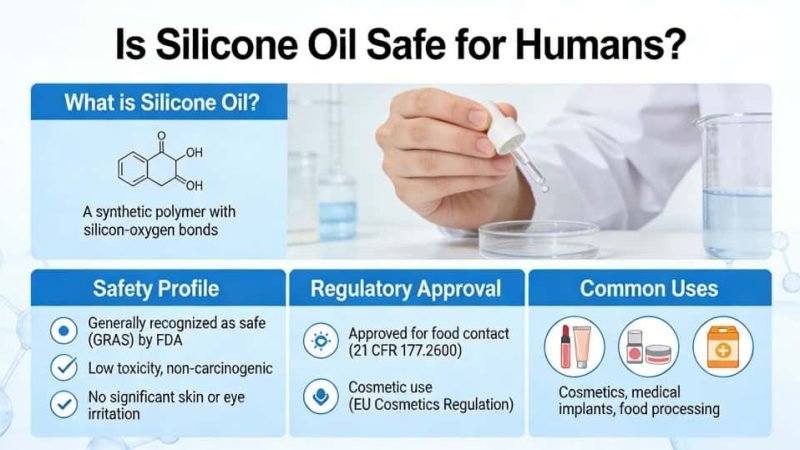
Silicone oil is generally considered safe for humans when used as intended because it is chemically inert, non-toxic, non-irritating, and biologically stable. Medical-grade silicone oils are widely used in pharmaceuticals, ophthalmology, cosmetics, and medical implants. Regulatory agencies such as the FDA, EU regulatory bodies, and international safety organizations classify many silicone oils—especially polydimethylsiloxane (PDMS)—as safe for topical, industrial, and medical applications when manufactured to the appropriate purity standards. However, safety depends on factors such as purity level, exposure route, viscosity, and whether the silicone oil is industrial-grade or medical-grade.
To fully understand the safety profile of silicone oil, it is necessary to explore its chemical structure, toxicological behavior, regulatory approval status, exposure routes, industrial applications, and the differences between various grades of silicone fluids. The following guide provides a comprehensive technical explanation designed for manufacturers, product developers, and industrial buyers.
Silicone oil safety cannot be evaluated through a simple yes-or-no answer because its safety depends on multiple variables including chemical composition, purity, viscosity, intended application, and exposure pathway. The following sections examine the scientific and regulatory evidence behind silicone oil safety in detail.
Silicone oil is highly toxic to humans because it is a synthetic chemical.False
Most silicone oils such as polydimethylsiloxane are considered non-toxic and biologically inert, which is why they are widely used in cosmetics, pharmaceuticals, and medical devices.
Medical-grade silicone oil is widely used in ophthalmic surgery and implantable medical devices.True
Highly purified silicone oils are used in retinal surgery and other medical applications because they are chemically stable, biocompatible, and non-reactive in biological environments.
Chemical Composition and Why Silicone Oil Is Generally Biocompatible
Understanding the safety of silicone oil begins with its molecular structure and chemical stability, which determine how it interacts with biological systems.
Basic Chemical Structure
Most commercial silicone oils are based on polydimethylsiloxane (PDMS) polymers.
The repeating molecular structure can be simplified as:
Si–O–Si backbone with methyl side groups
This structure is fundamentally different from traditional organic hydrocarbons.
Key Structural Characteristics
| Property | Description | Impact on Human Safety |
|---|---|---|
| Siloxane backbone | Flexible Si–O–Si chain | Chemically stable |
| Methyl side groups | Non-polar organic groups | Low reactivity |
| Large polymer molecules | High molecular weight | Poor biological absorption |
| Hydrophobic surface | Repels water | Low skin penetration |
Because silicone oils consist of large polymer chains, they generally do not penetrate biological membranes easily.
Chemical Inertness
Silicone oils exhibit extremely low chemical reactivity.
Important characteristics include:
• resistance to oxidation
• resistance to UV degradation
• resistance to hydrolysis
• resistance to biological enzymes
These properties make silicone oil biologically inert, meaning it rarely reacts with human tissue.
Comparison With Common Industrial Oils
| Property | Silicone Oil | Mineral Oil | Vegetable Oil |
|---|---|---|---|
| Chemical reactivity | Very low | Moderate | Moderate |
| Skin irritation potential | Very low | Low | Low |
| Oxidation stability | Excellent | Moderate | Poor |
| Biological degradation | Very slow | Moderate | Moderate |
Because of this stability, silicone oil is often considered safer than many petroleum-based oils in direct-contact applications.
Toxicological Studies and Safety Evaluations
Extensive toxicological research has been conducted on silicone oils for decades.
Acute Toxicity
Most silicone oils exhibit extremely low acute toxicity.
| Test Parameter | Typical Result |
|---|---|
| Oral LD50 (rat) | > 5000 mg/kg |
| Dermal LD50 | Very low toxicity |
| Eye irritation | Minimal |
| Skin irritation | Minimal |
An LD50 value above 5000 mg/kg indicates very low toxicity.
Chronic Exposure Studies
Long-term exposure studies have shown:
• no significant mutagenic effects
• no carcinogenic classification for PDMS
• minimal systemic absorption
Bioaccumulation
Silicone oils are generally not bioaccumulative in human tissue due to their molecular size and chemical inertness.
Skin Compatibility
Silicone oils are widely used in dermatology because they:
• form breathable protective films
• reduce water loss from skin
• cause minimal allergic reactions
This is why silicone oils appear in many skin-care formulations and medical creams.
Regulatory Approvals and Safety Classifications
One of the strongest indicators of silicone oil safety is its acceptance by global regulatory agencies.
United States FDA
The U.S. Food and Drug Administration (FDA) has approved various silicone oils for multiple applications.
Examples include:
| Application | Status |
|---|---|
| Food processing equipment | Approved |
| Medical devices | Approved |
| Pharmaceuticals | Approved in specific formulations |
| Cosmetics | Allowed |
European Union (EU)
Under EU cosmetic regulations, silicone oils such as dimethicone are permitted ingredients.
Pharmacopeia Standards
High-purity silicone oils are listed in:
• United States Pharmacopeia (USP)
• European Pharmacopeia (Ph. Eur.)
These standards define strict purity specifications.
Cosmetic Ingredient Review (CIR)
The CIR panel concluded that dimethicone and related silicones are safe in cosmetic formulations.
Medical Applications of Silicone Oil
One of the strongest demonstrations of silicone oil safety is its use in medical procedures and implantable devices.
Ophthalmic Surgery
Silicone oil is used in retinal detachment surgery.
Function:
• acts as a tamponade agent
• stabilizes the retina during healing
Typical viscosity used in ophthalmology:
| Silicone Oil Type | Viscosity |
|---|---|
| Low viscosity | 1000 cSt |
| Medium viscosity | 5000 cSt |
| High viscosity | 10000 cSt |
Medical Implants
Silicone materials appear in:
• breast implants
• catheters
• prosthetics
• shunts
Silicone oils contribute to lubrication and stability.
Pharmaceutical Uses
Certain silicone oils are used as:
• anti-foaming agents
• drug delivery components
Their inert nature prevents unwanted chemical reactions with active ingredients.
Cosmetic and Personal Care Safety
Silicone oils are among the most common ingredients in personal care products.
Common Cosmetic Silicone Oils
| Ingredient Name | Function |
|---|---|
| Dimethicone | Skin conditioning |
| Cyclomethicone | Volatile carrier |
| Phenyl trimethicone | Hair shine |
Benefits in Cosmetics
Silicone oils provide:
• smooth skin feel
• moisture barrier
• improved spreadability
• reduced irritation
Skin Barrier Protection
Silicone oils form a semi-occlusive barrier.
This barrier:
• reduces water loss
• protects damaged skin
• remains breathable
This is why silicone oils are often used in scar treatment products and medical ointments.
Industrial Exposure and Workplace Safety
Although silicone oil is generally safe, proper handling is still necessary in industrial environments.
Occupational Exposure
Typical exposure routes include:
• skin contact
• inhalation of aerosolized droplets
• accidental ingestion
Workplace Safety Guidelines
| Safety Measure | Purpose |
|---|---|
| Protective gloves | Prevent prolonged skin contact |
| Eye protection | Avoid splashes |
| Adequate ventilation | Reduce mist inhalation |
Silicone Oil Vapors
High-molecular-weight silicone oils have extremely low volatility, which reduces inhalation risks.
Environmental and Ecological Considerations
While silicone oil is considered safe for humans, environmental impact must also be considered.
Environmental Behavior
| Property | Silicone Oil |
|---|---|
| Water solubility | Insoluble |
| Volatility | Very low |
| Biodegradation | Slow |
Because silicone oils are hydrophobic, they tend to separate from water rather than dissolve.
Ecotoxicity
Studies indicate:
• low toxicity to aquatic organisms
• minimal bioavailability in water
However, large-scale industrial release should still be avoided.
Differences Between Industrial Grade and Medical Grade Silicone Oil
Not all silicone oils are equally safe.
The grade of silicone oil significantly affects safety.
Grade Comparison
| Grade | Purity | Typical Applications |
|---|---|---|
| Industrial grade | Moderate | Lubricants, hydraulic fluids |
| Cosmetic grade | High | Skin and hair products |
| Pharmaceutical grade | Very high | Medicines |
| Medical implant grade | Ultra-high | Surgery and implants |
Impurities in lower-grade silicone oils may include:
• residual catalysts
• volatile siloxanes
• trace solvents
Therefore grade selection is critical for safety.
Potential Risks and Misconceptions
Despite its safety record, silicone oil is sometimes misunderstood.
Misconception 1: Silicone Oils Block Skin Completely
In reality, silicone films are breathable and semi-permeable.
Misconception 2: Silicone Oils Are Toxic Plastics
Silicone oils are chemically distinct from plastics and behave differently in biological systems.
Misconception 3: All Silicones Are Identical
Different silicone compounds vary widely in properties and safety profiles.
Key Safety Takeaways
Based on decades of research and regulatory evaluations, the following conclusions can be drawn:
• silicone oils are chemically inert
• they exhibit extremely low toxicity
• they are widely used in medical and cosmetic applications
• regulatory authorities consider many silicone oils safe
• safety depends on purity and correct application
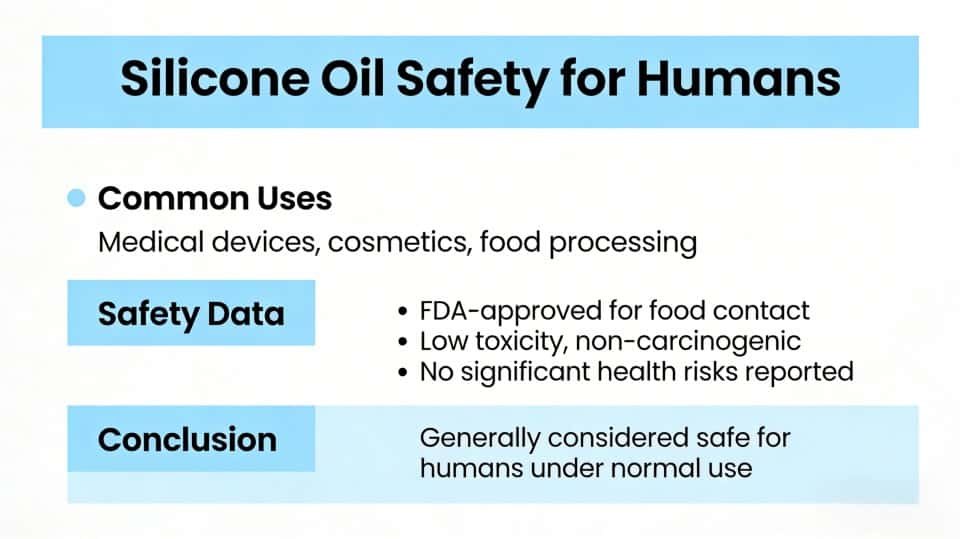
This combination of properties explains why silicone oils are used in medical implants, ophthalmic surgery, pharmaceuticals, and skincare products.
A Practical Note from [Silicon Chemicals](https://siliconchemicals.com/)
If you work with silicone oils in manufacturing, cosmetics formulation, medical devices, or industrial processing, understanding the grade, purity, and intended application is essential for ensuring safety and performance.
At Silicon Chemicals, we supply a wide range of silicone fluids including industrial PDMS oils, cosmetic-grade silicone oils, and specialized modified silicone fluids designed for specific applications. Our technical team can help you choose the correct viscosity, purity level, and formulation compatibility for your product or production process.
If you are sourcing silicone oil for cosmetics, medical devices, industrial lubricants, or specialty formulations, feel free to contact Silicon Chemicals for detailed specifications, technical guidance, and product recommendations.