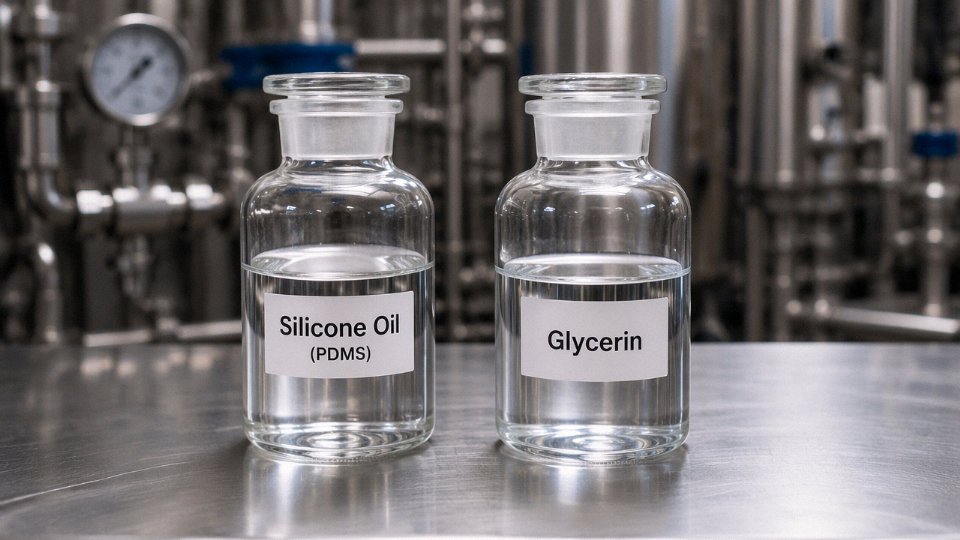
Silicone oil is widely used in industries ranging from cosmetics and pharmaceuticals to electronics, lubricants, and industrial processing. However, many engineers, formulators, and procurement specialists often encounter a fundamental question when designing formulations or selecting materials: does silicone oil dissolve in water? This question becomes critical when silicone fluids are used in emulsions, cooling systems, coatings, or industrial lubricants. If the compatibility between silicone oil and water is misunderstood, it may lead to unstable formulations, phase separation, poor performance, or equipment contamination. Understanding the real interaction between silicone oil and water is therefore essential for chemical engineers, product developers, and industrial buyers alike.
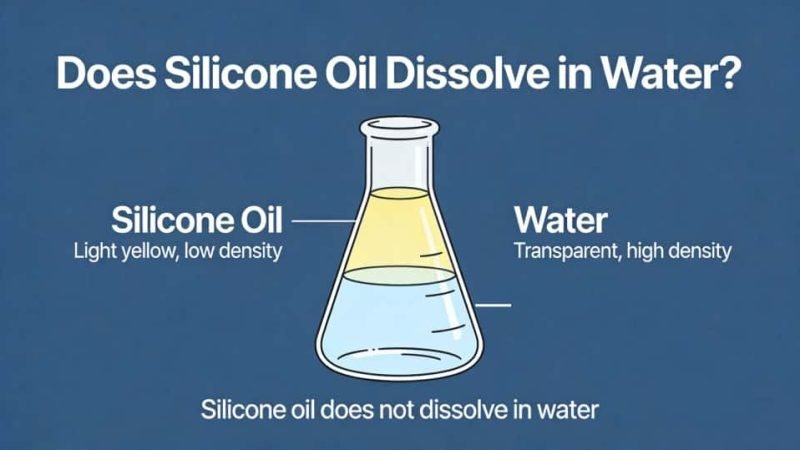
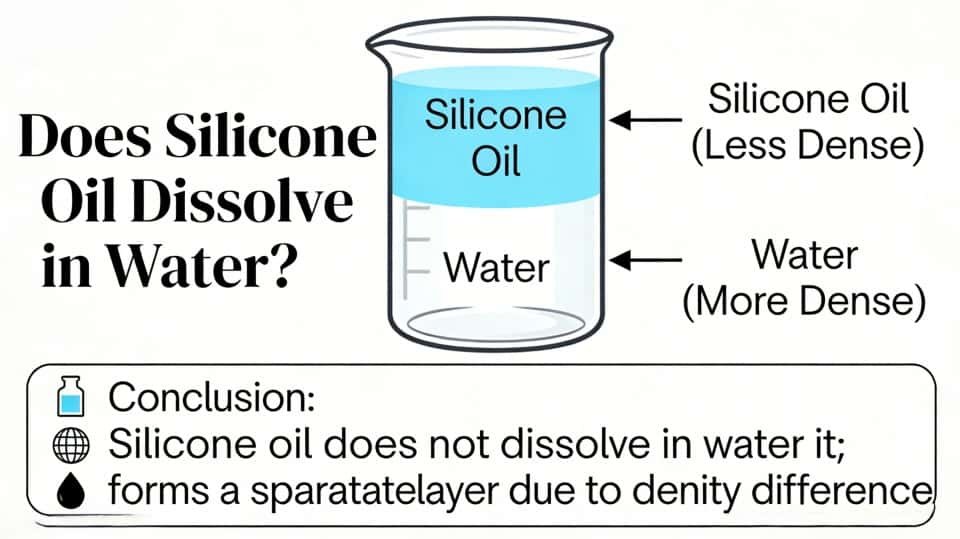
Silicone oil does not dissolve in water because it is a hydrophobic, non-polar polymer with a siloxane backbone (Si-O-Si) and organic side groups that repel water molecules. Instead of dissolving, silicone oil separates into a distinct phase when mixed with water. However, with the help of emulsifiers or surfactants, silicone oil can be dispersed in water to form stable emulsions, which are commonly used in cosmetics, textile finishing, defoaming agents, and industrial lubricants.
To fully understand why silicone oil behaves this way, it is necessary to explore its molecular structure, intermolecular interactions, thermodynamic compatibility with water, and how modern formulations overcome this incompatibility. The following guide explains the chemistry, physics, and industrial implications in detail, helping manufacturers, formulators, and buyers choose the correct silicone fluid for their applications.
Silicone oil dissolves easily in water because it contains oxygen atoms.False
Although silicone oil contains oxygen in its Si–O–Si backbone, its methyl or organic side groups create a highly hydrophobic surface that prevents water molecules from interacting strongly enough to dissolve it.
Silicone oil is generally immiscible with water but can form emulsions using surfactants.True
Silicone oil and water are naturally immiscible, but emulsifiers can stabilize silicone droplets in water, forming silicone emulsions widely used in industry.
Molecular Structure of Silicone Oil and Its Role in Water Insolubility
To understand why silicone oil does not dissolve in water, we must first analyze its chemical architecture and intermolecular behavior. Silicone oils belong to a family of polymers known as polysiloxanes, which are characterized by a repeating silicon-oxygen backbone structure. The most common form used industrially is polydimethylsiloxane (PDMS).
Basic Molecular Structure
The general formula of silicone oil is:
[
[-Si(CH_3)_2-O-]_n
]
This repeating siloxane structure gives silicone oils unique properties that differ significantly from traditional organic oils.
Key Structural Features
| Structural Element | Description | Impact on Water Interaction |
|---|---|---|
| Siloxane Backbone | Si-O-Si repeating chain | Highly flexible molecular structure |
| Methyl Side Groups | Hydrophobic CH₃ groups | Repel water molecules |
| Low Polarity | Weak dipole interactions | Poor compatibility with polar solvents |
| Large Molecular Size | Polymer chain structure | Low diffusion into water |
The presence of methyl groups (-CH₃) attached to silicon atoms is the most important factor influencing water compatibility. These groups create a non-polar molecular surface, preventing hydrogen bonding with water molecules.
Comparison with Water Molecules
Water molecules interact through strong hydrogen bonding networks, which require polar or hydrogen-bond-capable molecules.
| Property | Water | Silicone Oil |
|---|---|---|
| Molecular Polarity | Highly polar | Very low polarity |
| Hydrogen Bonding | Strong | None |
| Surface Energy | High | Very low |
| Solubility Compatibility | Hydrophilic | Hydrophobic |
Because silicone oil lacks the ability to participate in hydrogen bonding, it cannot integrate into water’s molecular network. As a result, the two liquids separate into distinct layers.
Surface Energy Considerations
Another important factor is surface energy.
Silicone oils have extremely low surface tension, typically around 20–21 mN/m, compared with water’s 72 mN/m.
| Liquid | Surface Tension (mN/m) |
|---|---|
| Water | ~72 |
| Silicone Oil (PDMS) | 20–21 |
| Mineral Oil | 30–35 |
| Vegetable Oil | 32–35 |
This low surface energy causes silicone oil to spread easily over surfaces but prevents it from mixing with water.
Thermodynamics of Silicone Oil and Water Mixing
The miscibility of two liquids is determined by thermodynamic principles, particularly Gibbs free energy of mixing.
For two substances to mix spontaneously:
[
Delta G_{mix} = Delta H_{mix} – TDelta S_{mix} < 0
]
Where:
- ΔGmix = Free energy of mixing
- ΔHmix = Enthalpy change
- ΔSmix = Entropy change
Energy Barrier to Mixing
In the case of silicone oil and water:
- ΔHmix is strongly positive because breaking water-water hydrogen bonds requires energy.
- ΔSmix is small because polymer molecules do not mix efficiently with water.
Therefore:
[
Delta G_{mix} > 0
]
This means mixing is thermodynamically unfavorable.
Solubility Parameter Analysis
Chemists often use Hildebrand solubility parameters to predict miscibility.
| Substance | Solubility Parameter (MPa½) |
|---|---|
| Water | ~47.9 |
| Silicone Oil (PDMS) | ~15.5 |
| Mineral Oil | ~16 |
| Hexane | ~14.9 |
Materials with similar solubility parameters tend to dissolve in each other.
Because silicone oil and water differ dramatically in this parameter, they remain immiscible.
What Actually Happens When Silicone Oil Is Mixed With Water?
If silicone oil is poured into water and stirred, several physical phenomena occur.
Phase Separation
Initially, droplets may form due to mechanical mixing, but eventually the system separates into two layers.
| Phase | Composition | Density Behavior |
|---|---|---|
| Upper Layer | Silicone oil | Lower density |
| Lower Layer | Water | Higher density |
Silicone oil usually floats because its density ranges from 0.93–0.98 g/cm³, while water is 1.00 g/cm³.
Droplet Formation
Temporary droplets form due to agitation.
Characteristics of droplets:
- Spherical shape
- High surface tension interface
- Rapid coalescence
Interfacial Tension
The interface between water and silicone oil has a measurable interfacial tension.
| System | Interfacial Tension |
|---|---|
| Water / Silicone Oil | ~40 mN/m |
| Water / Mineral Oil | ~50 mN/m |
Lower interfacial tension allows silicone oil to form droplets more easily than mineral oil.
How Silicone Oil Can Be Dispersed in Water
Although silicone oil does not dissolve in water, it can be dispersed using emulsification techniques.
Silicone Oil Emulsions
An emulsion consists of small droplets of one liquid dispersed within another.
| Emulsion Type | Description | Applications |
|---|---|---|
| Oil-in-Water (O/W) | Silicone droplets in water | Cosmetics, textiles |
| Water-in-Oil (W/O) | Water droplets in silicone oil | Waterproof coatings |
| Microemulsion | Very small droplets (<100 nm) | High-performance formulations |
Role of Surfactants
Surfactants reduce interfacial tension and stabilize droplets.
Typical emulsifiers include:
- Nonionic surfactants
- Silicone polyether copolymers
- Alkylphenol ethoxylates
- Polyethylene glycol derivatives
Droplet Size Distribution
| Emulsion Type | Droplet Size |
|---|---|
| Macroemulsion | 0.1 – 100 µm |
| Nanoemulsion | 20 – 200 nm |
| Microemulsion | <100 nm |
Smaller droplets produce greater stability and transparency.
Industrial Applications Where Silicone Oil Meets Water
Even though silicone oil is water-insoluble, industries frequently combine them.
1 Cosmetic and Personal Care Products
Silicone emulsions are widely used in:
- Hair conditioners
- Skin lotions
- Sunscreens
- Anti-frizz treatments
Benefits include:
- Smooth skin feel
- Water resistance
- Improved spreadability
2 Textile Finishing
Silicone emulsions provide:
- Softening effects
- Fabric lubrication
- Water repellency
3 Defoaming Systems
Silicone oils are powerful defoamers.
| Industry | Application |
|---|---|
| Food processing | Foam suppression |
| Paper manufacturing | Pulp defoaming |
| Wastewater treatment | Foam control |
4 Cooling and Heat Transfer Systems
Silicone oils are used in systems where water contamination may occur.
Advantages include:
- Thermal stability
- Oxidation resistance
- Electrical insulation
Factors That Influence Silicone Oil–Water Interaction
Several variables affect how silicone oil behaves in aqueous environments.
Viscosity
Silicone oils range from 5 cSt to over 1,000,000 cSt.
| Viscosity | Behavior in Water |
|---|---|
| Low viscosity | Forms small droplets easily |
| Medium viscosity | Stable droplets |
| High viscosity | Large droplets |
Temperature
Higher temperatures reduce viscosity and interfacial tension.
Mechanical Energy
High-shear mixing can temporarily disperse silicone oil in water.
Chemical Modification
Modified silicones can improve water compatibility.
Examples include:
| Modified Silicone | Functional Group | Effect |
|---|---|---|
| Silicone polyether | EO/PO groups | Water dispersibility |
| Amino silicone | Amine groups | Improved adhesion |
| PEG-modified silicone | Polyethylene glycol | Increased hydrophilicity |
Environmental and Safety Considerations
Silicone oils are considered chemically inert and environmentally stable.
Environmental Behavior
| Property | Silicone Oil |
|---|---|
| Biodegradability | Slow |
| Toxicity | Low |
| Volatility | Very low |
Because they do not dissolve in water, silicone oils tend to separate and accumulate in surface films rather than dispersing widely.
Wastewater Treatment
In wastewater systems:
- Silicone oils float
- They can be removed by skimming or filtration
Comparative Solubility of Silicone Oil in Different Solvents
Although silicone oil does not dissolve in water, it dissolves readily in many organic solvents.
| Solvent | Solubility |
|---|---|
| Hexane | High |
| Toluene | High |
| Xylene | High |
| Mineral Oil | High |
| Water | Insoluble |
This compatibility makes silicone oils useful as lubricants and additives in organic systems.
Key Takeaways
The interaction between silicone oil and water is governed by fundamental chemical and physical principles.
Important conclusions include:
- Silicone oil is hydrophobic and non-polar.
- It does not dissolve in water.
- It forms separate phases when mixed with water.
- Stable mixtures require emulsifiers or surfactants.
- Silicone emulsions enable widespread industrial use.
These properties explain why silicone oils are widely used in water-repellent coatings, lubricants, cosmetics, and industrial defoamers.
A Practical Note from [Silicon Chemicals](https://siliconchemicals.com/)
If you work with silicone fluids in industrial processes, cosmetics formulations, or specialty coatings, understanding the interaction between silicone oil and water is essential for choosing the correct material and formulation method.
At Silicon Chemicals, we supply a wide range of silicone fluids, modified silicones, and silicone emulsions designed for different industrial systems. Whether you need pure PDMS fluids, water-based silicone emulsions, or custom-formulated silicone additives, our technical team can help you select the right product for your application.
If you are developing a formulation or sourcing silicone oil for production, feel free to reach out to Silicon Chemicals for technical guidance, samples, or detailed specifications.