Lubrication plays a critical role in nearly every mechanical system, from automotive engines and industrial gearboxes to precision instruments and consumer electronics. Without effective lubrication, friction between moving parts generates heat, accelerates wear, and ultimately leads to mechanical failure. For more than a century, traditional lubricants—primarily mineral oils and synthetic hydrocarbon oils—have been used to reduce friction and protect machinery. However, as industrial systems have evolved, operating environments have become increasingly demanding. Modern equipment may operate at extremely high temperatures, extremely low temperatures, or in chemically aggressive environments where conventional lubricants struggle to maintain stability. These challenges have led engineers and materials scientists to explore alternative lubrication technologies, including silicone oil.
Silicone oil is not inherently “better” than traditional lubricants; instead, it offers superior performance in specific conditions such as extreme temperatures, chemically reactive environments, electrical insulation systems, and applications requiring low surface tension or long-term stability. Traditional lubricants, particularly mineral oils and synthetic hydrocarbon lubricants, typically provide stronger load-bearing lubrication and better performance in heavy mechanical systems such as engines and gearboxes. Therefore, whether silicone oil is better than conventional lubricant depends entirely on the application requirements, operating conditions, and mechanical load involved.
Understanding the relationship between silicone oil and conventional lubricants requires examining their chemical structures, lubrication mechanisms, physical properties, and performance in different industrial environments.
Silicone oil provides superior thermal stability compared with most conventional lubricants.True
The silicon–oxygen backbone of silicone oil polymers has higher bond energy than hydrocarbon lubricants, allowing silicone oils to remain stable across a wider temperature range.
Understanding What Lubricants Are
A lubricant is any substance used to reduce friction between moving surfaces. Lubricants form a thin film between contacting parts, preventing direct metal-to-metal contact and reducing wear.
Lubricants perform several critical functions in mechanical systems:
• reducing friction between moving parts
• preventing mechanical wear
• dissipating heat generated by friction
• protecting surfaces from corrosion
• removing debris and contaminants
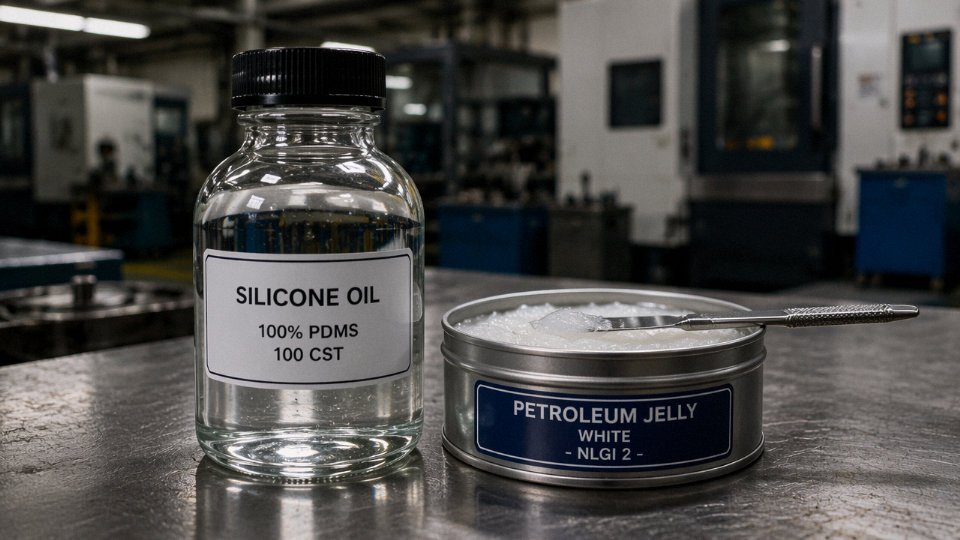
Lubricants exist in many forms, including oils, greases, solid lubricants, and specialty fluids.
The most common lubricants used in industry include:
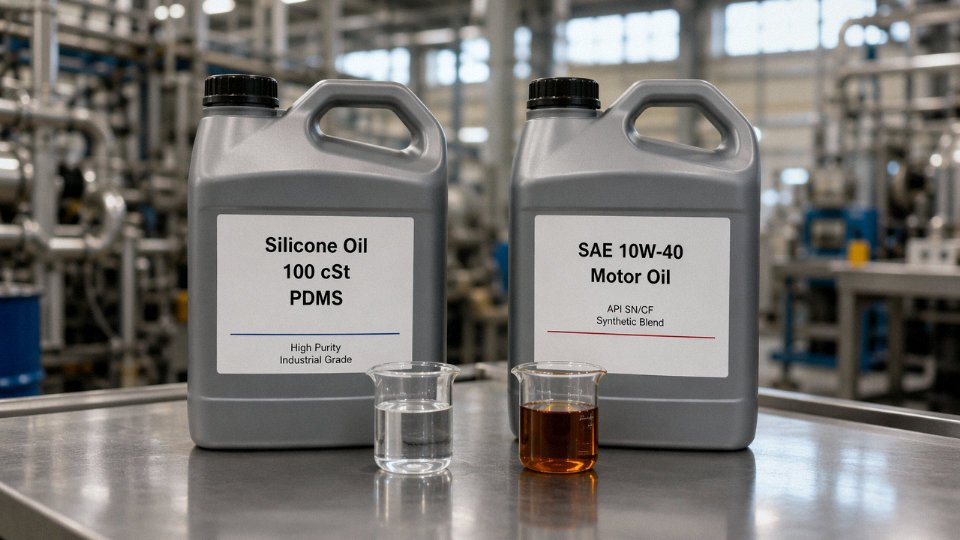
• mineral oils derived from petroleum
• synthetic hydrocarbon oils
• ester-based lubricants
• polyalkylene glycol fluids
These lubricants are specifically designed to perform well under mechanical load.
Table: Major Types of Conventional Lubricants
| Lubricant Type | Chemical Base | Typical Applications |
|---|---|---|
| Mineral Oil | Petroleum hydrocarbons | Automotive engines |
| Synthetic Hydrocarbon (PAO) | Engineered hydrocarbons | Industrial gear systems |
| Ester Lubricants | Organic esters | Aviation lubrication |
| PAG Fluids | Polyalkylene glycol | Compressors and gears |
Each lubricant type is optimized for specific operating environments.
Understanding Silicone Oil
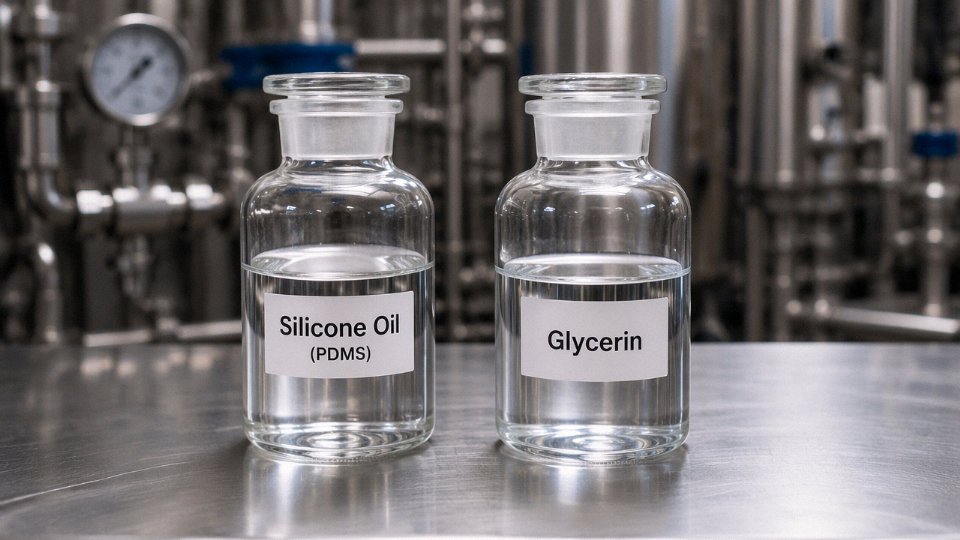
Silicone oil is a completely different type of fluid compared with conventional lubricants. Instead of being based on carbon-hydrogen molecules, silicone oil consists of silicon–oxygen polymer chains.
Most commercial silicone oils are based on polydimethylsiloxane (PDMS) chemistry.
This molecular structure gives silicone oil several unique properties:
• exceptional thermal stability
• excellent oxidation resistance
• stable viscosity across wide temperatures
• low surface tension
• chemical inertness
These characteristics make silicone oil valuable in specialized applications.
Table: Basic Properties of Silicone Oil
| Property | Typical Performance |
|---|---|
| Thermal stability | −50 °C to 250 °C |
| Oxidation resistance | Excellent |
| Surface tension | Very low |
| Electrical insulation | High |
These properties differentiate silicone oil from most conventional lubricants.
Structural Differences Between Silicone Oil and Conventional Lubricants
The performance differences between silicone oil and conventional lubricants originate from their molecular structures.
Conventional lubricants consist of hydrocarbon chains made of carbon and hydrogen atoms.
Silicone oil, however, consists of repeating silicon-oxygen bonds.
Table: Molecular Structure Comparison
| Feature | Silicone Oil | Conventional Lubricant |
|---|---|---|
| Molecular backbone | Si–O–Si polymer chain | Carbon-hydrogen chains |
| Bond energy | High | Moderate |
| Thermal stability | Excellent | Moderate |
| Chemical reactivity | Low | Moderate |
These structural differences influence how each fluid behaves under different conditions.
Thermal Performance Comparison
One of the most important advantages of silicone oil is its ability to operate across extremely wide temperature ranges.
Conventional lubricants often degrade when exposed to high temperatures because hydrocarbon molecules begin to oxidize and break down.
Silicone oils maintain stability because silicon-oxygen bonds are stronger than carbon-carbon bonds.
Table: Temperature Range Comparison
| Fluid Type | Typical Temperature Range |
|---|---|
| Mineral Oil | −10 °C to 120 °C |
| Synthetic Hydrocarbon | −30 °C to 180 °C |
| Silicone Oil | −50 °C to 250 °C |
This makes silicone oil ideal for high-temperature or extreme climate environments.
Oxidation and Chemical Stability
Oxidation is one of the primary causes of lubricant degradation. When oils oxidize, they form sludge, acids, and varnish deposits that reduce lubrication effectiveness.
Silicone oils exhibit excellent oxidation resistance due to their chemically stable backbone.
Advantages include:
• longer operational lifespan
• minimal sludge formation
• stable chemical composition over time
Conventional lubricants often require additives to slow oxidation.
Viscosity Stability
Viscosity determines how easily a lubricant flows. If viscosity changes significantly with temperature, lubrication performance may become unpredictable.
Silicone oils exhibit low viscosity-temperature sensitivity, meaning their viscosity remains relatively stable across wide temperature changes.
Table: Viscosity Behavior
| Property | Silicone Oil | Conventional Oil |
|---|---|---|
| Low-temperature fluidity | Excellent | Moderate |
| High-temperature viscosity retention | Excellent | Moderate |
| Viscosity stability | High | Variable |
This property is valuable in aerospace and precision instruments.
Lubrication Under Heavy Load
Although silicone oil performs well in many environments, traditional lubricants often perform better in heavy mechanical systems.
Hydrocarbon lubricants can form strong boundary lubrication films and work effectively with additives designed for extreme-pressure conditions.
Silicone oils have relatively low intermolecular attraction, which can limit their load-bearing capability.
Table: Load-Bearing Performance
| Property | Silicone Oil | Conventional Lubricant |
|---|---|---|
| Film strength | Moderate | High |
| Extreme pressure lubrication | Limited | Excellent |
| Gear lubrication | Limited | Excellent |
Because of this difference, conventional lubricants remain dominant in engines and gearboxes.
Electrical Insulation Advantages
Silicone oil offers another advantage not commonly provided by traditional lubricants: excellent electrical insulation.
Silicone oils are widely used as dielectric fluids in electrical systems.
Applications include:
• transformers
• capacitors
• electronic cooling systems
Conventional lubricants generally provide lower dielectric performance.
Table: Electrical Properties
| Property | Silicone Oil | Conventional Oil |
|---|---|---|
| Dielectric strength | High | Moderate |
| Electrical conductivity | Very low | Moderate |
This makes silicone oil valuable in electronics and electrical engineering.
Surface Interaction and Material Compatibility
Silicone oil interacts differently with surfaces compared with conventional lubricants.
Because silicone oil has extremely low surface tension, it spreads easily across surfaces and forms thin films.
This property provides benefits such as:
• excellent wetting ability
• uniform surface coverage
• reduced friction in small mechanical systems
However, conventional lubricants may adhere more strongly to metal surfaces under heavy loads.
Typical Applications of Silicone Oil
Silicone oil is commonly used in:
• damping fluids in mechanical systems
• electrical insulating fluids
• cosmetic formulations
• mold release agents
• heat transfer fluids
These applications take advantage of silicone oil’s stability and chemical inertness.
Typical Applications of Conventional Lubricants
Conventional lubricants remain essential in many mechanical systems.
Typical uses include:
• automotive engines
• industrial gearboxes
• hydraulic systems
• heavy machinery
In these environments, strong lubrication performance and lower cost are critical.
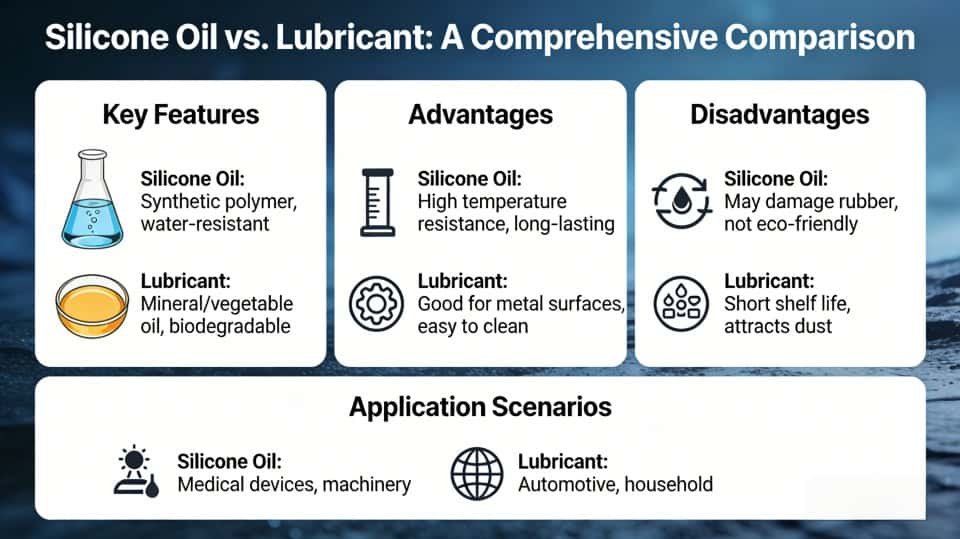
Key Comparison Summary
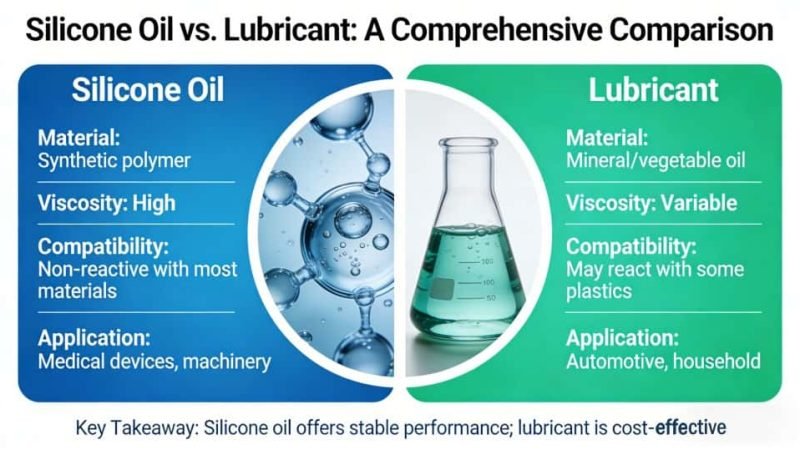
Table: Silicone Oil vs Conventional Lubricant
| Property | Silicone Oil | Conventional Lubricant |
|---|---|---|
| Thermal stability | Excellent | Moderate |
| Oxidation resistance | Excellent | Moderate |
| Viscosity stability | Excellent | Moderate |
| Load-bearing lubrication | Moderate | Excellent |
| Electrical insulation | Excellent | Limited |
| Cost | High | Lower |
This comparison shows that each fluid type has distinct strengths.
Conclusion
Silicone oil is not inherently better than conventional lubricants, but it excels in specialized applications where traditional lubricants struggle. Its silicon-oxygen molecular structure provides exceptional thermal stability, chemical inertness, viscosity stability, and electrical insulation properties. These characteristics make silicone oil particularly valuable in high-temperature systems, electrical equipment, precision mechanical devices, and cosmetic formulations.
However, conventional lubricants such as mineral oils and synthetic hydrocarbon oils remain superior for heavy-duty mechanical lubrication because they provide stronger load-bearing performance and significantly lower cost.
Choosing between silicone oil and traditional lubricants requires careful evaluation of operating temperature, mechanical load, environmental conditions, and economic factors.
Speak With the Silicone Materials Experts at [Silicon Chemicals](https://siliconchemicals.com/)
Selecting the correct silicone fluid or lubricant for your application can significantly affect equipment performance, durability, and maintenance costs.
At Silicon Chemicals, we supply a comprehensive range of high-quality silicone oils and specialty silicone fluids used in industrial manufacturing, electronics, coatings, cosmetics, and advanced materials.
If you are comparing silicone oils with conventional lubricants or selecting the right silicone fluid for your project, the team at Silicon Chemicals is always ready to help you identify the most effective solution.