Many modern industrial materials fail not because of poor raw materials but because the components do not bond properly. Engineers frequently encounter issues such as coatings peeling off metal, rubber separating from reinforcement fillers, composites losing mechanical strength, or adhesives failing under heat and moisture. These failures often stem from weak interfaces between inorganic materials (glass, metal, silica) and organic polymers (plastics, rubbers, resins). When the interface is weak, entire products—from automotive tires to electronics coatings—can degrade prematurely, leading to reduced durability, safety risks, and higher maintenance costs. Silane chemistry provides an elegant molecular solution to this problem by acting as a chemical bridge between incompatible materials, dramatically improving adhesion, durability, and performance across countless industrial sectors.
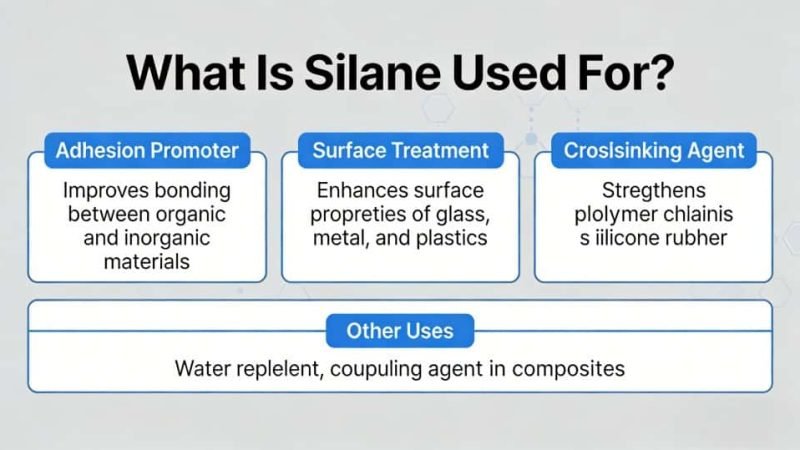
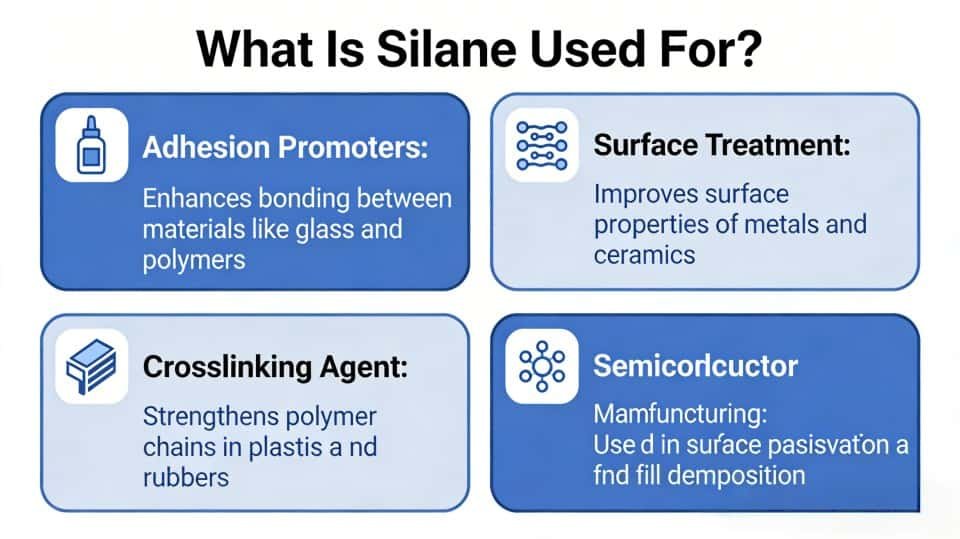
Silane is primarily used as a coupling agent, adhesion promoter, surface modifier, and crosslinking agent in industrial materials. It enables strong chemical bonding between inorganic substrates (such as glass, silica, metal, or minerals) and organic polymers (such as plastics, rubbers, coatings, and adhesives). Because of this bridging capability, silane compounds are widely applied in industries including coatings, rubber manufacturing, fiberglass composites, adhesives and sealants, electronics encapsulation, construction materials, and semiconductor manufacturing. By improving interface bonding, silane significantly enhances mechanical strength, moisture resistance, durability, and long-term stability of materials.
To fully understand why silane compounds have become indispensable across modern industries, it is necessary to explore how they work at the molecular level, the different categories of silane chemicals available, and the wide range of industrial applications they enable. From tire manufacturing and advanced composites to semiconductor production and waterproof coatings, silane chemistry plays a critical role in enabling materials that are stronger, lighter, and more durable.
Silane coupling agents chemically bond inorganic materials to organic polymers.True
Silane molecules contain both hydrolyzable groups that bond with inorganic surfaces and organic functional groups that react with polymers, forming a chemical bridge between the two materials.
Understanding What Silane Is and Why It Matters
Silane refers broadly to a group of silicon-containing compounds derived from the base molecule SiH₄ (silane gas). In industrial chemistry, however, the term more commonly refers to organosilanes, which are molecules containing silicon atoms bonded to organic functional groups and hydrolyzable groups such as alkoxy or chloro substituents. These molecules are designed to perform a very specific role: they act as molecular connectors that can react with both inorganic and organic materials.
The importance of silane becomes clear when examining how modern materials are constructed. Many high-performance materials are composites made from two fundamentally different components. For example, fiberglass composites consist of glass fibers embedded in polymer resins, tire rubber contains silica fillers dispersed in elastomers, and coatings often contain mineral pigments dispersed in polymer matrices. Without chemical compatibility between these components, the interface becomes a weak point where cracks, moisture penetration, or mechanical failure can occur.
Silane molecules solve this interface problem through a dual-function molecular structure. One end of the molecule contains hydrolyzable groups that react with hydroxyl groups on inorganic surfaces such as glass, silica, or metal oxides. The other end contains organic functional groups that react with polymers, resins, or elastomers. As a result, silane molecules form a chemical bridge between two otherwise incompatible materials.
This molecular bridging function dramatically improves material performance in several ways:
• Improved adhesion between fillers and polymer matrices
• Increased mechanical strength and durability
• Enhanced moisture resistance
• Improved chemical resistance
• Better dispersion of fillers
• Longer service life of materials
Because these performance improvements directly translate into stronger and more reliable products, silane chemistry has become fundamental in industries ranging from automotive manufacturing to electronics packaging.
Key Types of Silane Compounds Used in Industry
Not all silanes perform the same role. Industrial silane chemistry includes multiple functional categories depending on the reactive groups attached to the silicon atom. Each category is designed for specific materials and industrial applications.
Table: Major Types of Industrial Silane Compounds
| Silane Type | Typical Functional Group | Main Function | Typical Applications |
|---|---|---|---|
| Amino Silanes | –NH₂ | Adhesion promoter | Coatings, adhesives |
| Epoxy Silanes | Epoxide group | Crosslinking agent | Epoxy resins |
| Vinyl Silanes | –CH=CH₂ | Polymer bonding | Plastics, rubber |
| Methacryloxy Silanes | Methacrylate | UV curing resins | Composites |
| Mercapto Silanes | –SH | Rubber bonding | Tire manufacturing |
| Alkyl Silanes | Hydrophobic chain | Water repellent | Construction materials |
These functional silanes are engineered to match specific polymer systems, ensuring that the chemical bonding process occurs effectively.
How Silane Works at the Molecular Level
To appreciate the versatility of silane compounds, it is important to examine the three primary reaction stages that occur when silane is applied to a surface.
First, the hydrolyzable groups on the silane molecule react with moisture in the environment to form silanol groups (Si–OH). This hydrolysis process activates the molecule and prepares it for bonding with inorganic surfaces.
Second, the silanol groups react with hydroxyl groups present on inorganic materials such as glass, silica, or metal oxides. This reaction forms strong siloxane bonds (Si–O–Si) that anchor the silane molecule to the surface.
Third, the organic functional group on the opposite end of the silane molecule reacts with the polymer matrix. Depending on the functional group, this reaction may involve polymerization, crosslinking, or chemical bonding with the polymer chains.
Table: Silane Reaction Mechanism
| Reaction Stage | Chemical Process | Result |
|---|---|---|
| Hydrolysis | Si–OR + H₂O → Si–OH | Activation of silane |
| Condensation | Si–OH + Surface OH → Si–O–Si | Bonding to inorganic surface |
| Polymer Reaction | Functional group reacts with polymer | Bonding to organic matrix |
Through these reactions, silane effectively integrates two different materials into a single chemically bonded system.
Major Industrial Uses of Silane
The industrial uses of silane extend across many sectors where improved adhesion, durability, or moisture resistance is required.
Rubber and Tire Manufacturing
One of the largest uses of silane is in the tire industry, where silane coupling agents are used to bond silica fillers to rubber polymers. Silica fillers improve tire rolling resistance and fuel efficiency, but they do not naturally bond well with rubber.
Silane solves this compatibility issue by bonding silica particles to rubber chains. The result is improved mechanical strength, better abrasion resistance, and lower rolling resistance.
Benefits in tire manufacturing include:
• Improved fuel efficiency
• Longer tire lifespan
• Enhanced wet traction
• Reduced heat buildup
Modern “green tires” rely heavily on silane coupling technology.
Fiberglass and Composite Materials
Silane is widely used in fiberglass composites where glass fibers must bond strongly with polymer resins such as polyester or epoxy.
Without silane treatment, the interface between glass and resin becomes weak, leading to delamination and mechanical failure. Silane surface treatment dramatically improves fiber-matrix adhesion.
Industries that rely heavily on silane-treated composites include:
• Aerospace
• Automotive
• Wind energy
• Marine structures
• Construction materials
Adhesives and Sealants
Silane is commonly used as an adhesion promoter in adhesives and sealants. By modifying surfaces and improving bonding strength, silane allows adhesives to adhere strongly to glass, metal, ceramic, and plastic substrates.
This property is particularly important in structural adhesives used in automotive assembly, building construction, and electronics manufacturing.
Coatings and Paints
Silane compounds improve coating adhesion to difficult substrates such as aluminum, steel, and glass. They also enhance corrosion resistance and moisture protection.
In coatings, silane serves multiple roles:
• Adhesion promoter
• Crosslinking agent
• Surface modifier
• Corrosion inhibitor
Silane-modified coatings are widely used in marine, automotive, and architectural applications.
Electronics and Semiconductor Manufacturing
In electronics manufacturing, ultra-pure silane gas (SiH₄) is used as a precursor in chemical vapor deposition processes. It is essential for producing high-purity silicon layers used in semiconductors, solar cells, and flat panel displays.
This application is entirely different from organosilane chemistry but represents another major industrial use of silane compounds.
Construction and Building Materials
Silane compounds are widely used as hydrophobic treatments for concrete, masonry, and stone. When applied to porous surfaces, silane penetrates deeply and reacts with mineral substrates to create a water-repellent barrier.
This treatment prevents water infiltration while allowing vapor diffusion, making it ideal for protecting bridges, buildings, and infrastructure.
Silane Applications by Industry
Table: Silane Applications Across Major Industries
| Industry | Silane Function | Example Applications |
|---|---|---|
| Automotive | Coupling agent | Tire fillers, adhesives |
| Electronics | Semiconductor precursor | Silicon deposition |
| Construction | Water repellent | Concrete protection |
| Coatings | Adhesion promoter | Anti-corrosion coatings |
| Composites | Fiber treatment | Fiberglass reinforcement |
| Plastics | Surface modifier | Filler dispersion |
These applications demonstrate how silane chemistry enhances both structural materials and advanced technologies.
Advantages of Using Silane in Industrial Materials
The widespread adoption of silane compounds across industries is driven by several key advantages that directly impact product performance and durability.
First, silane significantly improves adhesion between dissimilar materials. This is particularly important in composites and filled polymers where interfacial bonding determines mechanical strength.
Second, silane enhances moisture resistance by creating hydrophobic surface layers that prevent water penetration. This property is valuable in coatings, construction materials, and electronics.
Third, silane improves filler dispersion in polymer matrices. Better dispersion leads to more uniform mechanical properties and improved product quality.
Fourth, silane increases long-term durability by preventing interface degradation under mechanical stress or environmental exposure.
These advantages make silane a critical additive in high-performance materials.
Key Factors When Choosing a Silane
Selecting the correct silane compound depends on several important technical factors.
Table: Silane Selection Criteria
| Factor | Importance | Example |
|---|---|---|
| Polymer compatibility | Determines bonding efficiency | Epoxy silane for epoxy resin |
| Substrate type | Surface chemistry compatibility | Silica vs metal oxide |
| Environmental conditions | Moisture and temperature stability | Outdoor coatings |
| Processing conditions | Reaction temperature | Rubber curing |
Correct selection ensures optimal performance and avoids processing issues.
Emerging Applications of Silane Technology
Silane chemistry continues to evolve as new materials and technologies emerge. Recent innovations include:
• Silane-modified polymers (SMP) used in hybrid adhesives
• Nanotechnology surface treatments
• Self-healing coatings
• Advanced composite reinforcement systems
• High-performance battery materials
These emerging applications highlight the ongoing importance of silane chemistry in advanced materials science.
Conclusion
Silane compounds play a fundamental role in modern materials engineering by enabling strong chemical bonding between inorganic and organic materials. Through their unique molecular structure, silane molecules act as bridges that connect mineral surfaces, metals, and glass with polymer systems. This capability dramatically improves adhesion, durability, mechanical strength, and environmental resistance across countless products.
From tire manufacturing and composite materials to semiconductor fabrication and waterproof construction treatments, silane chemistry has become a cornerstone technology that enables high-performance materials used in everyday life and advanced industrial systems.
Talk With the Experts at [Silicon Chemicals](https://siliconchemicals.com/)
If you are selecting silane coupling agents, surface modifiers, or specialty organosilane compounds for your products, the right formulation can make a dramatic difference in performance and durability.
At Silicon Chemicals, we work closely with manufacturers, material engineers, and chemical distributors worldwide to supply high-purity silane products for coatings, rubber, adhesives, composites, and advanced materials.
If you need technical guidance on choosing the right silane or sourcing reliable silane chemicals, reach out to the Silicon Chemicals team. We are always happy to help you find the best solution for your application.