Specifying the wrong silicone grade on a drawing costs more than a material upcharge. A procurement manager who orders solid silicone sheet stock when the design calls for liquid silicone rubber ends up with parts that won’t hold dimensional tolerance, a press operator fighting 6-minute cycles where 30-second injection was engineered in, and a scrap rate that quietly eats the margin on the whole production run before anyone traces the root cause back to a material misclassification made at the quoting stage.
Silicone and liquid silicone rubber (LSR) are both platinum- or peroxide-cured polydimethylsiloxane-based elastomers, but they differ fundamentally in viscosity, processing method, and achievable precision. Solid silicone is a high-consistency rubber processed by compression or extrusion; LSR is a two-part, pumpable compound designed for closed-mold injection with cycle times of 15–60 seconds versus 3–10 minutes for compression molding. That processing gap drives separate supply chains, tooling investments, and part geometries.
What makes this comparison harder than it looks is that both materials can produce a 40 Shore A gasket that feels identical in your hand — yet one got there through a heated press and a hand-loaded preform, the other through a fully automated injection cell running lights-out. The chemistry is close enough that suppliers sometimes blur the line in datasheets; the manufacturing implications are anything but close.
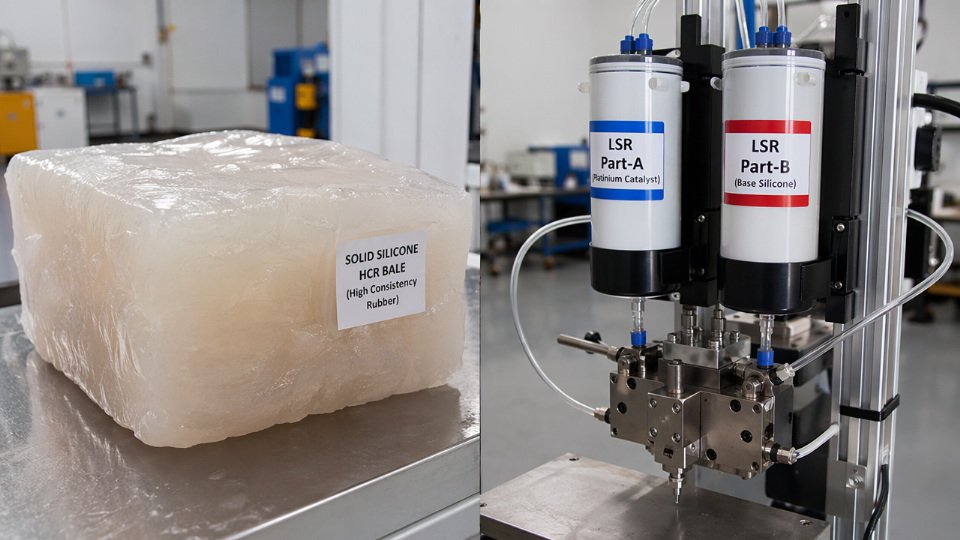
Shared Chemistry, Different Physical Forms: The Polydimethylsiloxane (PDMS) Foundation
Every commercial silicone product — whether a translucent gum bale sitting on a compounding floor or a two-part injectable liquid loaded into an LSR dosing unit — starts from the same molecular architecture: a backbone of alternating silicon and oxygen atoms in a repeating Si–O–Si chain. That backbone is not incidental. The Si–O bond angle sits around 144°, substantially wider than the C–C bond angle in organic polymers, which gives the chain unusual rotational freedom and low torsional resistance. Bond energy runs approximately 452 kJ/mol, meaningfully higher than a typical C–C bond (~347 kJ/mol). Those two facts together explain why all silicones — regardless of form — share a cluster of properties: continuous-use thermal stability from roughly –60°C to +250°C (with specialty grades pushing beyond that), inherent UV resistance without added stabilizers, low surface energy in the 20–25 mN/m range, and reliable electrical insulation across a wide frequency spectrum.
So when a procurement manager asks whether solid silicone and liquid silicone rubber are “completely different materials,” the accurate answer is no — and also yes. Same backbone, radically different molecular weight distribution, crosslink precursors, and processing behavior.
How Chain Length Determines Whether You’re Holding a Fluid or a Brick
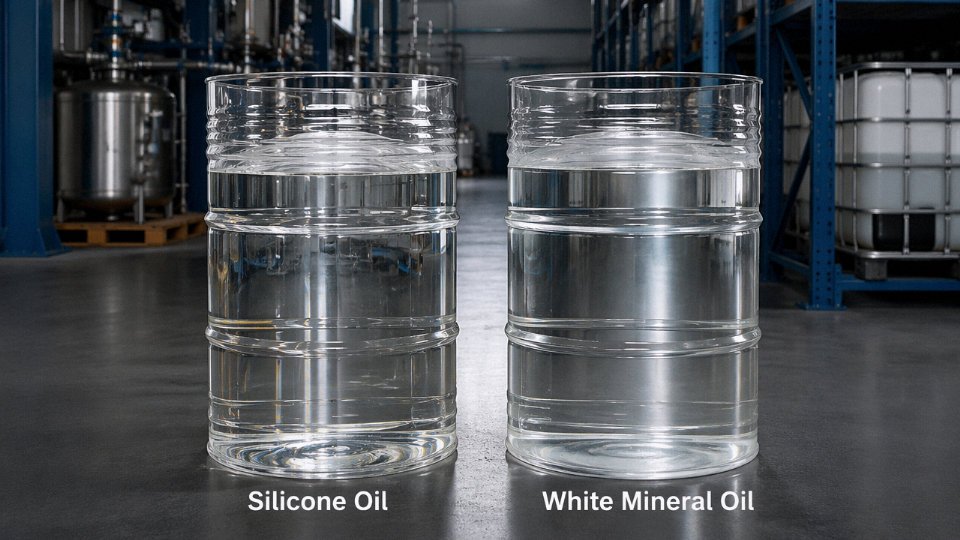
PDMS physical state is almost entirely a function of average molecular weight and what compounders add to it. Short-chain PDMS oligomers produce fluids with viscosities ranging from around 1 cSt (water-thin) up to 1,000,000 cSt (barely pourable, resembling thick honey), depending on degree of polymerization. As chains grow longer and molecular weight climbs into the hundreds of thousands of g/mol, the material transitions to a gum — the raw stock used to make high-consistency rubber (HCR). Add reinforcing silica, cure agents, and processing aids to that gum, and you have what most people call “solid silicone” or HCR compound, characterized by Williams plasticity numbers typically in the 100–200 range.
LSR occupies a different region of that molecular weight map. The base polymers are lower-to-medium molecular weight vinyl-functional PDMS, deliberately kept at dynamic viscosities between roughly 50,000 and 300,000 mPa·s before cure. That keeps the blended compound pourable or injectable while still delivering a fully crosslinked elastomeric network after curing.
The Four Commercial Classes and Their Processing Signatures
| Material Class | Base Polymer MW Range | Pre-Cure Physical State | Cure Chemistry | Post-Cure Network Density |
|---|---|---|---|---|
| Silicone fluids | Low (typically 1,000–150,000 g/mol) | Free-flowing liquid, 1–300,000 cSt | None (functional fluids) | Uncrosslinked |
| RTV-1 / RTV-2 compounds | Low to medium | Paste to low-viscosity liquid | Moisture cure (RTV-1); tin or platinum (RTV-2) | Low to moderate |
| HCR / solid silicone | Very high (300,000–800,000+ g/mol) | Gum-like solid, Williams plasticity 100–200 | Peroxide or platinum | Moderate to high |
| LSR | Medium (typically 50,000–250,000 g/mol) | Injectable liquid, 50,000–300,000 mPa·s | Platinum-catalyzed hydrosilylation (addition cure) | High, tightly controlled |
Crosslinking Chemistry: Where HCR and LSR Genuinely Diverge
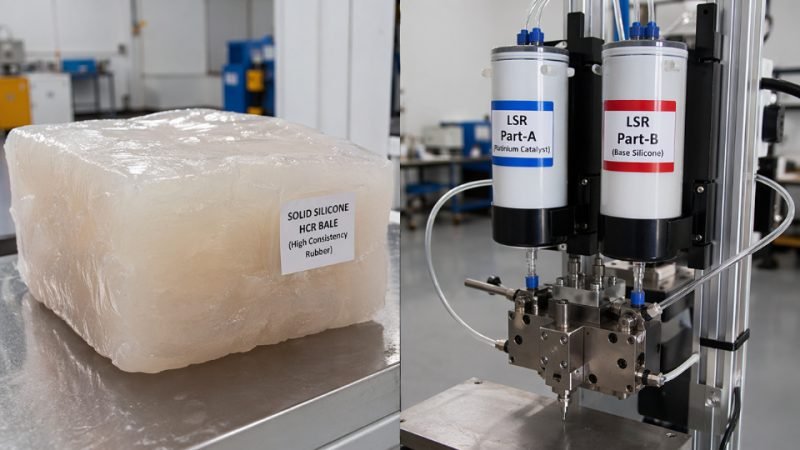
This is where processing engineers need precision. HCR cure can use either organic peroxide (which generates free radicals to bridge polymer chains, leaving oxidative byproducts that require post-bake in medical or food applications) or platinum-catalyzed addition cure. LSR exclusively uses platinum-catalyzed hydrosilylation. Part A carries vinyl-functional PDMS; Part B carries a hydride-functional crosslinker. Mixed at a 1:1 ratio at the injection point, they react rapidly at mold temperatures typically between 150°C and 200°C. No byproducts are released, and the platinum catalyst remains embedded in the cured matrix at concentrations typically in the parts-per-million range.
LSR's platinum-catalyzed hydrosilylation cure produces no volatile byproducts, which is why post-cure steps are optional in most LSR applications but often mandatory for peroxide-cured HCR used in medical or food-contact parts.True
Peroxide cure generates organic acid decomposition products (e.g., from dicumyl peroxide) that require extraction via post-bake at 200°C for 1–4 hours to meet ISO 10993 or FDA 21 CFR compliance. Addition-cure systems leave no such residuals, though some formulators still specify a post-cure to stabilize dimensional tolerances.
An operational warning worth internalizing: platinum catalyst in LSR is poisoned by sulfur compounds, tin residues, nitrogen-containing materials, and certain adhesives. In a plant running both tin-catalyzed RTV and LSR on shared tooling or mixing equipment, cross-contamination will cause inhibition — surfaces simply won’t cure, producing a sticky, unusable part. Keep the material streams physically separated.
SiliconChemicals manufactures both the upstream PDMS base polymers and the compounded, ready-to-process HCR and LSR grades. For procurement teams managing supply chain risk, that vertical integration means the polymer molecular weight distribution, filler loading, and catalyst package are controlled at a single source rather than assembled from multiple suppliers whose lot-to-lot variability compounds at each stage.
High-Consistency Rubber (HCR) Explained: Properties, Grades, and Processing Windows
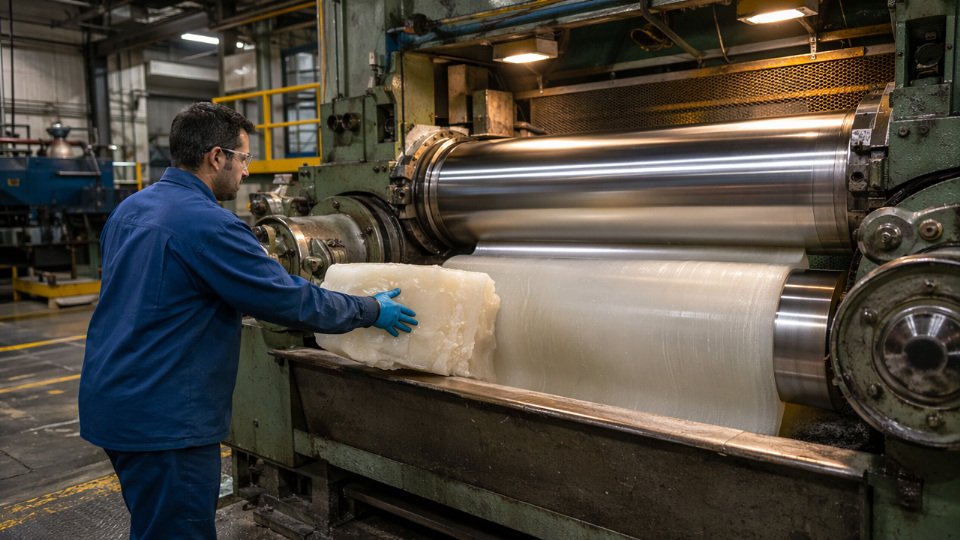
High-consistency rubber — also called solid silicone rubber or HCR — is the older, more established form of the two. It starts as a high-molecular-weight PDMS gum, typically in the 500,000–800,000 g/mol range, compounded with reinforcing filler and curing agents before being supplied as a solid bale or pre-formed slab. That molecular weight is what gives HCR its characteristic dough-like body at room temperature: stiff enough to hold a shape on a mill roll, tacky enough to laminate plies together, but nowhere near flowable enough to pump through a metering system.
Raw Material Form and Williams Plasticity
When you receive an HCR bale at goods-in, the first quality check most compounders run is Williams plasticity, which typically falls in the 100–200 range for standard grades (exact target depends on filler loading and intended process — extrusion grades sit toward the softer end, compression-molding stocks toward the stiffer end). Fumed silica at 15–45 phr is the primary reinforcing agent; precipitated silica appears in lower-cost or lower-transparency grades. Get plasticity wrong and you pay for it immediately: a stock that’s too stiff tears on the calender; too soft and it sags off the extruder die before you can get it into the oven.
Processing Methods and Their Real Cycle Economics
HCR cannot be metered or pumped without highly specialized warm-feed extruder equipment. Standard processing routes are compression molding, transfer molding, extrusion followed by continuous vulcanization, and calendering for flat sheeting.
Compression molding runs at 160–180°C with cure cycles of 3–10 minutes per cycle — the wide range reflects part thickness, peroxide type, and press tonnage. A 6 mm cross-section gasket might need 7–8 minutes; a 2 mm diaphragm can close out in 3–4. Transfer molding tightens dimensional consistency somewhat but still leaves flash at parting lines, and trimming is almost always a manual or semi-automatic downstream step. Continuous vulcanization (CV) lines — hot-air tunnel or steam autoclave — suit extruded profiles and cable jacketing where the geometry is constant along the length.
HCR compression molding cycle times are typically 3–10 minutes per part.True
Cycle time depends on part thickness, mold temperature (160–180°C range), and peroxide cure system used. Thicker cross-sections and lower-reactivity peroxides extend the window toward the upper bound.
Post-Cure Properties Across Grade Families
After a secondary post-cure (typically 2–4 hours at 200°C in a circulating-air oven), HCR delivers tensile strength of 6–12 MPa, elongation at break of 200–600%, Shore A hardness across the full 20–80 range, tear strength of 15–40 kN/m, and compression set of 10–30%. Skip the post-cure and you leave residual peroxide decomposition products in the part — a real problem in food-contact or medical applications where volatiles must be driven off.
Grade families map directly to end-use requirements:
| Grade Family | Defining Feature | Typical Certification or Target |
|---|---|---|
| General purpose | Balanced cost and properties | None required |
| High-tear | Elevated filler or [silica](https://siliconchemicals.com/silica/) hybrid | Tear strength toward 35–40 kN/m |
| Flame retardant | Halogen-free FR package | UL 94 V-0 |
| Conductive | Carbon black or silver filler | Surface resistivity target application-defined |
| Food contact | Controlled extractables | FDA 21 CFR 177.2600 |
| Medical grade | Biocompatibility tested | USP Class VI |
| Optical grade | Low haze, controlled refractive index | Optics OEM spec |
Where HCR Wins — and Where It Doesn’t
On cost per kilogram of raw material, HCR is consistently lower than LSR, which matters when you’re running high-volume extrusion of simple profiles or large-cross-section parts where injection pressure would be impractical. An automotive door seal running 50 meters per minute on a CV line is not a candidate for LSR regardless of cycle-time arguments. Large vibration mounts — 80 mm diameter and above — are another domain where HCR’s open-cure process and tolerance for thick sections is genuinely hard to replace.
The limitations are real, though. Manual labor requirements are high: bale opening, mill blending, pre-form weighing, and post-trim all add headcount and introduce variability. Wall thicknesses below about 0.5 mm are difficult to achieve reliably because the material doesn’t flow to fill thin sections under compression. And part-to-part hardness variation is broader than LSR — expect ±5 Shore A or more across a production run unless your mixing and weighing disciplines are tight. For complex geometries with undercuts or integrated sealing lips, flash accumulates in places that are expensive and slow to trim.
Understanding these constraints precisely is what makes HCR-versus-LSR a genuine engineering decision rather than a materials preference.
Liquid Silicone Rubber (LSR) Explained: Two-Component System, Platinum Cure, and Injection Processing
LSR is a two-component, addition-cure silicone system supplied as Part A (base polymer plus platinum catalyst) and Part B (crosslinker plus inhibitor package), mixed at a 1:1 ratio by volume. Pre-cure dynamic viscosity typically runs 50,000–300,000 mPa·s depending on grade, filler loading, and intended Shore A target — roughly the consistency of heavy grease to a thick paste. That pumpable, flowable state is the entire basis for everything LSR does differently from HCR.
The Processing Route: From Drum to Finished Part
Material arrives in 20 L pails or 200 L drums, and a closed-loop drum unloader — essentially a follower-plate pump system — feeds both components under controlled pressure to either a static mixer (adequate for most standard grades) or a dynamic mixer (required for heat-sensitive or fast-reacting systems). The mixed stream enters a liquid injection molding (LIM) machine, which keeps the material cold — typically at or just above ambient, sometimes actively cooled to 5–15°C to suppress premature crosslinking — and injects it into a heated, closed steel mold running at 160–220°C depending on wall thickness, grade, and acceptable cycle time.
Cure is fast. Thin-wall parts in the 0.5–2 mm range can eject in 15–30 seconds; thicker geometries or lower mold temperatures push toward 45–60 seconds. Compare that to compression molding of HCR at 3–10 minutes per cycle and the productivity arithmetic becomes obvious. A single LIM cell running 24-hour lights-out shifts produces volumes no press room can match without an enormous footprint.
Why Platinum Cure Is More Than a Marketing Point
Addition cure via platinum catalyst generates no byproduct gases or volatile acids — a direct contrast to peroxide-cured HCR, which releases acid fragments during vulcanization. That matters in two practical ways. First, thick cross-sections cure uniformly from the outside in without the trapped-void risk you get with peroxide systems, where volatiles have nowhere to escape in a closed mold. Second, parts intended for medical implants, drug-contact components, or FDA food-contact applications face a simpler extractables and leachables profile, which shortens biocompatibility testing timelines.
The liability side of platinum cure is inhibition. Sulfur compounds, organotin catalysts, amine-containing mold releases, certain plasticizers in adjacent thermoplastic components, and even residual latex from handling gloves can poison the platinum catalyst and produce a sticky, uncured surface layer. This is not a theoretical concern — it is a repeatable field failure mode.
Platinum-catalyzed LSR is inhibited by sulfur, organotin compounds, and amine-based mold releases, causing surface cure failure even at correct temperatures.True
Platinum addition-cure chemistry is well-documented to be sensitive to Lewis base and sulfur-bearing contaminants, which complex the platinum center and halt the hydrosilylation crosslinking reaction. This is described in both silicone supplier technical bulletins and peer-reviewed polymer chemistry literature.
Dedicated tooling, nitrile-free gloves, and strict segregation from tin-cure RTV silicones in the same facility are minimum controls, not optional best practice.
Post-Cure Properties and Lot Consistency
Cured LSR tensile strength runs 6–11 MPa (higher end achieved with reinforcing silica fillers at elevated loadings), elongation at break 300–700%, and compression set 8–18% at 175°C/22 hours — figures that depend heavily on crosslink density, which is dialed in by the Part B ratio. Hardness spans 10–80 Shore A, and the tighter lot-to-lot control (±2 Shore A) versus HCR (±5 Shore A) is genuinely significant for dimensionally critical seals or medical valves where a hardness drift would shift actuation force out of specification. Optical grades achieve light transmission above 92% without any filler, useful for LED optics and phototherapy devices.
Specialized Grades Worth Knowing
Self-adhesive LSR bonds to polycarbonate, nylon, and other thermoplastics during two-shot overmolding without a primer — relevant for consumer electronics and automotive connector seals. Fluorosilicone LSR adds fuel and solvent resistance where standard polydimethylsiloxane chemistry would swell. Electrically conductive LSR (carbon black or silver particle-loaded) serves EMI gasketing and medical electrode applications. Self-lubricating grades reduce friction coefficients for dynamic seals without requiring external lubricants that could contaminate adjacent media.
Honest Limitations
Raw material cost runs 20–40% above comparable HCR grades per kilogram, with the premium depending on grade specialization, lot size, and platinum market pricing. LIM tooling investment is substantially higher than compression molds for equivalent geometries. Two-component supply chain means two SKUs to qualify, two shelf-life clocks to manage (typically 12 months refrigerated), and two inbound quality checks. None of these are disqualifying for the right application — but specifying LSR for a low-volume, thick-wall, non-tight-tolerance part purely because it sounds more advanced is a reliable way to add cost without adding value.
Side-by-Side Technical Comparison: 12 Performance and Process Parameters
The table below is structured as a working reference, not a marketing summary. Pull it into your specification review or supplier RFQ package directly.
| Parameter | HCR (Solid Silicone) | LSR (Liquid Silicone Rubber) |
|---|---|---|
| Pre-cure physical state | Solid gum, 200,000–600,000 cP range; requires milling | Two-part liquid, typically 50,000–300,000 cP; pump-metered |
| Cure chemistry | Peroxide or platinum; post-cure often required | Platinum addition cure only; self-neutralizing byproducts |
| Primary processing method | Compression molding, transfer molding, extrusion | Liquid injection molding (LIM); automated closed system |
| Mold/tooling type | Lower-cost open compression tooling | Hardened steel, cold-runner LIM tooling; higher upfront cost |
| Cycle time | 3–10 min/cycle (depends on part thickness, cure temp) | 15–60 sec/part (depends on wall thickness and cavity count) |
| Minimum wall thickness | ~0.8–1.5 mm practical limit | 0.2–0.5 mm achievable; below 0.3 mm requires tight tool control |
| Dimensional tolerance | ±0.3–0.5 mm typical | ±0.05–0.15 mm; tighter lot-to-lot consistency from closed metering |
| Hardness range | 20–80 Shore A | 10–80 Shore A; tolerance held to ±2 Shore A in production |
| Tensile strength | 6–12 MPa (depends on filler loading and cure system) | 6–11 MPa (depends on grade; unfilled systems at lower end) |
| Elongation at break | 150–600% | 200–700%; grades optimized for tear resistance reach higher end |
| Compression set | 15–35% after 22 h at 175 °C (peroxide cure, post-cured) | 8–20% (platinum cure; lower values achievable without post-cure) |
| Transparency | Opaque to translucent depending on filler content | Optically clear grades available; light transmission >90% in thin sections |
| Biocompatibility pathway | ISO 10993 possible; peroxide residues may require extended extraction | ISO 10993 and USP Class VI; cleaner extractables profile from platinum cure |
| Post-processing requirements | Post-cure 4–8 h at 200 °C common; trimming/deflashing manual | Minimal to no post-cure; flash reduced by cold-runner design |
| Labor intensity | High; milling, loading, demolding, deflashing | Low; largely automated metering, injection, demolding |
| Raw material cost index | 1.0× (baseline) | 1.4–2.2× depending on grade, opacity, and regulatory spec |
| Typical annual volume fit | 500–500,000 parts; best below 50,000 where LIM ROI is poor | Economical above ~200,000–500,000 parts/year; ROI improves sharply with volume |
LSR compression set values are consistently lower than peroxide-cured HCR without post-cureTrue
Platinum addition cure produces no byproduct volatiles that plasticize the network; peroxide-cured HCR retains decomposition residues unless post-cured at elevated temperature for several hours, which degrades compression set performance if skipped.
Where HCR Holds the Clear Advantage
Large-shot applications above 500 g per shot favor HCR because LIM barrel and runner volume becomes a cost and residence-time liability. Continuous extrusion — tubing, cord, and seal strip — is HCR territory entirely; LSR cannot be extruded in the conventional sense. When Shore A above 70 is required with high filler loading for abrasion resistance, HCR compounding gives more formulation latitude. Low-to-medium annual volumes below 50,000 parts rarely recover the tooling investment that LIM demands, making compression molding the economically rational choice.
Where LSR Is the Only Sensible Answer
Precision medical components manufactured in multi-cavity tools at volumes exceeding 500,000 parts per year need the lot consistency that closed metering and cold-runner LIM delivers. Wall sections below 0.5 mm — infant care nipples, micro-membranes, thin-wall respiratory masks — are simply not viable in compression molding. Two-shot overmolding directly onto polycarbonate or nylon substrates relies on the cold-runner system keeping LSR below its activation temperature until it contacts the heated mold. Near-zero post-cure outgassing requirements in implantable or semiconductor-adjacent applications point directly to platinum-cured LSR.
RTV Silicones: The Third Class Buyers Frequently Mislabel
Room-temperature vulcanizing (RTV) silicones form a distinct category that neither HCR nor LSR covers. One-part moisture-cure RTV releases acetic acid or oxime as a byproduct and is used primarily in construction and electronics sealing. Two-part RTV systems — condensation cure (tin-catalyzed) or addition cure (platinum-catalyzed) — are pourable or spreadable compounds used for mold-making, encapsulation, and casting. Their working viscosity at pour may look superficially similar to LSR, which is exactly why buyers routinely receive an RTV-2 pourable compound and record it as “liquid silicone” in their material database. The distinction matters: RTV-2 condensation systems produce alcohol or acetic acid byproducts that inhibit platinum catalysts in adjacent components, and they cannot be injection-molded in LIM equipment.
Carrying all three material classes — HCR compounds, LSR two-component systems, and RTV sealant and encapsulant grades — under one supplier qualification means a single audit covers the full silicone material scope. For multi-material programs where documentation burden and supply-chain risk are real operating concerns, that consolidation has direct procurement value.
Regulatory Compliance and Biocompatibility: How HCR and LSR Navigate Medical, Food, and Electronics Standards Differently
Regulatory qualification is often where material selection gets locked in — and where a wrong choice costs far more than a reformulation. The consequences range from failed biocompatibility testing to a rejected 510(k) submission to a production line that passes internal QC but fails a customer audit. HCR and LSR follow fundamentally different paths through these frameworks, and understanding why matters before you commit to tooling or supplier qualification.
Medical Device Applications: Extractables, Leachables, and Cure Chemistry
LSR’s platinum addition cure is its primary regulatory advantage in medical contexts. The reaction consumes both components fully; there are no peroxide initiators and no acidic or volatile byproduct fragments to migrate out of the part. That cleaner extractables and leachables profile significantly shortens the path through ISO 10993 biocompatibility testing — particularly ISO 10993-12 (sample preparation) and ISO 10993-5 (cytotoxicity). FDA 510(k) support packages built around LSR components are routinely assembled with fewer extraction iterations because the baseline contamination risk is lower.
Peroxide-cured HCR is a different story. Depending on the peroxide system used, cure byproducts — acetic acid fragments from acetoxy peroxides, or methyl-group derivatives from di-cumyl peroxide — remain trapped in the matrix after press cure. Standard practice requires a secondary oven post-cure, typically 4 hours at 200 °C, to volatilize and drive off these residuals before any biocompatibility sample preparation begins. Skip that step, or shorten it because of schedule pressure, and cytotoxicity results will fail. The post-cure requirement is not optional for medical-grade HCR; it is a process control point that must appear in your manufacturing procedure and your technical file.
LSR platinum addition cure produces no peroxide byproducts, giving it a cleaner extractable profile than peroxide-cured HCR for medical device applicationsTrue
Platinum-catalyzed hydrosilylation addition cure is a complete reaction between vinyl and Si-H functional groups. Unlike organic peroxide systems used for HCR, it generates no acid or methyl radical byproducts, which is why LSR routinely achieves lower extractables in ISO 10993 testing without mandatory post-cure cycles.
Both material classes can achieve USP Class VI certification, but the formulation details matter: platinum catalyst loading, stabilizer packages, and filler surface treatment all appear in extraction test reports. A USP Class VI certificate on a compound does not automatically transfer to a reformulated version with a different pigment or release agent.
Food Contact Compliance: Filler Grade and Migration Testing
FDA 21 CFR 177.2600 and EU Regulation No. 10/2011 compliance is achievable for both HCR and LSR, but neither certification is automatic. The silica filler grade and its surface treatment directly affect migration test outcomes — specifically the overall migration limit of 10 mg/dm² under EU rules. Fumed silica used in LSR formulations is typically lower in ionic impurities than precipitated silica grades sometimes found in commodity HCR compounds. Pigment selection deserves the same scrutiny; not every colorant that passes internal aesthetics review survives migration testing in simulant D2 (vegetable oil) at 100 °C for two hours.
Electronics: Outgassing, Dielectric Loss, and Hermetic Sealing
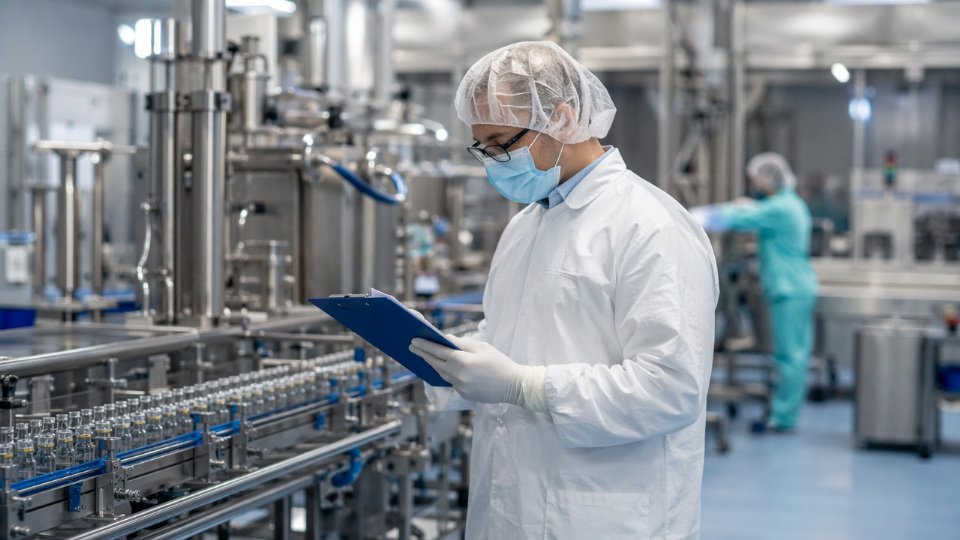
In electronics encapsulation, the relevant standards shift to IPC and JEDEC qualification flows. LSR’s low ionic content and near-zero outgassing behavior under vacuum make it the preferred choice for sealing optical sensors, MEMS devices, and hermetic cavities where even trace volatile siloxanes can deposit on optical surfaces or shift capacitance values. HCR compounds with higher filler loadings can exhibit elevated dielectric loss tangent at frequencies above 1 GHz — a real disqualifier for 5G antenna components where loss budget is tight and consistent permittivity across production lots is specified.
Automotive and REACH/RoHS Considerations
Under IATF 16949, automotive customers differentiate sharply between applications. LSR dominates in lighting seals, airbag inflator components, and connectors where dimensional tolerance across millions of injection-molded parts must hold. HCR holds its position in under-hood extrusion profiles, hose reinforcement, and gaskets where continuous vulcanization lines and raw material cost matter more than tight part-to-part consistency.
Both material classes can be formulated fully SVHC-free under REACH and compliant with RoHS Directive 2011/65/EU. The operative word is “formulated” — always request a full material declaration alongside the SDS, not just a compliance letter. SiliconChemicals provides CoA documentation with full test data, extraction test reports, California Proposition 65 compliance letters, and TSCA/REACH registration confirmation as standard for all export product lines. For regulated applications, that documentation package should be part of your supplier qualification checklist, not an afterthought requested six weeks before an FDA audit.
Cost Structure and Total Cost of Ownership: Beyond the Per-Kilogram Price
Raw material price is the first number procurement teams pull up, and it almost always tells the wrong story. HCR general-purpose grades run USD 4.50–8.00/kg; LSR general-purpose grades run USD 8.00–14.00/kg. Both figures move with silicon metal and methanol feedstock markets — a 20% swing in silicon metal spot pricing has historically pushed either material’s cost meaningfully in either direction within a single quarter. SiliconChemicals’ integrated China-based production sits inside the Zhejiang and Shandong organosilicon clusters, where upstream integration and scale typically deliver a 15–30% landed cost advantage over equivalent European or North American-sourced material, depending on destination port and incoterm. That gap narrows slightly on LSR because platinum-catalyst cost is geography-independent, but the polymer base and packaging logistics still favor China origin for most Asian and Middle Eastern buyers.
Tooling Investment and Amortization
HCR compression molds are mechanically simpler: single temperature zone, no cold-runner manifold, tolerances that a mid-tier mold shop can hold. Expect USD 3,000–25,000 per cavity, with cost driven primarily by part geometry complexity and steel grade. LSR liquid injection molds are a different class of asset — precision temperature-controlled platens, a cold-runner self-degating system, hardened steel to handle the abrasive filled grades, and valve-gate timing that must be repeatable to fractions of a second. Per-cavity cost ranges from USD 15,000–80,000. A four-cavity LSR tool for a mid-complexity medical seal could represent a USD 200,000–320,000 upfront commitment before a single production part ships.
That front-loaded cost must be spread across lifetime part volume. At low volumes — say, under 50,000 parts per year — compression-molded HCR wins on total invested capital almost every time. The tooling math starts reversing somewhere between 200,000 and 400,000 parts per year for a typical 50 g part, the exact crossover depending on part weight, cycle time advantage, and local labor rates. Above that threshold, LSR’s process economics compound rapidly.
Labor, Cycle Time, and Scrap
Compression molding HCR demands hands. Operators prep pre-forms, manually load blanks, monitor dwell time, and trim flash afterward. Realistic labor content runs 0.5–2.0 hours per 1,000 parts depending on part complexity and whether deflashing is done by hand or tumble. At a fully-loaded labor rate of USD 20–40/hour (relevant for Southeast Asian or Eastern European plants), that adds USD 10–80 per 1,000 parts to your cost basis — a number finance teams often fail to fully allocate.
LSR liquid injection with robotic part removal and an automatic cold-runner system runs near-unattended at high volume. Labor drops to 0.05–0.2 hours per 1,000 parts. Cycle time is 15–60 seconds per shot versus 3–10 minutes per compression cycle, and because a cold-runner LSR tool produces no sprue or runner waste, material utilization approaches 100%. HCR compression molding typically carries 3–8% scrap from flash, flow defects, and pre-form inconsistencies. LSR LIM with self-degating cold runner typically runs 0.5–2% scrap. On a high-volume program consuming 10,000 kg/year of material, that scrap differential alone represents 300–750 kg of saved material annually.
Hidden Costs That Rarely Appear in the RFQ
Switching material class mid-program — from HCR to LSR or vice versa — triggers full regulatory re-qualification in FDA Class II or III device programs.True
FDA 21 CFR and ISO 13485 change-control requirements treat a material class change as a significant design change, requiring updated biocompatibility testing, process validation, and potentially new 510(k) submissions, which typically cost USD 50,000–200,000 and 6–18 months of program time.
Inventory carrying cost is another factor. Two-component LSR requires controlled storage below 25°C with a 12-month shelf life, and Part A and Part B must be managed separately to prevent accidental mixing. HCR bale stock is more forgiving at 18–24 months ambient shelf life, though it still requires protection from UV and ozone. If your warehouse runs warm, LSR’s effective shelf life shortens further. Finally, LSR formulations carry platinum price exposure — platinum content in a standard addition-cure system represents 1–4% of raw material cost, and platinum spot prices can be highly volatile.
A procurement manager who builds a TCO model capturing tooling amortization, labor, scrap, energy, qualification risk, and inventory carrying cost will arrive at a very different supplier selection than one comparing only per-kilogram prices.
Application Selection Guide: Which Material Wins in Automotive, Medical, Electronics, and Consumer Goods
The prior sections established what differentiates HCR and LSR. This section answers which one to specify — by end market, by geometry, and by the downstream consequences of getting it wrong.
Automotive: Split the Application List, Not the Material Choice
Automotive is the clearest example of a single industry using both materials intelligently, in parallel, for different part families.
HCR dominates wherever continuous profiles, large cross-sections, or cost sensitivity govern the specification. Radiator hose inner liners, door and window seal extrusions, spark plug boots, and vibration damper pads all fit this profile. These parts run through extrusion or compression presses, tolerate ±0.3 mm dimensional variation, and are ordered in linear meters or kilogram lots rather than piece counts. A shift toward LSR here rarely makes economic sense — tooling amortization and cycle-time arithmetic simply don’t favor injection molding for a door seal running 80 meters per vehicle.
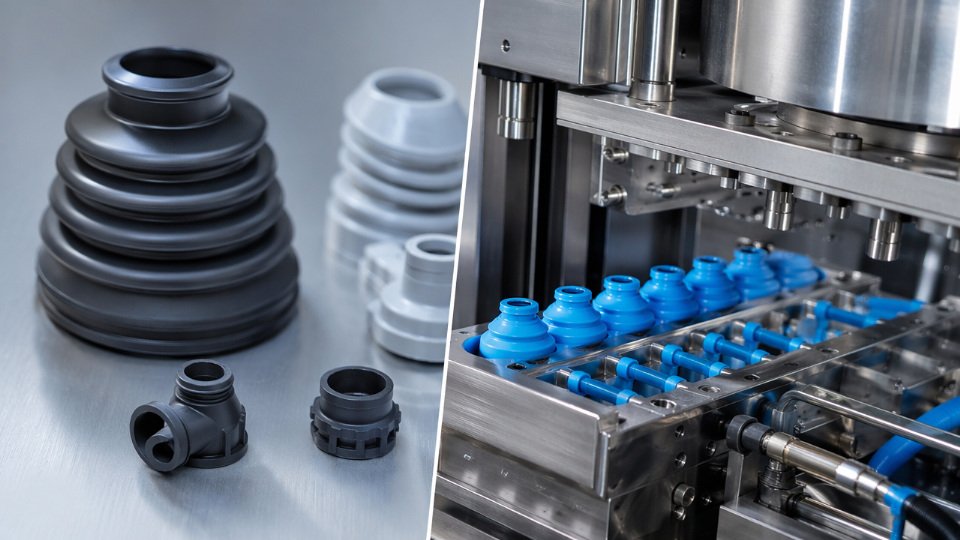
LSR earns its place in the same vehicle on precision, high-volume, safety-critical components. LED headlamp seals must maintain a hermetic barrier against moisture ingress across a –40 °C to 150 °C service range, at flash-free tolerances that HCR compression molding cannot consistently hit in high volume. Throttle body gaskets, airbag igniter seals, crankshaft sensor O-rings, and multi-pin connector boots all share the same logic: tight geometry, six-figure annual volumes, and zero tolerance for dimensional scatter. LSR injection cycles of 15–60 seconds per part (depending on part mass and cure temperature) support the throughput these components require.
Medical and Healthcare: LSR Is the Default; HCR Is the Exception
Regulatory and contamination risk drives this market more than any processing preference. LSR’s closed injection system, platinum-cure chemistry, and lot-to-lot consistency make it the default choice for catheter tips, respiratory mask bodies, infant feeding nipples, cochlear implant housings, and drug delivery valve membranes. The absence of peroxide cure byproducts removes an extraction concern that medical device teams would otherwise have to characterize and justify to regulatory bodies. For Class III implantable devices, implantable-grade LSR formulations — those completing ISO 10993-6 chronic implantation studies — are essentially the only practical silicone route.
HCR is not disqualified from medical use. General-purpose surgical tubing produced by continuous extrusion remains cost-justified when the application is not implantable and secondary post-cure is acceptable within the manufacturing process. Peristaltic pump tubing in small production runs is another realistic HCR application — precision extrusion is well understood, and the volumes may not justify an LSR injection tool.
LSR's closed injection molding process eliminates the operator-contact contamination risk that open-mill processing of HCR introduces in clean-room environments.True
HCR compounding and sheeting requires open mill or internal mixer contact, creating particulate and operator-contamination exposure. LSR is metered, mixed, and injected in a closed path from drum to mold cavity, which is a documented process-control advantage in ISO 14644 clean rooms.
Electronics and Electrical: Frequency and Form Factor Decide
Low-dielectric-loss LSR grades (dissipation factor typically in the 10⁻³ range at gigahertz frequencies, depending on filler package) are the right choice for 5G antenna radomes, fiber optic cable seals, and LED lens overmolding where optical clarity and tight geometry intersect. EV battery pack connector seals are a growing LSR volume — the combination of precise flash-free geometry and UL 94 flame rating matters here.
HCR holds the wire and cable insulation market because continuous extrusion at high filler loadings is operationally straightforward on existing crosshead lines. High-voltage bushing pads and transformer coil wrapping benefit from the high ATH filler loading that HCR processing accommodates without the viscosity constraints that would compromise LSR injection equipment.
Consumer Goods and Industrial: Purity vs. Toughness
Food-contact and baby care items — baking mats, infant bottle nipples, kitchen spatula tips — lean toward food-grade LSR for its purity profile and freedom from post-cure volatiles. Self-adhesive LSR grades enable decorative overmolding directly onto toothbrush handles and wearable device straps without a secondary adhesive step, which cuts assembly operations.
Industrial gaskets, expansion joints, conveyor belts, and roll covers favor HCR. The geometries are large, toughness and tear resistance under mechanical loading matter more than dimensional precision, and the economics of compression or transfer molding scale correctly for these parts.
Emerging Applications: Where LSR Is Still Defining the Boundary
Ultra-soft LSR grades below 15 Shore A are enabling skin-contact wearable sensors where conformability to body contour affects signal quality — a requirement HCR cannot meet at equivalent durometer without sacrificing mechanical integrity. Thermally conductive LSR (1.5–3.5 W/m·K, depending on filler type and loading) is entering EV thermal interface and battery cooling pad applications, competing with phase-change materials on the basis of compression set resistance over long service life.
Decision Flowchart: Four Questions in Sequence
Start with part geometry. If the part is a continuous profile, sheet, or large-cross-section molding, evaluate HCR first. If it is a precision injection-molded component with complex geometry, LSR is the baseline assumption.
Move to annual volume. Below roughly 200,000 parts per year, the tooling investment for LSR injection molding may not amortize within a reasonable product cycle — HCR compression or transfer molding deserves a cost model. Above 500,000 parts per year, LSR’s 15–60-second cycle time and minimal post-processing labor typically win on TCO.
Then apply regulatory class. Implantable or Class III medical device? LSR with documented implantable-grade qualification is effectively mandatory. General industrial or non-regulated consumer? Either material is technically eligible — geometry and volume drive the choice.
Finally, check dimensional tolerance. If the finished part requires ±0.1 mm or tighter on critical dimensions, LSR injection molding is the only silicone process that reliably delivers it in production quantities. If ±0.3 mm is acceptable, HCR tooling costs and processing flexibility remain competitive.
Frequently Asked Questions About Silicone vs. Liquid Silicone
Is liquid silicone rubber the same as silicone fluid ([silicone oil](https://siliconchemicals.com/silicone-oil/))?
No — and this confusion trips up purchasing teams regularly. Silicone fluid is a linear, non-crosslinking polydimethylsiloxane polymer supplied as a clear liquid anywhere from 1 cSt (water-thin) to 300,000 cSt (near-grease consistency), depending on molecular weight. It functions as a lubricant, mold release agent, hydraulic fluid, or cosmetic emollient. It will never harden under any normal processing condition. LSR is an entirely different product category: a two-component, platinum-catalyzed system that crosslinks irreversibly into a solid elastomer during injection molding. The liquid appearance before cure is the only superficial similarity. Ordering silicone fluid when you need LSR feedstock produces a useless non-curing mass in your mold — a costly mistake on a first production run.
Silicone fluid (PDMS oil) and liquid silicone rubber (LSR) are both liquid silicones and can be used interchangeably.False
Silicone fluid is a non-crosslinking linear polymer; LSR is a crosslinkable two-component elastomer precursor. They have entirely different chemistries, cure mechanisms, and end-use functions. One remains liquid permanently; the other cures to a solid rubber.
Can I substitute HCR for LSR in an existing mold?
Generally not, and attempting it without significant tooling redesign will likely destroy the tool or scorch the material. LSR tooling uses a cold-runner liquid injection molding (LIM) system — cold side for material delivery, heated cavity for cure. HCR has a viscosity orders of magnitude higher than LSR; it cannot flow through LIM cold-runner nozzles under any practical injection pressure. If you force HCR into a heated mold designed for LSR, the compound contacts heat before fully filling thin sections, scorches at the gate, and produces short shots with degraded mechanical properties. The reverse substitution has its own problems: LSR in a compression mold designed for HCR will flash excessively because LSR’s low viscosity requires far tighter parting-line tolerances (typically below 0.01 mm) than HCR tooling provides. Material and process are co-designed; treat them that way from the start.
Is liquid silicone rubber safe for food contact and baby products?
Yes, when the correct grade is formulated and documented to FDA 21 CFR 177.2600 or the applicable EU food contact framework. The critical advantage of LSR over peroxide-cured HCR in these applications is the platinum addition cure mechanism: no peroxide byproducts remain in the cured part, and no post-cure bake is required to hit regulatory compliance for baby nipples, pacifiers, or food-preparation tools. LSR grades qualified for these applications also contain no BPA, phthalates, or heavy-metal catalysts. Verify the specific grade’s compliance documentation — not all LSR products carry food-contact certification, and a grade used for industrial gaskets may share a chemistry platform with a food-contact grade but lack the formal regulatory filing.
Why does platinum-cure LSR sometimes fail to cure near certain substrates?
Platinum catalyst inhibition is a real and underappreciated processing hazard. Sulfur compounds are the most common culprit: natural rubber tooling, latex gloves, sulfur-based mold releases, and sulfur-vulcanized adjacent components all deposit trace amounts that deactivate the platinum catalyst, leaving tacky or uncured surfaces. Tin compounds from some RTV silicones or plasticized PVC, nitrogen-based amines in epoxy primers, and certain UV stabilizers cause identical failures. The inhibition is localized — you may see a perfectly cured part interior with a sticky skin exactly where it contacted a contaminated surface. Qualifying all adjacent materials before production start, using nitrile or vinyl gloves exclusively on the LSR line, and running a simple adhesion/cure test coupon against any new substrate will catch this before it shuts down a production shift.
What are the shelf life and storage requirements for LSR versus HCR?
LSR has a shelf life of approximately 12 months when stored at or below 25°C, with Part A and Part B kept in separate, sealed containers until the moment of use. Even brief cross-contamination of the two components begins the cure clock. Keep LSR away from any potential inhibitor sources during storage — this means segregated shelving, away from sulfur-containing materials or tin-catalyst RTV products. HCR bale stock is more forgiving: 18–24 months at room temperature, protected from UV radiation and ozone, which will prematurely age the polymer surface and introduce surface cracking. Both materials require first-in, first-out inventory rotation with full lot traceability. For regulated applications — medical devices, food contact — lot-level documentation ties directly into your own product traceability system, so CoA retention is non-negotiable, not optional.
How does SiliconChemicals ensure consistent quality across large export orders?
Manufacturing runs under ISO 9001:2015 certification with in-line viscosity monitoring throughout each production batch, not just at final QC. Platinum content in LSR is verified by ICP-OES to confirm catalyst loading falls within specification — this directly controls cure speed and final hardness. Every production batch undergoes Shore A hardness and tensile strength testing before release. Each shipment includes a Certificate of Analysis, Safety Data Sheet, and full material declaration. For OEM customers operating under strict supplier qualification programs — medical device manufacturers, automotive Tier 1s — third-party audit arrangements are available. Traceability from raw material lot through finished product is maintained to support customers’ own regulatory submissions.
What minimum order quantities apply to LSR and HCR grades?
LSR standard MOQ runs approximately 200 kg per grade, structured as a matched drum set of Part A plus Part B. HCR MOQ is approximately 100 kg per grade. Both figures depend on grade complexity and whether the formulation is a standard catalog product or a customized specification. For qualification and development work, sample quantities of 1–5 kg are available — enough material to run mold trials, complete mechanical testing, and initiate any regulatory coupon testing your application requires. High-volume customers with predictable consumption can access consignment stock programs that support just-in-time delivery, reducing your own warehousing burden without exposing you to supply disruption risk.
Sourcing Silicone and Liquid Silicone from SiliconChemicals: Capabilities, Grades, and Global Supply
Working with a single supplier who covers the full organosilicon value chain changes the procurement equation considerably. Specification errors get caught earlier, documentation packages arrive complete, and there is one technical contact who understands both the chemistry and the downstream process — not a distributor reading from a datasheet.
Portfolio Depth Across the Entire Organosilicon Chain
SiliconChemicals supplies PDMS fluids from 1 cSt to 60,000 cSt, covering everything from release agents and antifoams to cosmetic-grade emollients and dielectric cooling fluids. HCR gum and pre-compounded HCR grades span Shore A 20–80 in a range of filler systems — fumed silica for optical clarity and tight mechanical tolerances, precipitated silica for cost-sensitive extrusion profiles, carbon black grades for conductive gaskets, and peroxide or vinyl-specific gum bases for customers running their own compounding lines.
The LSR portfolio runs Shore A 10 to 80 in standard platinum-cure two-component systems, self-adhesive grades for direct-bond-to-substrate molding, low-compression-set grades for sealing applications, and optical-grade LSR with light transmittance above 90% in the 400–700 nm range — relevant for LED encapsulation and wearable biosensor lenses. RTV-1 and RTV-2 sealant bases serve electronics potting and construction sealing customers. Silane coupling agents — including vinyltrimethoxysilane, 3-aminopropyltriethoxysilane, and glycidoxypropyltrimethoxysilane — round out the range for customers formulating primers, adhesion promoters, or surface-treated filler systems in-house.
Production Location and Feedstock Integration
Facilities sit within China’s established organosilicon industrial clusters across Zhejiang, Shandong, and Guangdong provinces. That geography matters operationally. Direct proximity to domestic silicon metal smelters and chlorosilane crackers shortens the raw material supply chain by two to four logistics steps compared with formulators who purchase finished PDMS polymer from third parties. When methyl chlorosilane spot prices move — and they do move, sometimes 15–30% within a quarter depending on energy costs and upstream capacity — an integrated producer absorbs those swings with more stability than a non-integrated blender passing every spike through to the customer.
Quality Management and Release Testing
ISO 9001:2015 governs the quality system. The in-house analytical laboratory runs GC for volatile content and residual monomer, ICP-OES for platinum, heavy metals, and catalyst residues, a rheometer for viscosity and cure profile, a universal testing machine for tensile and elongation, DMA for dynamic mechanical behavior across temperature, and TGA for thermal stability confirmation. Every LSR lot is tested for dynamic viscosity at 25°C, platinum content, gel time at 150°C, and post-cure Shore A and tensile before a certificate of analysis is issued. That is not paperwork — it is the data a molding engineer needs to set barrel temperatures and injection pressure with confidence on the first production run.
SiliconChemicals tests every LSR production lot for platinum content, gel time, and post-cure mechanical properties before release.True
This is a stated in-house quality protocol consistent with standard practice for platinum-cure LSR manufacturers supplying medical and food-contact markets, where lot-to-lot consistency is a regulatory requirement.
Regulatory Documentation Ready on Request
Standard documentation with every shipment includes CoA, GHS-compliant SDS in English, full material declaration, REACH SVHC declaration, and RoHS compliance letter. For food-contact programs, FDA 21 CFR 177.2600 self-declaration is available on food-contact grades. Medical device customers can request USP Class VI test reports. Having that documentation package assembled before a customer asks for it cuts qualification timelines — procurement teams managing EU REACH registration or FDA 510(k) support files know exactly how much time a missing SDS or incomplete extractables declaration can add to a launch schedule.
Global Logistics and Regional Stocking
Exports reach more than 30 countries, including the United States, Germany, India, South Korea, Japan, Brazil, and Mexico. Standard shipment moves by sea freight in FCL or LCL depending on order size; urgent sample requests travel by air. Regional warehousing partnerships in Europe and Southeast Asia give repeat customers buffer stock options that reduce lead time sensitivity to vessel schedules and port congestion — a real operational benefit for customers running just-in-time molding lines.
Engagement Process from Sample to Standing Order
The sequence is straightforward: initial technical consultation to define application, hardness target, cure system, and compliance requirements; sample shipment of 1–5 kg at no charge for qualified buyers; technical data package with full rheological and mechanical data; commercial quotation with tiered pricing at sample, trial, and volume quantities; qualification support through first article testing; and transition to a standing purchase order or blanket contract with scheduled releases. For industrial buyers who have read through the technical comparison in this article and identified whether HCR or LSR fits their process, that first technical consultation is the logical next step — reach out to the SiliconChemicals technical sales team with your application description, annual volume estimate, and any active compliance requirements, and expect a material recommendation within one business day.