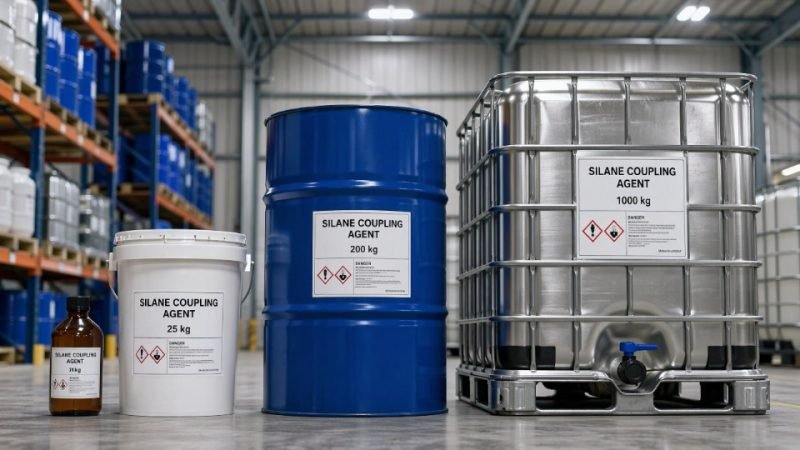
Silane coupling agents degrade quietly. A drum stored six months past its reorder date, or resealed carelessly after partial use, can show near-normal appearance while delivering measurably weaker adhesion, poor crosslink density, or premature coating delamination at the bond line. The financial hit rarely announces itself as “bad silane” — it shows up as rework costs, customer returns, and scrap rates that baffle your quality team until someone finally pulls the certificate of analysis and traces the lot number back to a warehouse shelf.
Silane coupling agents in sealed, unopened containers stored at 5–25°C typically remain usable for 12–24 months, depending on functional group chemistry and packaging integrity. Once opened, that window collapses to 3–6 months without proper resealing and inert-gas blanketing. Packaging format — from 1 kg bottles to 1,000 kg IBC totes and bulk isotanks — directly determines moisture exposure risk, handling logistics, and total cost of ownership.
What most procurement specs and technical data sheets understate is how aggressively the wrong packaging decision interacts with functional group chemistry. An aminosilane and an epoxysilane are not equivalent in how fast humidity destroys them, and a 200 kg drum bought for “volume savings” can become an expensive liability if your line only pulls 15 kg per month. The sections below map packaging formats to real consumption scenarios, explain which chemistries demand the tightest moisture controls, and give you the decision logic to match container size and storage practice to your actual production cadence.
 packaging formats — bottles, pails, steel drum, and IBC tote — arranged in an industrial warehouse storage area](https://siliconchemicals.com/wp-content/uploads/2026/06/silane-coupling-agent-packaging-shelf-life-01-hero.jpg)
Silane Coupling Agent Chemistry Classes and Their Intrinsic Stability Profiles
Before you specify a drum size or negotiate lead times, you need to understand what your silane’s functional group actually does when it meets moisture, oxygen, heat, or CO₂. Packaging is not a logistics afterthought — it is a direct consequence of chemistry. Get the chemistry wrong in your spec sheet and you will pay for it in gel formation, hydrolysis losses, or a container that arrives corroded.
Vinylsilanes and Methacryloxysilanes: Moderate Stability, Still Moisture-Sensitive
Vinylsilanes such as A-151 (vinyltriethoxysilane) and A-172 (vinyltrimethoxysilane) carry an ethoxy or methoxy leaving group paired with a relatively inert vinyl functionality. Their primary degradation route is alkoxysilane hydrolysis rather than functional-group reactivity, so they sit toward the more stable end of the commercial silane spectrum. Methacryloxysilanes like KH-570 (3-methacryloxypropyltrimethoxysilane) add a second vulnerability: the methacrylate group can undergo free-radical polymerization if storage temperatures creep above 30–35°C or if inhibitor is depleted over time. A drum of KH-570 stored in a sun-exposed warehouse in a warm climate is a real scrap risk — viscosity creep is often the first sign, and by that point the material is marginal for composite applications.
Aminosilanes: The Most Demanding Class in the Lineup
Aminosilanes (A-1100, A-1110, KH-550 — all variants of 3-aminopropyltriethoxysilane or trimethoxysilane) are hygroscopic, basic, and reactive with atmospheric CO₂. The CO₂ reaction produces carbamate salts through a mechanism called carbamation, which raises viscosity and introduces insoluble particulates that foul spray systems and metering pumps. Aminosilanes also self-condense — amino groups catalyze their own alkoxysilane hydrolysis, accelerating oligomerization even from trace moisture ingress. In practical terms, a partially used drum of A-1100 left with a loose bung in a humid environment can degrade visibly within days. Nitrogen blanketing is non-negotiable for this class, and the permissible moisture ingress threshold is the tightest of any common coupling agent.
Aminosilanes will react measurably with atmospheric CO₂ during normal warehouse handling without nitrogen blanketing.True
Primary and secondary amines on aminosilane molecules react with CO₂ to form carbamic acid or carbamate salts. This is a well-documented degradation pathway that increases product viscosity and introduces solids, reducing coupling effectiveness at the substrate interface.
Epoxysilanes: Epoxy Ring Integrity Is the Critical Variable
KH-560 (3-glycidoxypropyltrimethoxysilane) and A-187 carry a glycidyl ether epoxy ring that is susceptible to acid- or base-catalyzed ring-opening. The trimethoxysilane leaving group hydrolyzes faster than ethoxy equivalents, so moisture ingress attacks from two directions simultaneously — the silane backbone and the epoxy ring. Storage above 30°C accelerates ring-opening noticeably. At the receiving dock, a quick viscosity check against the certificate of analysis is a sensible practice; epoxy equivalent weight (EEW) drift is a more definitive quality indicator but requires lab access.
Chlorosilanes: Packaging Is a Safety and Corrosion Issue, Not Just Stability
Trichlorosilane intermediates and other chlorosilane-functional species evolve HCl on contact with atmospheric moisture. This is not a slow degradation — it is rapid and aggressive. HCl generation drives specific requirements: lined or passivated steel drums, no standard carbon-steel fittings, pressure-relief provisions, and hazardous-goods classification under ADR/IMDG Class 8 (corrosive). A standard unlined drum will develop internal corrosion within weeks, contaminating the product with metal chlorides and creating a disposal problem on top of a quality failure.
Comparative Stability at a Glance
| Chemistry Class | Primary Degradation Mechanism | Max Recommended Storage Temp | Sealed Shelf Life (typical) |
|---|---|---|---|
| Vinylsilane (ethoxy) | Hydrolysis of alkoxy groups | 30°C | 18–24 months |
| Vinylsilane (methoxy) | Faster hydrolysis; same mechanism | 25°C | 12–18 months |
| Aminosilane | Carbamation, oligomerization, hydrolysis | 25°C | 12–18 months |
| Epoxysilane (methoxy) | Epoxy ring-opening + fast hydrolysis | 25°C | 12–18 months |
| Methacryloxysilane | Radical polymerization + hydrolysis | 25°C | 12–24 months |
| Mercaptosilane | Oxidation of thiol group, hydrolysis | 25°C | 12–24 months |
| Chlorosilane | Rapid HCl evolution on moisture contact | 20°C | 6–12 months |
Figures depend on actual container integrity, warehouse humidity control, and whether the drum has been opened. Methoxy leaving groups consistently hydrolyze faster than ethoxy across all classes — sometimes 5–10× faster under identical humidity conditions — which means methoxysilane-based products require tighter moisture barriers regardless of functional group.
Why Class Identification Comes Before Packaging Specification
Knowing that you are buying KH-550 versus KH-560 should change what you ask a supplier for: container lining spec, headspace gas, inner packaging moisture barrier, and temperature requirements during sea freight. When you provide SiliconChemicals with the functional group class and your application’s minimum acceptable purity threshold, the packaging recommendation follows logically from the chemistry rather than from a generic catalog default. That alignment between chemistry and packaging specification is where avoidable degradation losses actually get designed out.
Commercial Packaging Formats: Dimensions, Materials, and Appropriate Use Cases
Choosing the wrong packaging format doesn’t just create a handling inconvenience — it can degrade product quality before it ever reaches your process line, trigger waste disposal costs, or leave you short on volume at a critical production run. Every format discussed below reflects a real trade-off between container cost, moisture protection, logistics compatibility, and the silane chemistry involved.
Small-Quantity Containers: 1 kg and 5 kg
Lab-scale and specialty work calls for HDPE bottles or amber glass bottles fitted with induction-seal liners under screw caps. Amber glass is the right choice for UV-sensitive silanes such as methacryloxy and acryloxy functional types; HDPE handles most alkoxysilanes cleanly at these volumes. The induction seal is non-negotiable — a simple screw cap alone admits enough ambient humidity through micro-gaps to initiate surface hydrolysis on aminosilanes within days in a tropical or humid-climate warehouse.
These containers suit R&D chemists evaluating adhesion promoter candidates, QC labs running incoming-material checks, and specialty formulators who juggle eight or ten silane types simultaneously without committing to larger volumes. Shelf life at this size depends heavily on whether the liner is intact after opening; realistically, a 1 kg HDPE bottle with a broken induction seal in a lab running at 55–70% RH has a working life measured in weeks, not months.
Mid-Range Pails and Jerry Cans: 10 kg, 20 kg, 25 kg
This tier covers the practical backbone of most compounders, adhesive manufacturers, and surface treatment lines with moderate but steady silane consumption. UN-rated fluorinated HDPE containers — fluorination reduces permeability to reactive organics — with tamper-evident ring caps and a nitrogen headspace represent the current industry standard for aminosilanes and epoxysilanes at this weight class. The fluorinated inner wall matters most for chlorosilane-containing blends; plain HDPE swells and can develop micro-permeation channels over a multi-month storage window.
A realistic scenario: a rubber compounding plant using 3-mercaptopropyltrimethoxysilane in 25 kg pails at roughly two pails per shift cycle should expect container integrity to hold for the full 12–24 month unopened shelf life — provided storage stays below 25°C and the pails are kept away from direct sunlight and floor-level humidity near loading dock doors.
Steel Drums: 200 kg
The 200 kg steel drum (roughly equivalent to the 55-gallon US drum) is the default mid-to-large production format globally. For most alkoxysilane types, an epoxy-phenolic interior lining gives adequate corrosion and contamination resistance. Chlorosilane-containing products demand a more aggressive lining specification — unlined or standard-epoxy drums will corrode at the bung area and introduce iron contamination into the product, compromising coupling efficiency and potentially causing gelled deposits in downstream processes.
Bung closures should be torqued to the drum manufacturer’s specification and pressure-relief vents verified functional before storage. Drums sitting in outdoor staging areas, even under cover, accumulate heat that accelerates hydrolysis; internal temperatures in a drum exposed to afternoon summer sun can exceed 40°C even when ambient reads 30°C.
Standard epoxy-phenolic drum linings are compatible with most alkoxysilane coupling agents but are insufficient for chlorosilane-functional products without additional fluoropolymer or specialized chemical-resistant coatings.True
Chlorosilanes hydrolyze to produce hydrochloric acid under trace moisture, which attacks standard epoxy-phenolic linings and introduces metal contamination. Drum suppliers for chlorosilane service specify fluoropolymer or high-specification phenolic linings accordingly.
Intermediate Bulk Containers: 1000 kg IBC Totes
High-volume users — large rubber goods producers, glass fiber manufacturers, sealant plants — find IBCs economically attractive because per-kilogram packaging cost drops substantially and handling moves from manual drum rolling to forklift operations with dry-break couplings. Stainless steel IBCs are the correct choice for moisture-sensitive silanes; HDPE-lined carbon steel is acceptable for lower-reactivity types where cost pressure is real.
The dry-break coupling system deserves specific attention: a poorly seated dry-break fitting allows ambient air ingress every time the IBC is tapped, and over a production week with multiple draw-down events this translates to measurable viscosity increase in aminosilane products. Pressure-rated fittings rated to at least the vapor pressure of the specific silane at your maximum storage temperature are required — not a preference.
IBC reuse is tempting from a cost standpoint but carries genuine risk. Residual silane from a previous fill can hydrolyze and polymerize on inner surfaces, contaminating the next fill with oligomeric siloxane species that interfere with coupling chemistry. A validated cleaning protocol — typically solvent rinse followed by dry nitrogen purge with moisture measurement confirmation below a defined dew point — should be documented and audited before any IBC re-enters the filling cycle.
Isotanks and Flexitanks: 16,000–20,000 kg Bulk Shipments
For global customers taking full container load volumes, isotanks built from 316L stainless steel with electropolished interiors are the appropriate format for any silane with meaningful moisture sensitivity — aminosilanes, epoxysilanes, and methacryloxy types. The electropolished surface minimizes residue retention and simplifies cleaning between fills. Transit times from China to European or North American destinations typically run 25–40 days depending on routing and port conditions; a well-sealed, nitrogen-blanketed stainless isotank maintains product specification across that window.
Flexitanks are sometimes proposed as a lower-cost bulk option and are genuinely appropriate for low-reactivity silane types such as alkyl-functional or vinyl-functional products on shorter sea routes. They are not suitable for aminosilanes or chlorosilane-adjacent chemistries: flexitank liners are typically polyethylene-based and provide limited moisture barrier performance, and the bags cannot be pressure-tested for integrity before loading the way an isotank valve system can.
Packaging Selection Matrix
| Format | Typical Volume | Compatible Silane Classes | Buyer Profile | Freight Mode |
|---|---|---|---|---|
| HDPE / glass bottle | 1–5 kg | All classes for lab use | R&D, QC, specialty formulators | Air, courier, small parcel |
| Fluorinated HDPE pail / jerry can | 10–25 kg | Amino, epoxy, mercapto, methacryloxy | Compounders, adhesive mfg., surface treatment | Road, LCL sea |
| Epoxy-phenolic steel drum | 200 kg | Alkoxy, vinyl, amino, epoxy | Mid-to-large production lines | Road, FCL sea, rail |
| Lined steel drum | 200 kg | Chlorosilane-functional types | Chemical intermediates, specialty coating | Road, FCL sea |
| Stainless or lined carbon steel IBC | 1000 kg | Low-to-moderate reactivity; SS for sensitive types | Large-volume continuous production | Road, FCL sea |
| 316L stainless isotank | 16,000–20,000 kg | Moisture-sensitive: amino, epoxy, methacryloxy | Global industrial importers, distributors | FCL sea |
| Flexitank | 16,000–20,000 kg | Low-reactivity only: alkyl, vinyl | Cost-driven bulk buyers, shorter routes | FCL sea |
The format decision is ultimately driven by three intersecting variables: the hydrolytic sensitivity of the specific silane chemistry, the volume consumption rate that determines how long a container stays open and in service, and the logistics chain conditions between the supplier’s fill station and your process dosing point. Get any one of those wrong and the chemistry itself becomes the least reliable variable in your formulation.
Packaging Material Compatibility: What Containers Can and Cannot Hold
Choosing the wrong container material for a silane coupling agent is not a theoretical risk. It produces real failures: corroded drums leaking onto a warehouse floor, contaminated batches that cause adhesion failures three steps downstream, or gel formation discovered only when a customer opens a drum six weeks after shipment. Understanding the chemistry-to-container relationship is a procurement prerequisite, not an afterthought.
Why Container Chemistry Matters More Than It Looks
Silane coupling agents are reactive by design. That same reactivity that bonds an organic matrix to an inorganic substrate will interact with container walls, gaskets, and closures if the combination is wrong. The failure modes differ by chemistry class, and they are worth knowing specifically.
Chlorosilanes are aggressive toward carbon steel and aluminum. Hydrolysis of residual Si–Cl bonds generates hydrochloric acid at the liquid-vapor interface, and that acid attacks both metals measurably within weeks. A standard ungalvanized steel drum used for a chlorosilane-functional product will show pitting at the headspace ring first, then contaminate the product with iron chloride particulates that are nearly impossible to filter out in the field.
Aminosilanes present a different problem. Primary and secondary amino groups are basic and nucleophilic. Certain grades of polypropylene — particularly recycled or lower-density formulations — are susceptible to environmental stress cracking under sustained contact with amines, especially at elevated storage temperatures (above 30°C). A PP closure or inner liner that survives initial filling can fail gradually under stress, appearing sound until mechanical handling triggers a split.
Epoxysilanes, particularly 3-glycidoxypropyltrimethoxysilane (GPTMS), are moderate extractors of plasticizers from lower-quality HDPE. Standard HDPE contains processing additives and antioxidant packages. Over three to six months of contact, epoxysilanes can leach these compounds into the product at concentrations in the low-ppm range — enough to interfere with cure kinetics in epoxy adhesive and coating formulations where the silane is used as a primer or coupling additive.
Vinyl- and methacryloxy-functional silanes carry a specific metal ion sensitivity. Trace iron or copper ions released from non-passivated or poorly rinsed steel containers catalyze free-radical or coordination polymerization of the reactive organic group. The result is viscosity drift — detectable by rheometry — or, in worse cases, visible gel nodules. A batch that passes QC at dispatch can be out of specification by the time it clears customs, with the contamination source already disposed of.
Compatibility Matrix by Container Material
| Container Material | Chlorosilanes | Alkoxysilanes | Aminosilanes | Epoxysilanes | Vinyl/Methacryloxy |
|---|---|---|---|---|---|
| Carbon steel (standard) | Not suitable | Marginal (short-term only) | Acceptable | Acceptable | Not suitable (ion risk) |
| 304 stainless steel | Marginal | Acceptable | Acceptable | Acceptable | Marginal |
| 316L stainless steel | Preferred | Preferred | Preferred | Preferred | Preferred |
| HDPE (standard) | Not suitable | Acceptable | Stress-crack risk | Extract risk | Acceptable |
| Fluorinated HDPE | Acceptable | Preferred | Preferred | Preferred | Preferred |
| PTFE-lined steel | Preferred | Preferred | Preferred | Preferred | Preferred |
| Borosilicate glass | Preferred | Preferred | Preferred | Preferred | Preferred |
Ratings assume ambient storage at 5–25°C and contact duration up to 24 months. Higher temperatures compress acceptable windows significantly.
Gaskets and Seals: The Overlooked Failure Point
Drum bungs, IBC valve seats, and tanker manhole gaskets are frequently specified generically even when the drum material is correctly chosen. EPDM and nitrile elastomers swell noticeably in contact with most alkoxysilane coupling agents, causing closure torque loss and slow vapor leakage. Viton (FKM) is the standard-of-practice recommendation for most silane families and holds dimensional stability across the relevant temperature range. For high-purity electronic-grade or pharmaceutical-adjacent applications, PTFE-encapsulated gaskets or pure PTFE tape on threaded closures eliminate elastomer contact entirely.
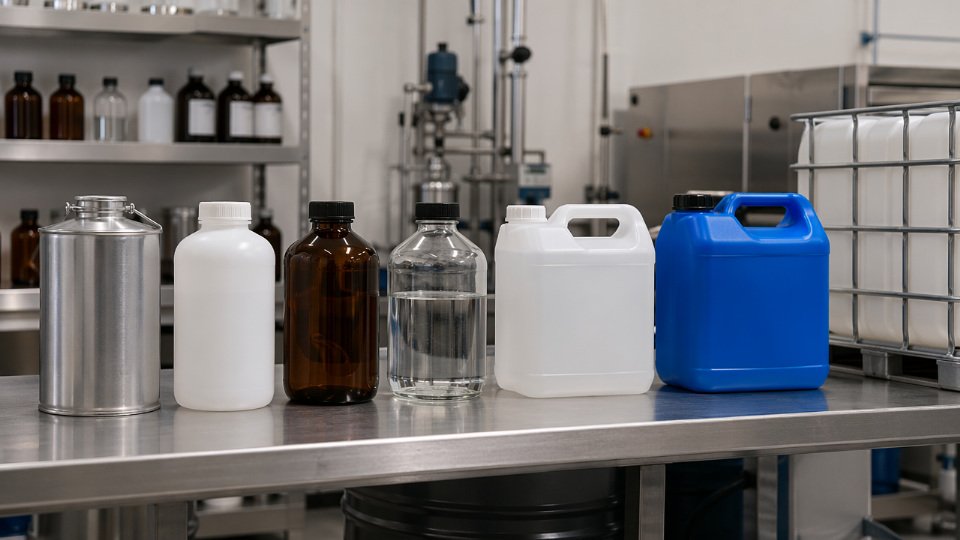
What to Request From Your Supplier
Requesting a packaging material compatibility certification for the specific product-container combination is standard practice among experienced silane buyers.True
Reputable silane manufacturers maintain internal compatibility test records by product grade and container type; buyers who ask for this documentation before first shipment avoid the majority of storage-related failures and can verify container choice matches their storage conditions.
Ask for the SDS appendix or a separate compatibility note that explicitly names the container material, liner, and gasket specification used for your product grade — not a generic document covering an entire product family. The functional group, the specific alkoxy leaving group, and the inhibitor package (if present) all affect compatibility, and a document written for vinyltrimethoxysilane does not cover methacryloxypropyltrimethoxysilane even though both are listed under “alkoxysilanes” in many catalogs.
SiliconChemicals runs internal compatibility testing for each product-container combination prior to commercial shipment and provides this documentation on request, which gives procurement managers a defensible paper trail if a customer or internal QA team later questions storage integrity.
Optimal Storage Conditions: Temperature, Humidity, Light, and Segregation Requirements
Getting the chemistry right on the production line means nothing if the product degraded in your warehouse first. Silane coupling agents are reactive by design — that same surface-binding reactivity makes them vulnerable to moisture, heat, UV radiation, and incompatible neighbors on the shelf.
Temperature: Ranges, Chemistry Classes, and What Goes Wrong at Extremes
Most alkoxysilane coupling agents — the workhorses of the product category, covering epoxy-, amino-, vinyl-, and methacryloxy-functional grades — store safely between 5°C and 25°C in sealed, unopened containers. Push ambient temperature consistently above 30°C and you accelerate hydrolysis and self-condensation through straightforward Arrhenius kinetics: a 10°C rise roughly doubles reaction rate, so a warehouse running at 35°C is functionally aging your product two to four times faster than one at 20°C. Shelf life rated at 18 months under ideal conditions can collapse to under nine months in an uncooled tropical or desert warehouse.
Aminosilanes and mercaptosilanes carry an additional constraint. The amine group promotes autocatalytic hydrolysis, and mercapto grades are prone to oxidative dimerization at higher temperatures. Store these below 20°C. A dedicated temperature-controlled zone rather than a shared ambient bay is worth the infrastructure cost — a rejected batch of aminosilane used in a glass-fiber sizing operation can mean an entire production run of composite material failing interlaminar shear testing.
Chlorosilane intermediates sit in a separate category entirely. These require explosion-proof, temperature-controlled storage with continuous ventilation, HCl-rated containment trays, and emergency scrubbing provisions. They are not warehouse floor material.
Humidity Control: The Numbers That Matter
Target ambient relative humidity below 50% in any area where silane coupling agents are stored — opened or sealed. Most alkoxysilanes begin measurable hydrolysis within minutes of direct exposure to air above 60% RH. The less obvious risk is micro-permeation: HDPE containers are not perfectly vapor-impermeable, and over months of storage in a persistently humid environment (>70% RH), trace moisture can diffuse through container walls at a rate sufficient to initiate surface hydrolysis near the container interior wall. This rarely fails a product completely, but it does produce visible cloudiness or sediment that triggers incoming quality rejections and rework costs. Use capacitive RH sensors with data logging in storage bays; spot checks alone miss overnight humidity spikes in coastal or monsoon climates.
Light Exposure: UV Sensitivity in Vinyl and Methacryloxy Grades
Vinyl- and methacryloxy-functional silanes carry unsaturated carbon bonds that UV radiation can activate into radical chain polymerization. Amber or fully opaque containers are mandatory for these grades — clear HDPE or glass drums are incompatible regardless of other storage quality. For open-container dispensing operations, warehouse lighting should be UV-filtered LED or UV-filtered fluorescent (filter cutoff below 400 nm). Standard cool-white fluorescent fixtures emit enough near-UV to cause slow surface skinning in open drums of methacryloxy grades over a single shift.
Nitrogen Blanketing Protocol After Opening
Once a container is opened, dry nitrogen purging before resealing is non-negotiable for aminosilanes, epoxysilanes, and methacryloxy grades. Use dry nitrogen with a dew point below −40°C. For a 25 kg pail, a 30–45 second purge at 0.05–0.10 bar gauge displacement pressure is generally sufficient to reduce headspace oxygen and moisture to acceptable levels. For a 200 kg drum, extend purge time to 90–120 seconds with the purge wand positioned near the bottom of the headspace. Do not rely on ambient CO₂ as a substitute — it dissolves into some silane formulations and shifts pH.
Nitrogen blanketing with a dew point below −40°C is sufficient to prevent moisture-initiated hydrolysis in opened silane containers during resealingTrue
Hydrolysis of alkoxysilanes requires water; reducing headspace humidity to levels corresponding to a −40°C dew point (~0.013 g/m³ absolute humidity) effectively eliminates the moisture driver for hydrolysis during short-term storage after resealing.
Chemical Segregation Requirements
| Storage Hazard Class | Keep Silanes Away From | Specific Risk |
|---|---|---|
| Water and aqueous solutions | All chlorosilanes; aminosilanes | Violent hydrolysis, HCl release, exotherm |
| Strong oxidizers (peroxides, nitric acid) | Vinyl- and mercapto-silanes | Fire, exothermic decomposition |
| Strong bases (NaOH, KOH) | All alkoxysilanes | Rapid Si–O bond hydrolysis, heat generation |
| Reactive metals (Al, Zn powder) | Chlorosilane grades | H₂ generation, ignition risk |
| Acids (concentrated) | Aminosilanes | Salt formation, loss of functional activity |
Segregation should align with NFPA 430 flammable/combustible liquids storage principles and OSHA 1910.106 requirements for flammable liquid handling. Physical separation — separate rooms or bunded bays — is more reliable than proximity distance alone, particularly where forklift traffic creates spill risk.
FIFO Inventory Management and Lot Traceability
First-in, first-out rotation sounds obvious; it is routinely ignored when new deliveries are stacked in front of existing stock. Every pallet received should be labeled at intake with manufacture date, lot number, and calculated expiry date pulled directly from the supplier’s certificate of analysis. SiliconChemicals includes batch-specific COA and manufacture date on every shipment label, which makes incoming inspection and shelf-life calculation straightforward rather than dependent on internal record reconstruction. Set a 60-day pre-expiry alert in your inventory system — that window is typically enough time to consume or redistribute stock before it becomes a quality write-off.
Shelf-Life Benchmarks by Silane Type and How Degradation Manifests in Product Quality
Shelf life for silane coupling agents is not a flat number you can apply across your entire inventory. It depends on silane class, container integrity, storage temperature, and how aggressively moisture is excluded after first opening. Treating the supplier’s stated shelf life as a guaranteed performance window under any conditions is one of the most common procurement errors in composites and rubber manufacturing plants.
Reference Shelf-Life Data by Silane Type
The table below reflects realistic ranges under recommended conditions. Actual performance will narrow toward the lower bound if storage temperatures fluctuate, if containers are opened repeatedly, or if nitrogen purge is inconsistent.
| Silane Type | Sealed, Unopened (5–25°C) | Opened, Nitrogen-Purged |
|---|---|---|
| Vinyltrimethoxysilane (VTMO) | 18–24 months | 6–9 months |
| 3-Aminopropyltriethoxysilane (APTES) | 12–18 months | 3–6 months |
| 3-Glycidoxypropyltrimethoxysilane (GLYMO) | 18–24 months | 4–8 months |
| 3-Methacryloxypropyltrimethoxysilane (MPS) | 18–24 months | 5–8 months |
| Bis[triethoxysilylpropyl]tetrasulfide (TESPT) | 12–18 months | 3–5 months |
Ranges reflect variability across packaging formats and storage discipline. A 200 kg drum opened daily in a humid compounding room will hit the lower bound fast.
What Degradation Actually Looks Like
Each silane class degrades through a distinct chemical pathway, and each pathway leaves a signature you can catch with the right incoming QC.
Alkoxysilanes — VTMO, GLYMO, MPS — hydrolyze in the presence of moisture, producing silanol intermediates that condense into oligomeric siloxanols. The first visible sign is turbidity or a fine white precipitation. At the process level, this matters because oligomers do not couple effectively; they deposit as a loosely bonded interlayer rather than forming the intended covalent bridge between filler and polymer. A lot with 5% oligomeric siloxanol content will show a measurable drop in interfacial shear strength in glass-fiber reinforced nylon — expect tensile adhesion results roughly 10–20% below a fresh-lot control, depending on fiber sizing chemistry and composite geometry.
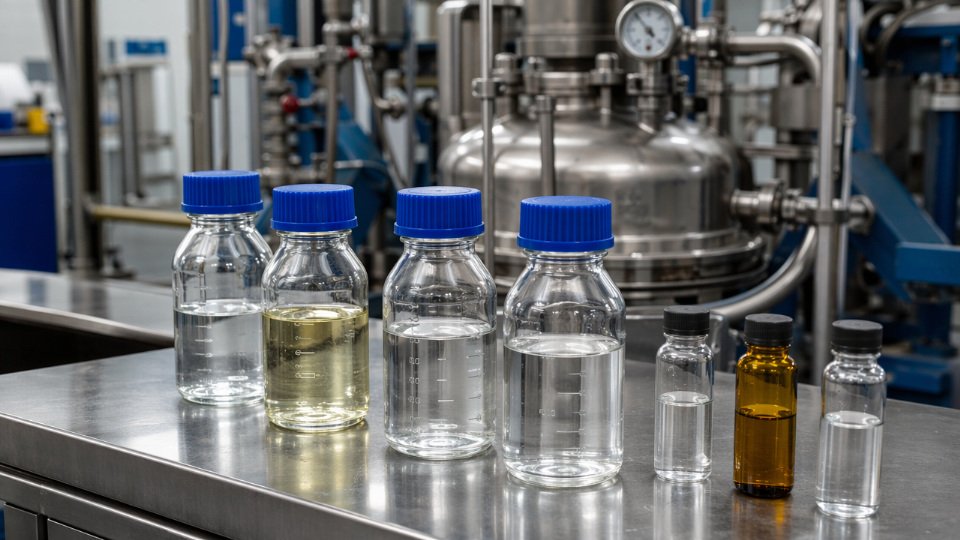
Aminosilanes like APTES are particularly vulnerable to carbamation — reaction with atmospheric CO₂ — and to autoxidation. The symptom is color darkening, typically from water-white to pale yellow or amber, accompanied by a viscosity increase. A lot that has carbamated significantly will show reduced reactivity in epoxy curing applications and uneven coupling density on mineral fillers. Color alone is not always disqualifying, but a viscosity more than 20–30% above the specification baseline is a reliable rejection criterion.
TESPT and other polysulfidosilanes oxidize at the sulfur chain, producing disulfide and shorter polysulfide by-products. This is not visible to the eye. Detection requires GC analysis against a certified reference standard. In tire compound applications, degraded TESPT shifts the silica silanization reaction profile, leading to processing problems during mixing and reduced bound rubber content — a quality issue that often only surfaces during vulcanization, not incoming inspection.
Temperature Abuse During Transit Is a Multiplier
Ocean freight through tropical routing or summer rail transit through inland China can expose drums to 35–40°C for weeks. Product stored at 35°C for six months may exhibit degradation equivalent to 18 months at 20°C. The acceleration factor is roughly 1.5–2× for every 10°C rise above the recommended ceiling, depending on moisture ingress and specific chemistry. This is why cold-chain compliance during container loading, transit, and last-mile delivery is not a procurement luxury — it is a direct lever on usable shelf life.
SiliconChemicals validates shelf-life claims for each product grade using accelerated aging studies conducted at 40°C and 75% relative humidity before market release.True
Accelerated aging under ICH-aligned conditions (40°C/75% RH) is standard practice for specialty chemicals suppliers with formal product qualification programs; it allows realistic shelf-life projection within months rather than years and is referenced in ISO and ASTM guidance for chemical stability testing.
Buyers should request accelerated aging data as part of technical documentation, not accept a shelf-life statement without supporting test methodology. A 24-month claim backed by real stability data is more useful than an 18-month claim based on industry convention alone.
Incoming Quality Inspection and Re-Testing Protocols Before Production Use
Receiving a shipment of silane coupling agent and feeding it directly into production without verification is one of the quieter ways a plant accumulates unexplained scrap. By the time a drop in adhesion, bond failure, or filler dispersion problem surfaces on the line, the root cause is often sitting in a drum that passed through goods receipt unchecked three weeks earlier. A structured incoming inspection protocol costs a few hours per lot; a single production run contaminated with hydrolyzed silane can cost multiples of the original material purchase.
Visual and Physical Inspection at Goods Receipt
Start with the container before you open it. Bulging on a 25 kg pail or a 200 kg drum indicates either internal pressure buildup from hydrolysis-generated alcohol vapors or thermal expansion during transit — either way, that drum is quarantined pending investigation. Check for leakage staining around the bung, corrosion on metal drum seams, and seal integrity on IBC tote fittings. Any deformation of the nitrogen bladder or pressure-relief membrane on a specialty moisture-barrier container is a direct rejection criterion.
Cross-reference the label and lot number against the Certificate of Analysis before the drum moves off the receiving dock. Silane grades look nearly identical in appearance — an aminosilane and a methacrylsilane in the same drum format are visually indistinguishable, and a mislabeled shipment fed into a rubber compounding line or an epoxy primer system will produce defects that take days to trace. Color and clarity give a fast first-pass signal: most commercial alkoxysilane coupling agents ship water-white to pale yellow and clear; visible turbidity, haze, or brown discoloration against the COA description warrants immediate hold and analytical follow-up.
Core Analytical Tests
Gas chromatography purity assay is the primary tool for confirming monomer identity and detecting hydrolysis by-products. A well-specified COA will state minimum purity (typically 97–99% depending on grade) and list acceptable limits for common impurities including the parent alcohol — methanol for methoxy-functional silanes, ethanol for ethoxy variants. An elevated alcohol peak combined with a new by-product peak is a reliable signature of moisture ingress and partial hydrolysis.
Karl Fischer titration for moisture content is non-negotiable for any aminosilane or epoxysilane scheduled for moisture-sensitive downstream applications. Acceptable moisture limits vary by grade and application: general-purpose grades are typically specified below 500 ppm, while grades used in electronics encapsulants or precision adhesive primers often carry a tighter limit of 200 ppm or below. Running KF on receipt takes under 20 minutes with in-house equipment and immediately confirms whether the nitrogen blanket held during transit and storage.
Refractive index measurement serves as a rapid identity and gross-purity surrogate — it will not catch low-level impurities but will flag a wrong product or a severely degraded lot in under two minutes. Pair it with specific gravity if your incoming QC workflow needs a second quick check before committing samples to the GC queue.
Functional Performance Tests
Analytical purity is necessary but not sufficient. A silane that meets GC and KF specification can still underperform if surface reactivity has been compromised by subtle oligomerization. For aminosilane-treated glass fiber, methanol extractables testing quantifies the proportion of silane that has bonded to the fiber surface versus remaining as extractable oligomer — a high extractables result with on-spec purity points to application-side process problems or borderline silane activity.
For epoxysilane used in adhesive primers, peel strength or lap shear adhesion testing on a representative substrate (aluminum, glass, or the specific composite in production) against a retained reference sample is a practical performance gate. Sulfur-functional silanes used in filled rubber should be validated through a short coupling efficiency screen in a representative compound — measure bound rubber content or Payne effect reduction against baseline before releasing the lot to production compounding.
Silane coupling agents that pass GC purity and Karl Fischer moisture specifications are always suitable for production use without functional testing.False
Analytical purity confirms chemical identity and moisture content but does not verify surface reactivity or coupling efficiency. Partial oligomerization, subtle surface contamination, or degraded functional groups can pass standard purity assays while significantly reducing adhesion promotion performance in production.
Re-Test Intervals and Documentation Requirements
Any lot stored beyond 12 months from manufacture date — regardless of whether the nominal shelf life extends further — should be re-tested with the full analytical panel before use. Opened containers that have not been fully consumed within 30 days require re-testing even if the original receipt inspection passed; nitrogen blanket integrity after resealing is rarely as reliable as the original factory seal, and moisture uptake in a partially filled drum can be significant depending on ambient humidity.
Documentation requirements for incoming lots should be standardized in your supplier quality agreement. At minimum: a full analytical COA with lot-specific test data (not a generic certificate), a current SDS, and for regulated applications — food-contact components, REACH-registered markets, RoHS-restricted assemblies — a Declaration of Compliance citing the relevant regulatory framework. SiliconChemicals issues a full lot-specific analytical COA with every shipment and supports third-party verification testing at accredited external laboratories on customer request, which is a meaningful assurance for buyers qualifying a new silane grade into a validated production process.
Regulatory and Hazardous-Goods Classification for Transport and Import
Procurement teams that treat silane coupling agents as ordinary chemicals invite costly freight holds, customs seizures, and carrier liability exposure. Getting the classification right before booking — not after the container is loaded — is where the real work happens.
UN and GHS Classification: What You Are Actually Shipping
Most alkoxysilane coupling agents, including vinyltrimethoxysilane, 3-aminopropyltriethoxysilane (APTES), and glycidoxypropyltrimethoxysilane (GPTMS), fall under UN Class 3 Flammable Liquids. Packing Group assignment depends on flash point: materials with flash points below 23°C and initial boiling points above 35°C land in PG II; those with flash points in the 23–60°C range typically fall into PG III. The methanol or ethanol released during hydrolysis is the primary driver of flammability classification, not the silane backbone itself.
Chlorosilane-functional grades complicate the picture considerably. Trichlorosilane derivatives carry a dual classification: Class 3 for flammability and Class 8 for corrosivity, and some carry an additional Class 4.3 water-reactive placard because contact with moisture generates hydrochloric acid and hydrogen gas. A single chlorosilane drum therefore requires multi-hazard placarding, specific segregation from oxidizers and bases, and often a separate cargo stowage category on vessel manifests.
Most common methoxysilane coupling agents are classified as UN Class 3 flammable liquids for transport purposes.True
The methanol content and low flash points of common methoxysilane coupling agents such as VTMO and APTES place them firmly in UN Class 3 under the UN Model Regulations and GHS framework, typically Packing Group II or III depending on flash point measurement.
IMDG Code Requirements for Ocean Freight
For containerized sea shipments, the International Maritime Dangerous Goods Code governs. Your bill of lading and dangerous goods declaration must include the correct proper shipping name (e.g., “Flammable liquid, n.o.s.”), UN number, packing group, flashpoint value, and marine pollutant status. Many silane coupling agents are not classified as marine pollutants, but this must be verified product-by-product against the IMDG Amendment 41-22 or current version — do not assume.
Drums and IBCs must carry a UN performance certification mark. A valid UN mark on a 200 kg steel drum looks like: UN 1H1/Y1.8/150/23/CN/XXXX. Reading left to right: container type code, packing group suitability, specific gravity, test year, country of manufacture, and manufacturer’s code. If the drum or IBC arriving at your dock lacks a legible UN mark conforming to this structure, it is non-compliant for DG shipment regardless of what the paperwork says. Reject it before it reaches the port.
Emergency contact information — typically a 24-hour response number — is mandatory on the dangerous goods transport document. Many carriers will reject bookings where this field is blank or shows a standard business-hours number.
Air Freight: Restrictions That Catch Buyers Off Guard
IATA Dangerous Goods Regulations restrict most silane coupling agents classified as PG II flammable liquids to cargo aircraft only (CAO). Passenger aircraft either prohibit them outright or impose very low quantity-per-package limits, often 1 liter or less in certain configurations. Before booking any air shipment of silane coupling agents — even a small sample — confirm the specific UN number and PG against the current IATA DGR table. Freight forwarders unfamiliar with organosilicon materials sometimes attempt passenger aircraft routing for small orders and get flagged at the airline acceptance desk, causing delays of days or longer.
Import Regulations in Key Markets
In the United States, most commercial silane coupling agents are listed on the EPA TSCA Chemical Substance Inventory. If a specific grade or formulation you are importing is not listed, a TSCA Section 5 pre-manufacture notice or low-volume exemption filing is required before the material can legally enter commerce. This is a genuine supply chain risk for novel or custom-functionalized silanes.
EU imports trigger REACH obligations. Importers exceeding one metric ton per year per substance must ensure the substance is pre-registered or registered, and SVHC screening under Annex XIV/XVII should be performed — particularly for silanes carrying amine or epoxy functional groups that may interact with SVHC candidate list criteria over time. Distributors reselling into the EU must also confirm they hold or access to a compliant registration dossier.
For China-bound shipments, hazardous chemical imports are regulated under the Measures for the Safety Administration of Hazardous Chemicals and require a hazardous chemicals import license alongside customs classification under the correct HS code. Misclassifying a chlorosilane as a standard organosilicon compound to avoid the license requirement is a violation with serious customs penalty exposure.
SiliconChemicals prepares export documentation including Safety Data Sheets in English, Chinese, and other requested languages, along with CN22/CN23 forms, COA, and DG declarations formatted to IMDG or IATA requirements as applicable — which reduces the document-preparation burden on the importer’s side, particularly for buyers in markets with strict port inspection protocols.
Working With the Right Freight Partner
General-cargo forwarders routinely misfiling silane shipments as non-hazardous is a more common problem than most procurement managers expect. Identify freight forwarders who specifically handle chemical DG cargo and can demonstrate familiarity with Class 3 and Class 4.3 organosilicon materials. Request the full dangerous goods documentation package — DG declaration, SDS, UN packaging certificates, and emergency contact confirmation — from your supplier before the booking is made. Trying to reconstruct missing documents after a vessel has sailed rarely ends well.
Supplier Packaging Customization Options and Minimum Order Quantities
Procurement teams often treat packaging as a fixed variable — you order the chemistry, you get whatever drum or tote the supplier ships. That assumption costs money. Specifying packaging precisely, and understanding exactly what order volumes unlock which options, is one of the most underutilized levers available when sourcing silane coupling agents.
What Can Actually Be Customized
Container size is the most common customization request. Beyond the standard commercial fills (1 kg, 5 kg, 25 kg, 200 kg, 1000 kg), manufacturers with flexible filling lines can accommodate non-standard volumes — 10 kg HDPE jugs for small-batch compounders, 50 kg drums for pilot-scale operations, or 500 kg intermediate IBCs for facilities without forklift access to full totes. Whether a supplier can actually do this depends on their filling equipment, minimum batch economics, and inventory policy. Ask specifically about filling flexibility rather than assuming it doesn’t exist.
Nitrogen headspace specification is critical for aminosilanes and epoxysilanes. A standard purchase order will not automatically trigger nitrogen blanketing unless you write it into the specification. Request documented nitrogen purity in the COA (typically ≥99.5% N₂ displacement) and ask for the supplier’s blanketing procedure as part of quality documentation.
Label customization covers language, regulatory content, and private-label branding. Distributors sourcing for resale into multiple markets routinely specify bilingual or region-specific GHS labels to meet local import and workplace safety requirements. Private-label programs — where the container carries the distributor’s brand with SiliconChemicals as manufacturer of record in the background — are available but involve artwork approval cycles that add time.
Desiccant inclusion in cap liners is a smaller but consequential option. For moisture-sensitive grades shipped into high-humidity climates, a cap liner with integrated desiccant sachet provides a measurable additional moisture barrier between container closure and product surface. It adds cost per unit, but that cost is trivial compared to a batch of hydrolyzed aminosilane that failed incoming QC.
MOQ Realities by Container Format
Small containers (1–5 kg) with custom labeling typically carry MOQ thresholds of 50–100 units per SKU per order. Below that, the label setup cost and filling line changeover don’t pencil out for either party. Standard labels in stock sizes often have no minimum beyond one unit, though unit economics favor ordering in case quantities.
Drums (200 kg) are generally available from a single unit for standard grades held in finished-goods inventory. Lead time from SiliconChemicals’ facility on stocked grades runs 5–10 business days for standard packaging — adequate for most replenishment scenarios, tight if your safety stock is already depleted.
IBC totes (1000 kg) and bulk isotank shipments practically require full-pallet or full-container commitment. A single IBC rarely justifies the logistics and documentation cost on either side. For isotanks starting at 16,000–20,000 kg, you’re entering contract-supply territory where pricing, scheduling, and quality protocols should all be formalized in a frame agreement.
Custom container sizes or special certifications — UN approval markings for specific container types, food-contact compliance declarations, or customer-specific QC documentation packages — add 3–6 weeks to lead time. Build that into your project timeline, not your emergency procurement window.
Sample Programs and Formulation Trials
SiliconChemicals offers technical samples from 250 mL to 1 kg for new product evaluations. These come with abbreviated documentation turnaround specifically designed to support formulation trials, not production — COA, TDS, and SDS included, without the full commercial order minimum. If you’re qualifying a new silane grade for an adhesive or composite application, this is the right entry point before committing to drum quantities.
Manufacturer-Direct Versus Distributor Sourcing
Buying silane coupling agents directly from the manufacturer eliminates repackaging steps that can introduce moisture contamination and break COA traceability.True
Every transfer between containers is a moisture and contamination exposure event. Repackaging also generates a new container with a new fill date, which may not accurately reflect the original manufacture date, making shelf-life management unreliable.
Buying direct from SiliconChemicals means the product in the container is the product that left the filling line — no intermediate decant, no secondary labeling over a primary label, no ambiguity about actual manufacture date. Distributor sourcing serves a purpose when you need local inventory, consolidated invoicing, or small spot quantities, but for any volume above a few drums, or for any application where traceability matters to your quality system, manufacturer-direct sourcing gives you control that a distribution layer cannot replicate.
Export Packaging for Long-Haul Ocean Freight
Transit through high-humidity ports — particularly during summer months on Asia-to-Europe or transpacific lanes — introduces moisture stress that inadequate outer packaging will not survive. Robust export configurations include moisture-desiccant lining inside outer corrugated boxes, stretch-wrap palletization with corner protectors to handle stacking loads in container stacks, and heat-seal overwrap on individual containers. These are not decorative. A pallet of 5 kg jugs arriving with condensation inside the corrugated box after 35 days at sea is a real failure mode, and it’s entirely preventable with the right outer packaging spec written into the purchase order.
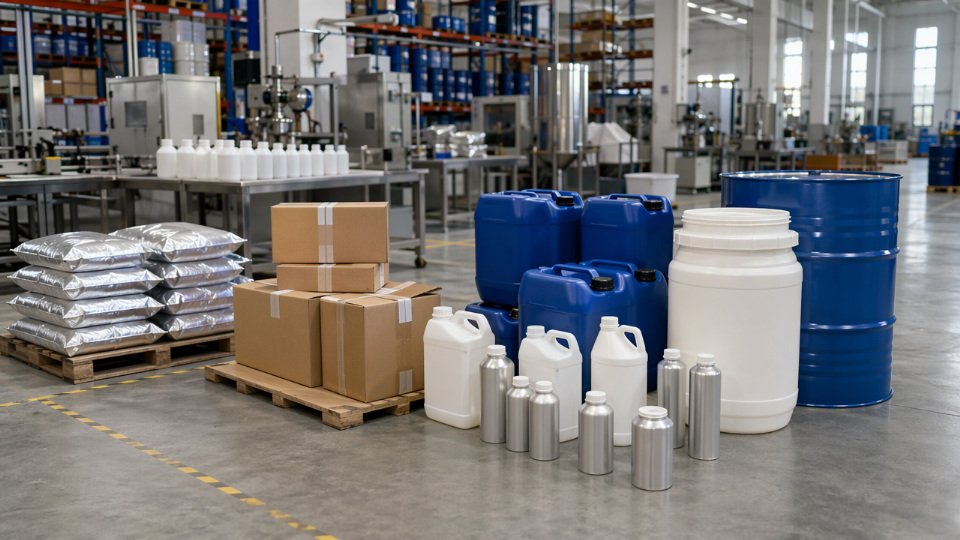
Total Cost of Ownership: How Packaging Choice Affects Procurement Economics
Procurement teams that evaluate silane coupling agents purely on unit price are looking at roughly half the actual cost picture. Packaging format, order cadence, freight classification, warehousing footprint, and waste disposal all feed into the real per-kilogram cost — and the differences between a well-optimized and poorly-optimized procurement strategy can easily reach 15–25% of annual spend, depending on volume and geography.
Decomposing the True Cost per Kilogram
Start with what most buyers see: the quoted unit price. Then layer in what they often miss.
Packaging cost is real and amortizable. A 200 kg steel drum carries a container cost of roughly $30–60 per unit depending on origin and specification; spread across its contents, that adds $0.15–0.30/kg before you’ve moved it anywhere. An IBC tote at $200–400 per unit holding 1,000 kg reduces that packaging contribution to $0.20–0.40/kg — but the key variable is whether it’s a returnable or single-use IBC, which changes the math significantly.
Hazmat freight surcharges are a separate multiplier. Many silane coupling agents ship under UN 1993 (flammable liquid, n.o.s.) or UN 3082 classification, triggering dangerous-goods surcharges on both air and sea freight. Those surcharges are applied per shipment, not per kilogram, so larger, less frequent shipments dilute the surcharge cost. A buyer shipping 400 kg monthly in drums may pay $150–300 per shipment in DG fees; consolidating to quarterly IBC shipments of 1,200 kg absorbs the same fee across three times the volume.
Customs duties are calculated on CIF value in most jurisdictions. Packaging format affects declared value and, in some cases, the HS code classification. Verify your classification with a licensed customs broker — misclassification is surprisingly common with specialty silanes, and the correction cost after the fact is always higher than getting it right upfront.
Warehousing footprint adds cost through floor space, racking, and the administrative burden of lot tracking. Four 200 kg drums occupy more usable floor space and require more individual log entries than a single IBC holding the same volume. At $8–20 per square meter per month for climate-controlled chemical storage (the range depends on facility type and region), this is not a trivial line item at scale.
Empty container disposal is the cost nobody budgets until the drums start stacking up. Steel drum reconditioning runs $15–35 per unit where services exist; disposal without reconditioning often requires hazardous waste manifesting and licensed contractors, adding $20–60 per drum depending on local regulation. IBC disposal or return logistics carry their own costs but are typically more favorable per kilogram of product handled.
Drum Versus IBC: A Realistic Volume Threshold
A facility consuming 2,000 kg per month sits near the crossover point where IBC economics typically become favorable. At that volume, an IBC-based procurement program can deliver 8–12% savings per kilogram versus 200 kg drums once freight density, reduced handling labor (loading/unloading time per kilogram drops substantially with IBCs), and disposal costs are factored together. The offsetting investment is IBC handling infrastructure — a forklift with appropriate tine spacing, a drum-free decanting station, and a dedicated bunded storage bay. That capital outlay typically pays back within 6–18 months at the 2,000 kg/month consumption level, faster at higher volumes.
Customers switching from 200 kg drums to IBC format at 2,000+ kg/month consumption routinely achieve freight and handling savings in the 8–12% per-kilogram range.True
This range reflects documented logistics economics: freight density improvement with IBC versus drums, reduced per-unit handling labor, and lower amortized packaging cost per kilogram. Actual savings depend on shipping lane, labor rates, and whether IBCs are returnable.
The Hidden Cost of Shelf-Life Mismanagement
If annual silane spend is $200,000 and 10% of purchased material is scrapped each year due to expiry or quality degradation — a conservative estimate for operations without disciplined FIFO and lot-rotation practices — that’s $20,000 in direct material waste. That figure doesn’t include the downstream costs: production downtime while replacement material is sourced, rework or scrap from composite or coating batches that ran with degraded silane before the problem was caught, and the technician time spent on root-cause investigation.
The operational rule that prevents most of this: size your order quantity so that any opened container is fully consumed within 60 days. Partially used containers of aminosilanes and epoxysilanes are the highest-risk items — both begin measurable hydrolysis within minutes at relative humidity above 60%, and a poorly resealed container in a humid plant environment can drop from specification to out-of-spec in under a week.
The Repackaging and Traceability Premium
Purchasing from intermediaries who break bulk introduces costs that don’t appear on the invoice. Contamination risk rises every time a silane is transferred between containers outside the original manufacturing environment. Chain-of-custody documentation becomes fragmented, sometimes making it impossible to trace a quality failure back to a production lot. And the shelf life clock doesn’t stop during warehousing at the distributor level — material described as “fresh” may have already consumed 6–9 months of its 12–24 month shelf life before it arrives at your dock.
Manufacturer-direct purchasing with documented lot numbers, original sealed containers, and a COA tied to the batch eliminates these ambiguities. The unit price may be slightly higher than a spot buy through a local intermediary, but the total cost, including quality risk, is typically lower.
A Practical Procurement Optimization Framework
Match packaging size to consumption rate first, then optimize order frequency around shelf life and storage capacity. A straightforward decision sequence: calculate your 60-day consumption volume and use that as your target order quantity per packaging unit. Implement FIFO with lot number tracking — this is non-negotiable for any operation running multiple concurrent lots. Set a reorder trigger at 30 days of remaining stock, not when you run out, to preserve buffer against lead time variability.
For high-volume customers, SiliconChemicals’ commercial team conducts packaging optimization reviews that map actual consumption data against available container formats, freight lanes, and storage infrastructure to recommend the combination that minimizes total cost of ownership — not just the line-item unit price.
Frequently Asked Questions About Silane Coupling Agent Packaging and Shelf Life
Can I use a silane coupling agent past its stated shelf life if it looks clear and colorless?
Visual clarity is necessary but not sufficient. Early-stage oligomerization — particularly in aminosilanes and epoxysilanes — does not reliably produce visible turbidity until the reaction has progressed well beyond the point where coupling performance is already compromised. A drum of KH-550 or KH-560 can look perfectly clear while GC purity has dropped by several percentage points and moisture content has climbed past 500 ppm. The correct fitness-for-use screen combines GC purity (compare against the original COA lot value, not just a generic specification floor), Karl Fischer moisture titration, and a hydrolysis/coupling test if your application is particularly sensitive. Passing all three on an expired lot is not a guarantee of full performance, but failing any one of them is a hard stop. Never substitute a visual check for instrument data when committing material to a production run.
Visual clarity alone is not a reliable indicator of silane coupling agent quality after extended storage.True
Oligomerization and moisture uptake can degrade functional performance significantly before any visible turbidity or color change appears, as confirmed by GC and Karl Fischer testing protocols used in industrial quality control.
What is the best way to store a partially used drum of 3-aminopropyltriethoxysilane (KH-550)?
Purge the headspace thoroughly with dry nitrogen before resealing — dew point of the purge gas should be below −40°C; anything warmer carries enough residual moisture to matter over weeks. Reseal with a Viton-gasketed bung rather than a standard rubber plug, because KH-550 will swell and permeate many common elastomers over time. Store the drum below 20°C and below 50% relative humidity. Under those conditions, plan to consume the remainder within 60–90 days. If the drum sits longer than that, re-test moisture content and purity before use. Aminosilanes are among the most moisture-reactive functional classes; the amine group accelerates hydrolysis catalytically, so degradation in a partially used container is faster than in the same product sealed at the factory.
Are 200 kg steel drums safe for vinyltrimethoxysilane, or should I use HDPE?
Epoxy-phenolic lined steel drums are acceptable for vinyltrimethoxysilane and are the standard commercial format for this grade. Plain unlined carbon steel is not recommended: trace iron ions can catalyze methanol liberation and accelerate slow decomposition, particularly at elevated temperatures. HDPE drums are a workable alternative for quantities below roughly 50 kg, but confirm wall thickness and bung compatibility with your supplier — vinyltrimethoxysilane has moderate permeability through thin HDPE over multi-month storage periods. For any drum format, verify that vent plugs are pressure-rated and that the liner coating shows no visible holiday defects on receipt.
Does SiliconChemicals offer private-label packaging for distributor customers?
Yes. Private-label HDPE bottles, pails, and steel drums with custom English-language labels are available for established distributor accounts that meet qualifying minimum order volumes. Label specifications — including hazard pictograms, batch traceability codes, and destination-market regulatory language — are coordinated during account setup. Lead time for first-run custom labels is typically longer than standard shipments, so factor that into your initial order planning.
How does ocean freight transit time affect shelf life?
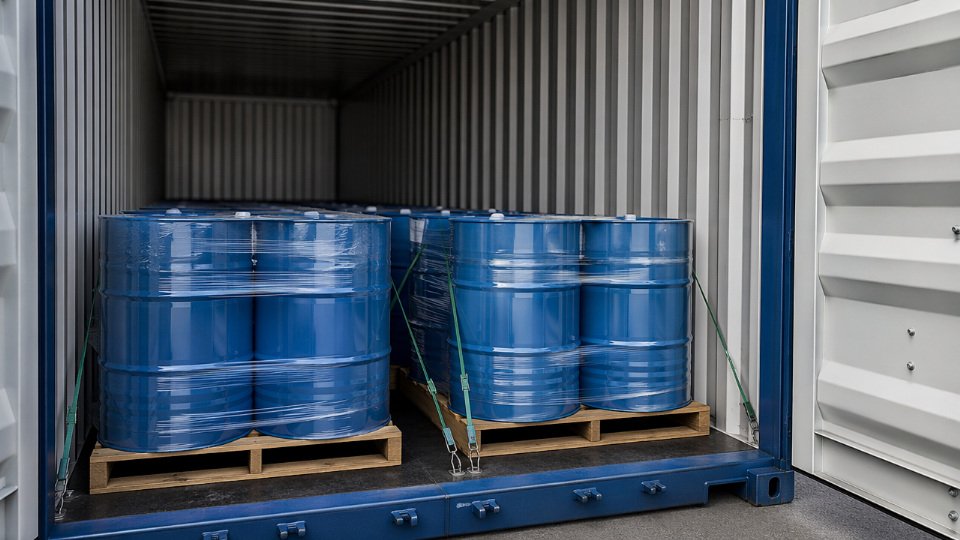
A 30–45 day transit from China to Europe or North America consumes roughly 3–4% of a 12-month shelf life under controlled temperature conditions. That fraction sounds small, but it compounds with warehouse dwell time at origin and destination. The more serious risk is temperature excursion: an unventilated 40-foot container in tropical summer conditions can reach 50–60°C internally, and even brief excursions above 35°C measurably accelerate hydrolysis in alkoxysilane grades. For temperature-sensitive aminosilanes and epoxysilanes, specify reefer container or shaded stowage and request container temperature logs from your freight forwarder. A few hundred dollars of controlled freight can easily offset a rejected batch.
What documentation should I require from a supplier for each shipment?
At minimum: a certificate of analysis carrying the lot number, manufacture date, and actual test results (not just pass/fail); a current Safety Data Sheet in the destination country’s official language; UN-performance-tested packaging certification for any hazardous goods classification that applies; and a REACH compliance declaration or TSCA import certification depending on your market. For distributor re-export scenarios, request the original manufacturer’s COA alongside any repackager documentation — traceability back to the production lot is essential if a quality dispute arises months later.
Can silane coupling agents be stored in the same warehouse as epoxy resins and hardeners?
Yes, with deliberate segregation. Aminosilane coupling agents function as curing catalysts for epoxy systems, so co-storage of KH-550 or similar grades adjacent to epoxy resin containers creates a genuine cross-contamination risk — even residue from a spilled or leaking bung can initiate partial cure in nearby epoxy stocks. Maintain at least one full aisle separation or a non-combustible partition between aminosilanes and epoxy materials. Chlorosilane-functional grades carry a harder constraint: they must be isolated in a dedicated hazmat zone, separated from all moisture-sensitive materials, water sources, and reactive chemicals, consistent with their corrosive gas evolution hazard on moisture contact. Label storage zones clearly, and make sure forklift operators know the segregation map before any stock movement.