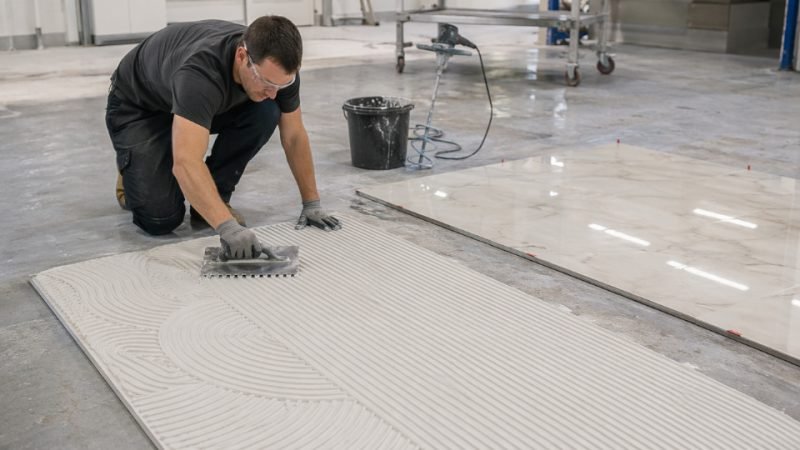
Large-format porcelain slabs fail not because of the slab itself, but because the wrong adhesive system leaves nowhere near enough mechanical and chemical grip on a surface that is intentionally engineered to repel penetration. A 12 mm slab at roughly 15 kg/m² exerts peel and shear forces that exposed-aggregate cementitious mortars simply cannot sustain long-term — especially on facades, heated floors, or substrates with any differential movement. The result is debonding within 12–36 months, replacement labour that typically costs two to four times the original installation, and in overhead or vertical applications, a genuine safety liability.
The best bond for porcelain slabs combines a silane-modified polymer (SMP) or high-performance epoxy adhesive with a silane coupling agent primer — such as gamma-methacryloxypropyltrimethoxysilane (MPS) or APTES — applied to the slab back before bonding. This system routinely achieves pull-off strengths of 2.5–4.5 N/mm² on polished vitrified porcelain, well above the EN 1348 minimum of 1.0 N/mm², and is the configuration most installation engineers and adhesive formulators now specify for slabs above 6 mm thick.
What makes this worth understanding at a chemistry level is that polished porcelain is not just smooth — it is a near-inert, ultra-low-porosity glass-ceramic surface where conventional adhesive mechanisms (mechanical keying, moisture-activated cement hydration) contribute almost nothing. The 40–80% bond-strength uplift that silane coupling agents deliver on these surfaces is not a marketing claim; it comes from covalent bridging between the adhesive polymer matrix and residual silanol groups at the tile surface, and the difference between getting that chemistry right or wrong is exactly the difference between a 20-year installation and an early-failure callback.
Adhesive Technology Options Ranked: Epoxy, PU, MS Polymer, and Modified Cementitious
Four adhesive families dominate large-format porcelain slab installations. Each solves a different subset of the bonding problem — rigidity versus movement tolerance, speed versus working time, cost versus performance margin. Picking the wrong family doesn’t just mean a failed bond test; it means callbacks, delamination under thermal cycling, or slabs pulling scaffold fixings out of a ventilated facade. Here is how they actually compare.
Epoxy Two-Part Mortars
Epoxy systems deliver the highest compressive strength of any option — typically 60–80 N/mm², depending on resin grade and filler loading — and pull-off values on polished vitrified porcelain generally fall between 2.0 and 3.2 N/mm² in controlled conditions. That performance comes from a near-rigid cured matrix; elongation at break is only 1–3%, which means virtually no accommodation of differential movement. On a climate-controlled interior floor with a stable substrate and proper expansion joints at perimeter and field, that rigidity is irrelevant. On a south-facing exterior or over underfloor heating, it becomes a liability.
The operational constraint that catches installers most often is pot life. At 25°C, most two-part epoxy mortars give you fewer than 30 minutes of workable time after mixing. In a warm plant hall or on a summer rooftop terrace, that window shrinks further. Vertical large-slab work with epoxy is genuinely difficult — the material sags before it grabs, and temporary mechanical support or full-perimeter nosing clips become necessary rather than optional.
Polyurethane Adhesives
PU adhesives occupy the opposite end of the rigidity spectrum. Elongation at break runs 200–600% depending on formulation, which means the bond layer absorbs vibration and the thermal racking movement that destroys rigid bonds on facades and large suspended floors. Pull-off strength on polished porcelain sits in the 1.8–3.0 N/mm² range — adequate for most facade specifications but not the highest absolute value in this group.
The isocyanate component is moisture-sensitive before cure. Applying PU adhesive over a substrate with residual construction moisture or in high-humidity conditions causes foaming and voids in the bond line. Full mechanical strength takes 12–48 hours depending on temperature and humidity, so trafficking or loading the slab before cure is a real site-management issue on fast-track projects.
MS Polymer and SMP Hybrid Adhesives
Modified silicone polymer (MS) and silyl-modified polymer (SMP) hybrids borrow silicone’s flexibility — elongation typically 150–400% — and graft it onto a polyurethane-style adhesion mechanism. The result is a system that is paintable, low in VOC, and tolerant of joint movement up to roughly ±25%, which is why ventilated facade engineers increasingly specify this family for clip-fixed and bonded-hybrid porcelain slab systems. Pull-off values on polished porcelain run 1.5–2.8 N/mm², enough to meet EN 1348’s 1.0 N/mm² minimum with meaningful margin.
Cure is moisture-triggered (atmospheric or substrate humidity), so very dry interiors slow it down. Cost per m² installed is higher than cementitious by a meaningful margin.
Polymer-Modified Cementitious (C2TE S2 Class)
This remains the workhorse of the industry — familiar to every tile setter, available everywhere, and lowest in installed cost. A C2TE S2 mortar with a silane-based primer applied to the porcelain back can achieve 1.8–2.5 N/mm² pull-off on vitrified surfaces, clearing the EN 1348 threshold comfortably. Without the primer, the same mortar on the same slab may fail below 1.0 N/mm² because cementitious binders have almost no inherent chemical affinity for low-porosity glazed porcelain.
Silane coupling agent primers improve pull-off adhesion by 40–80% on vitrified porcelain surfaces compared to unprimed cementitious application.True
Published pull-off test data for silane-primed versus unprimed vitrified tile surfaces, using agents such as MPS (gamma-methacryloxypropyltrimethoxysilane) and APTES, consistently show this improvement range, with exact gain depending on silane chemistry, dilution rate, and substrate surface energy.
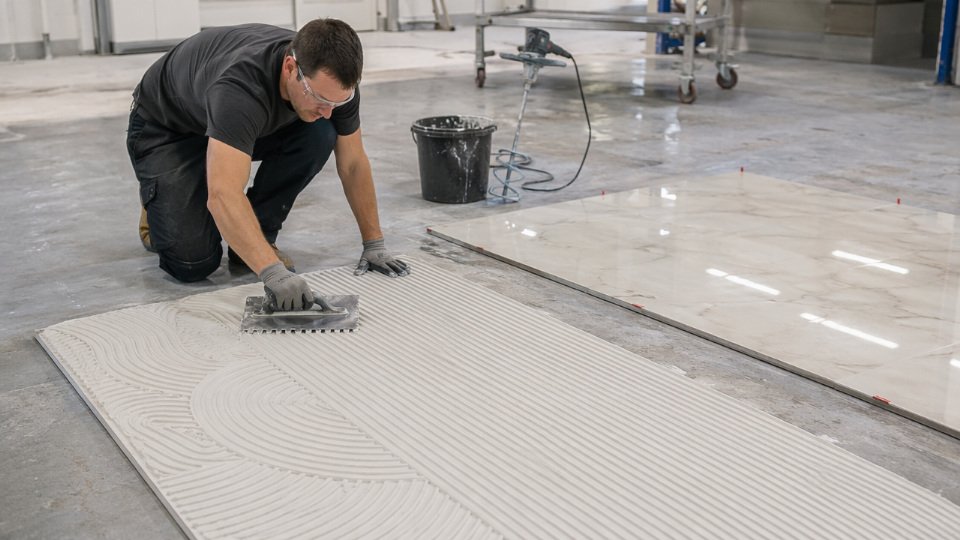
The technique requirements are non-negotiable: full back-buttering combined with notched-trowel application on the substrate, achieving greater than 85% contact coverage verified by lifting a test slab. Skipping back-buttering on a 12 mm slab weighing 18–22 kg/m² is one of the most common causes of hollow spots and long-term delamination.
| Adhesive Type | Elongation (%) | Pull-off on Polished Porcelain (N/mm²) | Open Time | Temperature Resistance | VOC Level | Approx. Installed Cost (per m²) |
|---|---|---|---|---|---|---|
| Epoxy two-part mortar | 1–3 | 2.0–3.2 | 20–30 min at 25°C | Up to 80–100°C (cured) | Low–medium | High |
| Polyurethane | 200–600 | 1.8–3.0 | 30–60 min | –40°C to +80°C | Medium | Medium–high |
| MS/SMP hybrid | 150–400 | 1.5–2.8 | 20–40 min | –40°C to +90°C | Very low | Medium–high |
| C2TE S2 cementitious + silane primer | <1 | 1.8–2.5 (primed) | 20–40 min | Up to 60°C continuous | Very low | Low–medium |
Cost ranges depend on slab format, required bed thickness, and regional labor rates. Temperature resistance figures apply to correctly cured product under static load; cyclic thermal loading narrows usable limits.
The Silane Surface Chemistry That Makes or Breaks the Bond on Vitrified Porcelain
Vitrified porcelain presents a paradox for adhesive engineers: it is dimensionally stable, chemically inert, and mechanically hard — exactly the qualities that make it attractive for large-format installations and exactly the qualities that make it refuse to bond. Water absorption sits below 0.5% (ISO 10545-3), which means the capillary suction that pulls cementitious adhesive into a conventional tile simply does not exist. What you are left with is a near-glassy surface with a sparse, inconsistent population of hydroxyl groups (Si–OH) — and that surface chemistry is where the bonding problem either gets solved or doesn’t.
How [Silane Coupling Agents](https://siliconchemicals.com/silane-coupling-agents/) Actually Work at the Interface
A silane coupling agent is a bifunctional molecule. One end carries alkoxy groups — typically methoxy (–OCH₃) in silanes like gamma-methacryloxypropyltrimethoxysilane (MPS) or ethoxy (–OC₂H₅) in aminopropyltriethoxysilane (3-APTES). In the presence of trace moisture — atmospheric humidity is enough — those alkoxy groups hydrolyze to silanols (Si–OH). Those silanols then condense with the residual hydroxyl groups on the porcelain surface, forming covalent Si–O–Si bonds that anchor directly into the ceramic network. The other end of the molecule — the organofunctional group — is selected to co-react chemically with the adhesive polymer matrix applied over it.
The result is a molecular bridge. The porcelain is no longer relying on mechanical interlocking or van der Waals contact alone. There is a continuous covalent pathway from ceramic substrate through the silane interlayer into the adhesive body.
 hydrolysis and condensation bonding mechanism at a porcelain surface](https://siliconchemicals.com/wp-content/uploads/2026/06/best-bond-for-porcelain-slabs-01-silane-hydrolysis-condensation-mechanism-diagram.jpg)
Matching the Coupling Agent to Your Adhesive Chemistry
Silane selection is not interchangeable. Using the wrong organofunctional group gains you very little.
| Adhesive system | Recommended silane | Organofunctional group reacting with matrix |
|---|---|---|
| Epoxy (two-part) | 3-APTES, 3-APTMS | Amine reacts with epoxide ring |
| Polyurethane | 3-APTES, mercaptopropylsilane | Amine or thiol reacts with isocyanate |
| Acrylic-modified cementitious | MPS, gamma-MPS | Methacrylate co-polymerizes with acrylic phase |
| MS polymer / hybrid sealant | Vinyltrimethoxysilane | Vinyl integrates into silicone-organic backbone |
| Polysulfide | Mercaptopropyltrimethoxysilane | Thiol reacts with polysulfide chain |
A site applying a PU adhesive over an MPS primer is not getting chemical co-reaction — the methacrylate group has nothing to bond to in a urethane matrix. That mismatch is a common procurement error when job-site teams source primer and adhesive from different suppliers without checking chemistry compatibility.
The Performance Numbers — and What They Depend On
Published lap-shear and cross-cut adhesion tests consistently show that a correctly applied silane primer on polished porcelain increases bond strength by 40–80% compared to unprimed surfaces. The range depends on surface cleanliness, ambient humidity during application (40–70% RH is the working window for most water-based primers), substrate temperature, and cure time before adhesive application.
Silane coupling agents improve adhesive bond strength by 40–80% on vitrified porcelain in pull-off testingTrue
This range is consistent with published data in adhesion science literature and aligns with EN 1348 pull-off test results comparing primed vs. unprimed vitrified surfaces using epoxy and silane-modified polymer adhesives.
More diagnostically useful than the strength number is the failure mode shift. On unprimed vitrified porcelain, failure under pull-off testing is adhesive — the bond breaks at the tile-adhesive interface, leaving the tile face clean. After correct silane priming, failure becomes cohesive — the adhesive itself ruptures while the interface holds. That shift tells you the interface is no longer the weak link in the system. For large-format slabs weighing 15–25 kg/m², that distinction separates a tile that stays on a wall through thermal cycling from one that delaminates within two winters.
Concentration, Carrier Solvent, and Why Over-Application Backfires
Water-based silane primers at 0.5–2% active silane content are the standard for occupied or low-ventilation job sites. They comply with most low-VOC specifications and carry lower flash and handling risk. The trade-off is flash-off time: water-based primers typically need 30–60 minutes before adhesive application, depending on temperature and airflow. IPA-carried solutions flash off in 10–20 minutes — useful when you are working in temperature-controlled interior environments and need to turn the job quickly.
The critical control variable is coat weight. Wet application of 5–10 g/m² is the target range for most commercial primers. Below that, coverage is patchy and the molecular bridge is incomplete. Above it — and this catches out applicators who assume more is better — you build up a thick silane-rich layer that is internally weak. The polysiloxane condensation layer itself becomes the failure plane. A useful site check: the primed surface should look uniformly wet then dry to a near-invisible film. If you can see a white haze or residue, you have over-applied.
Oligomeric Silane Systems for Industrial Formulators
Monomeric silanes have a shelf-life limitation once opened and are sensitive to premature hydrolysis in storage. Pre-hydrolyzed silane oligomers — short-chain polysiloxane structures with retained organofunctionality — address both issues. Because hydrolysis is already partially complete, they are less sensitive to ambient humidity variation during application and more tolerant of light surface contamination such as residual release agent or mold dust. Adhesion performance on partially contaminated porcelain is meaningfully better than monomeric equivalents in controlled comparative tests.
For adhesive formulators incorporating silane functionality directly into their product rather than relying on a site-applied primer, oligomeric silanes offer processing advantages: they distribute more uniformly in polymer matrices and do not segregate as readily during storage. SiliconChemicals manufactures pre-hydrolyzed silane oligomer grades — including amino-functional and methacryloxy-functional variants — specifically for adhesive and sealant formulation, with consistent active content and controlled molecular weight distribution suited to industrial batch production.
Substrate Preparation and Back-Surface Treatment Protocols for Large-Format Slabs
Getting the adhesive chemistry right means nothing if the surfaces it contacts are contaminated, too smooth, or geometrically wrong. This section is about what happens before the adhesive is ever opened.
Classifying the Slab Back Face Before You Touch a Brush
Not all porcelain slab backs are equivalent, and treating them as such is one of the most common installation errors seen in large-format projects.
Natural textured or rough-ground backs — common on sintered compact slabs from pressing — have surface roughness values (Ra) already above 2 µm in most cases. They absorb silane primer readily, and capillary contact with the adhesive is reasonably predictable. These are your easiest starting condition.
Fully polished backs, sometimes a side effect of through-body polishing or reversed handling, present Ra values below 0.5 µm. Silane coupling agents cannot develop adequate molecular contact on a surface that flat. The fix is mechanical: a diamond abrasion pad used in overlapping passes until Ra exceeds 1.5 µm, verified with a profilometer if the project warrants it. On site, a fingernail drag test and a water-drop spread test give a fast proxy — water should spread rather than bead. Chemical etching with dilute hydrofluoric acid gel is used in factory pretreatment workflows, but HF carries serious health hazard and is rarely appropriate for site work. Confirm which back condition you have before materials are ordered.
Structured mesh-back slabs create a third category. The increased surface area sounds favorable, but the mesh geometry traps air pockets under adhesive if the mortar or adhesive isn’t worked firmly into the voids. Full-contact transfer is harder to achieve and harder to verify. Back-buttering the slab while simultaneously applying adhesive to the substrate — a double-sided application — is the correct technique here. Open time management becomes more critical because you’re manipulating more material before seating.
Cleaning Sequence: What You’re Actually Removing
Mold-release agents, cutting oils from fabrication, and fine silica dust are the three main contaminants on slab back faces. Any one of them creates a barrier layer that prevents silane coupling agents from reaching the silanol groups on the porcelain surface.
Wipe down with isopropanol (IPA, ≥70% purity) using lint-free cloths, replacing cloths before they redistribute oils. For slabs that have been stored in fabrication environments, an alkaline degreaser solution followed by a clean-water rinse is more reliable than IPA alone. Allow surfaces to dry fully — residual solvent or water interferes with silane hydrolysis kinetics if a solvent-based primer is specified.
On the receiving substrate — cementitious screeds, concrete, or existing tile — check for efflorescence before doing anything else. White salt deposits indicate moisture migration and ongoing alkaline activity; bonding over them produces failure within months. Treatment: scrub with a 5% HCl solution, neutralize with dilute sodium bicarbonate solution, rinse, and allow a minimum of 24–48 hours dry-out time depending on ambient humidity and substrate porosity. Do not rush this step. A substrate that tests dry at the surface can still carry enough residual moisture to disrupt epoxy cure or suppress silane coupling efficiency.
Silane coupling agents improve adhesive bond strength by 40–80% on vitrified porcelain surfacesTrue
Published pull-off test data for agents such as MPS and APTES on low-porosity vitrified porcelain show this range; actual improvement depends on surface roughness, primer concentration, application method, and adhesive type.
Silane Primer Application: Method, Rate, and Timing
Application rate for silane primer on porcelain slab backs typically runs 5–10 g wet per m², depending on surface roughness and the specific primer formulation. Rough backs consume toward the upper end; mechanically abraded backs closer to the lower end. Apply by brush for small batches or spot treatment, roller for large slab volumes, or airless spray for production-scale prefabrication workflows.
Open time discipline is non-negotiable. Water-based hydrolyzed silane primers need 45–60 minutes before adhesive application — long enough for the methoxy or ethoxy groups to complete hydrolysis and for the alcohol byproduct to evaporate. Solvent-based formulas work faster, typically 15–20 minutes. Apply adhesive too early and you’re laminating into a wet, unreacted film. Apply too late and the reactive silanol surface has condensed and lost reactivity. Mark the clock when primer goes on.
Shelf life after mixing or opening a water-based hydrolyzed primer is typically 4–8 hours. Label containers with time of opening. Re-contamination after priming — fingerprints, dust settlement, droplets — negates the treatment. On active construction sites, physical barriers or sequenced workflow scheduling are necessary, not optional.
Substrate Flatness: Tolerance Isn’t a Suggestion
EN 13 793 sets the baseline: maximum 3 mm deviation measured under a 2 m straightedge. For slabs exceeding 1 m in any direction, many project specifications tighten this to 2 mm, and there are good structural reasons for that. A large-format slab bridging a substrate high spot concentrates stress at the contact point; under live load, the adhesive sees peel rather than shear. That’s how you get cracking at seemingly random intervals post-installation.
Self-leveling underlayments reinforced with polymer dispersion are the right correction tool — they flow into low spots without the shrinkage cracking that affects plain cementite pours. Let them cure fully before grinding high spots and checking flatness again. For structural floors, also verify deflection-to-span ratio. L/360 minimum is the commonly referenced threshold; below that, dynamic flex will fatigue adhesive joints regardless of adhesive quality.
Environmental Conditions That Can Quietly Destroy the Job
Substrate temperature range during installation: 5–35°C. Below 5°C, most polymer adhesives and silane primers slow cure dramatically; below 0°C, water-based systems freeze before they set. Above 35°C, open time shrinks faster than most installers account for.
The more commonly overlooked risk is direct solar exposure on large slabs during open time. When surface temperature exceeds 40°C — easily reached on exterior cladding in summer — adhesive can skin over within 5–8 minutes. The slab seats onto a cured skin rather than wet adhesive, and pull-off values drop sharply. On exterior projects in warm climates, shade screening or scheduling installation for early morning or night hours isn’t a comfort measure; it’s a technical requirement. Check the slab surface temperature with an infrared thermometer, not just the air temperature.
| Condition | Acceptable Range | Risk Below/Above |
|---|---|---|
| Substrate temperature | 5–35°C | Cure inhibition / open time collapse |
| Relative humidity | 40–80% | Slow primer hydrolysis / surface condensation |
| Slab surface temperature | 30 min at 30°C substrate | Thermal shear from daily cycling |
| Wet area (kitchen / spa / pool) | Two-part epoxy mortar | Gamma-GPTS (glycidoxypropyltrimethoxysilane) | 2.5–3.5 N/mm² | Per manufacturer (typically 20–40 min) | Chemical attack; grout joint permeability |
| Exterior ventilated facade ≤20 m | Single-component polyurethane | Aminosilane | ≥1.5 N/mm² wet adhesion | Per system TDS | Wind peel load; primer omission on polished backs |
| High-rise structural facade >20 m | Structural silicone | Silane primer on slab and frame | Project-specific (pull-off + shear tested) | Controlled application window | No mechanical backup; inadequate batch testing |
| Countertop / furniture, 3–6 mm slab | MS polymer | Mercaptosilane or vinylsilane | >1.5 N/mm² | 15–30 min typical | Substrate deflection; edge moisture ingress |
Quality Control, Testing Standards, and Field Verification Methods
Bond failure in large-format porcelain slab installations rarely announces itself during installation. It shows up six months later as a cracked 12 mm slab on a facade, or a hollow-sounding kitchen floor that cost three times the original installation to remediate. The only reliable way to prevent that outcome is a layered verification program running from formulation lab through to installed work — and knowing exactly what each test is telling you.
Pre-Installation Laboratory Testing
Before any adhesive system goes near a project, it needs to be classified against EN 12004. The minimum standard for large-format porcelain work is C2 (improved cementitious) or equivalent in epoxy or reaction-resin class. The pull-off tensile adhesion test under EN 12004 requires specimens cured 28 days, then tested across four conditioning states: standard cure, water immersion, heat aging at 70 °C for 14 days, and 25 freeze-thaw cycles. The minimum passing value for all states is 0.5 N/mm² — that threshold is the floor, not the target.
On vitrified porcelain, which has near-zero surface porosity, unprimed adhesive systems frequently come in at 0.6–0.9 N/mm² in the heat-aged and freeze-thaw states even when they pass the standard cure condition comfortably. When a silane coupling agent primer — MPS or APTES-based — is applied to the slab back face before adhesive contact, the same formulations typically reach 1.5–2.5 N/mm² across all four conditioning states. That improvement of 40–80% is not theoretical; it reflects the covalent bridge the silane forms between the silica-rich ceramic surface and the polymer adhesive matrix. Any lab protocol for porcelain slab projects should set the internal specification at ≥1.5 N/mm² in all conditioning states, not the EN minimum.
Silane coupling agent primers can increase pull-off adhesion strength on vitrified porcelain by 40–80% compared to unprimed surfaces in standardized lab conditioning tests.True
Published pull-off test data on polished and semi-polished vitrified porcelain consistently show this improvement range when MPS or APTES-type silane primers are applied at appropriate coverage rates before adhesive contact, attributable to silane-mediated covalent bonding at the ceramic surface.
On-Site Pull-Off Testing
Once slabs are installed, EN 1542 or ASTM D4541 hydraulic pull-off testing gives you a direct in-place bond value. The procedure uses a 50 mm diameter metal dolly epoxy-bonded to the slab face, loaded to failure with a calibrated hydraulic gauge. Record both the failure load and, critically, the failure mode: A (adhesive failure at tile interface), B (cohesive failure through the adhesive body), or C (adhesive failure at substrate). A well-bonded system should show ≥80% cohesive failure (mode B) and minimum 1.0 N/mm². If you are seeing predominantly mode A failures, the problem is almost certainly inadequate surface preparation or missing silane primer on the slab back face. A minimum test frequency of one test per 50 m² is standard practice; increase this on facades and in wet areas.
Hollow-Tile Sounding
A rubber mallet or dense wooden mallet dragged across the slab surface between 7 and 28 days after installation is one of the most practical checks available on a live site. A debonded area produces a distinctly hollow, resonant tone versus the flat thud of a fully bonded slab. Any single hollow zone covering more than 5% of a slab’s area is cause for investigation. Edge hollows are particularly serious — edge lifting under point load generates peel stress that propagates debonding rapidly inward. This test costs nothing and catches problems before they become structural.
Adhesive Contact Coverage
Lifting a slab immediately after laying — within the adhesive open time, before any set occurs — and inspecting mortar transfer onto the slab back face is the most direct check of installation technique. Minimum acceptable coverage is 85% for interior floors. In wet areas, facades, and any application subject to thermal cycling, 95% is the correct requirement. Coverage below these thresholds concentrates all bond stress onto a fraction of the designed area, mechanically explaining the majority of long-term delamination failures. Low coverage traces directly to trowel notch size being too small for the slab thickness, skipping back-buttering on large formats, or adhesive that has begun to skin over.
Silane Primer Verification on Site
The lab knows the silane primer is working because tensile adhesion numbers go up. The site needs a faster check. Water contact angle measurement on the primed back face of a porcelain slab is the most reliable method: properly primed vitrified porcelain should show a contact angle below 40°, indicating a hydrophilic, reactive surface ready for adhesive bonding. Untreated polished porcelain typically shows contact angles of 60–90°, depending on the specific glaze and firing temperature. Where goniometry is not available on site, dyne test pens calibrated above 44 dynes/cm give a rapid pass/fail indication for the same surface energy criterion. Reject any primed surface that fails the dyne test and re-apply primer — the alternative is investing in a pull-off test failure six months later.
Sourcing [Silane Coupling Agents](https://siliconchemicals.com/silane-coupling-agents/) and Adhesive Raw Materials: SiliconChemicals Supply Chain Advantage
For adhesive formulators and large-format tile contractors, the silane coupling agent is rarely the largest line item in a bill of materials — but it is consistently the item where supply chain failures cause the most damage. A late shipment, an off-spec batch, or a silane blend that behaves differently from the development sample can stall an entire production run or invalidate a project specification. Getting the sourcing right matters as much as getting the chemistry right.
China’s Organosilicon Industrial Clusters and What They Mean for Cost
SiliconChemicals operates within the established organosilicon manufacturing corridors of Zhejiang, Shandong, and Jiangxi provinces. These are not assembly operations. The cluster model means that methanol, chlorosilane monomers, and specialty organofunctional intermediates are produced, reacted, and distilled within compact regional supply chains — often within the same industrial park. That integration eliminates the import markups and multi-tier distributor margins that European and North American silane buyers typically absorb.
The practical result: for equivalent purity grades (>97% GC purity, verified by certificate of analysis issued with every batch), delivered cost to a European adhesive formulator running SiliconChemicals material is typically 20–40% below comparable Western-sourced product. The exact differential depends on order volume, the specific silane grade, and freight market conditions — ISO tank quantities compress that gap somewhat compared to drum orders, but the cost advantage holds across common porcelain-relevant silanes at every volume tier.
Core Silane Product Lines for Porcelain Slab Bonding
The five silanes most directly relevant to porcelain slab adhesive and primer systems are all standard catalog items:
| Trade Code | IUPAC / Common Name | Primary Bonding Role |
|---|---|---|
| KH-550 / A-1100 | 3-Aminopropyltriethoxysilane (APTES) | Epoxy and PU adhesive primers; cementitious modifier |
| KH-560 / A-187 | 3-Glycidoxypropyltrimethoxysilane | Epoxy crosslinker coupling; MS polymer systems |
| KH-570 / A-174 | 3-Methacryloxypropyltrimethoxysilane (MPS) | Acrylate and UV-cure adhesive formulations |
| KH-151 | Vinyltrimethoxysilane | Polyolefin and EPDM-backed composite substrates |
| KH-590 | Mercaptopropyltrimethoxysilane | Sulfur-cure rubber and polysulfide sealant systems |
All five are available in 180 kg drums, 1,000 kg IBCs, and ISO tank quantities. For a mid-size adhesive manufacturer running 500–2,000 tonnes of finished product per year, IBC supply with scheduled call-off typically offers the best balance between inventory carrying cost and unit pricing.
Pre-Hydrolyzed Oligomeric Blends and Co-Development
Raw monomeric silanes are not always what a formulator needs. Hydrolysis sensitivity, pot-life requirements, and compatibility with specific polymer backbones sometimes make a pre-hydrolyzed oligomeric silane blend the more practical starting point. SiliconChemicals offers custom oligomeric blends — silane content, degree of condensation, and solvent system specified to the customer’s adhesive architecture — with batch-to-batch consistency documented by viscosity, GC purity, and hydrolyzable chloride content.
Co-development engagements are available for formulators working on new porcelain primer systems. That means application engineers on SiliconChemicals’ side reviewing the full adhesive formulation context, not just selling a commodity silane into it.
SiliconChemicals coordinates third-party testing through SGS and Intertek to generate project specification compliance documentation.True
This is a stated value-added service offered to customers who need pull-off adhesion data and material conformance reports for project specifications under EN 1348 or equivalent standards.
Logistics, Lead Times, and Sampling
FCL and LCL export moves through Shanghai and Ningbo ports under UN-certified dangerous goods packaging. Typical transit is 15–25 days to Europe and 20–30 days to Middle East and Southeast Asia ports — realistic ranges that depend on the specific destination, shipping line scheduling, and any customs clearance variables on the receiving end.
New formulation development starts with samples. A 1–5 kg sample of any catalog silane ships within five business days. That turnaround is fast enough to run a meaningful bench trial before committing to a drum order.
Quality Assurance Framework
ISO 9001 certified production with full batch traceability from raw silanol feedstock through finished packaged product. Every export shipment includes SDS, TDS, and COA in English — not translated summaries, full technical documents. The technical support hotline is staffed by PhD-level organosilicon chemists, which means formulation troubleshooting conversations start at the right technical level rather than being routed through a commercial sales layer before reaching someone who can actually answer the question.
Frequently Asked Questions About Bonding Porcelain Slabs
Can I use standard wall-tile adhesive for large porcelain slabs?
No — and this is one of the most common and costly mistakes on commercial fit-out sites. Standard C1 cementitious adhesives rely heavily on mechanical keying into a porous substrate. Polished or vitrified porcelain presents near-zero porosity, so pull-off values on a smooth slab back face typically fall below 0.5 N/mm², well under the EN 1348 minimum of 1.0 N/mm² for large-format installations. Beyond raw adhesion, C1 materials carry no deformability classification — meaning a 1200 × 2400 mm slab cycling through a 30°C temperature swing will generate differential movement that a rigid cementitious bond simply cannot absorb. The correct minimum specification is a C2TE S2 polymer-modified cementitious adhesive used with a silane coupling agent primer, or a reactive resin system (epoxy or MS polymer) for demanding conditions.
Standard C1 tile adhesives reliably bond large-format porcelain slabsFalse
C1 adhesives achieve less than 0.5 N/mm² pull-off on low-porosity vitrified porcelain surfaces — below the EN 1348 minimum of 1.0 N/mm² — and have no deformability rating to handle thermal movement in large-format pieces.
How long should I wait after applying silane primer before laying the adhesive?
Open time depends entirely on the carrier system. Water-based silane primers need 45–60 minutes at 20°C and 50% RH to complete hydrolysis and surface condensation. Solvent-based primers using an IPA carrier react faster — 15–20 minutes is typically sufficient. The practical rule: never apply adhesive to a primer that still looks wet or feels tacky from solvent. Residual moisture or solvent at the bondline disrupts adhesive cure and can trap voids. Equally important — do not leave primed surfaces sitting for more than 4 hours. The reactive silanol groups will repassivate or become contaminated, and the chemical bridge you created between the porcelain and the adhesive degrades substantially.
Do silane primers work on polished (mirror-finish) porcelain faces?
Yes, but only if you address the fundamental surface chemistry problem first. A mirror-polished porcelain face has very few exposed surface hydroxyl groups and minimal physical roughness, so silane coupling agents have limited sites to condense onto. The practical fix is mechanical abrasion to Ra > 1.5 µm using a light diamond pad or silicon carbide block, followed by IPA degreasing. On a properly prepared surface, published pull-off data shows silane primers improving bond strength by 40–80% versus unprimed controls. Skip the abrasion step and the improvement is marginal — you are essentially priming a glass-smooth, chemically inert surface.
What causes porcelain slabs to debond within 6–12 months of installation?
Three failure mechanisms account for the large majority of field callbacks. First: insufficient adhesive contact coverage, almost always caused by skipping back-buttering — installers comb only the substrate, leaving the slab back face partially unbonded. Coverage below 85% concentrates stress at contact points. Second: missing movement joints, which allows compressive stress from thermal cycling to build until the bond shears. Third: using a rigid adhesive — standard epoxy or unmodified cementitious — on a substrate that has any residual deflection or vibration. In that third scenario the bond is stronger than the screed beneath it, and the screed tears. Each failure mode is preventable; all three appear together on sites where the specification was cut to save cost.
Is epoxy adhesive always better than cementitious for porcelain?
Not always. Epoxy delivers the highest absolute bond strength and excellent chemical resistance, which makes it the right call for chemical plant flooring, commercial kitchens, and areas subject to aggressive cleaning. The liability is rigidity — typical elongation at break below 3% — and irreversibility. On substrates subject to thermal cycling, vibration, or minor structural movement, a flexible silane-modified polymer (MS) or polyurethane adhesive will hold longer in service precisely because it can dissipate stress rather than accumulating it at the interface. Match the adhesive stiffness to your substrate behavior, not just to the headline bond strength figure.
Can SiliconChemicals supply silane primers ready for direct application, or only raw materials?
SiliconChemicals operates primarily as a raw material supplier to adhesive formulators and construction chemical manufacturers. The core product range covers silane coupling agents including gamma-methacryloxypropyltrimethoxysilane (MPS), aminopropyltriethoxysilane (APTES), and related functional silanes used in primer and adhesive formulations. For customers without in-house silane chemistry capability, the technical team can supply pre-hydrolyzed oligomeric silane solutions that reduce formulation complexity — you blend them into the primer base without needing to manage the hydrolysis step independently. Formulation guidance on active content, solvent ratio, stabilizer choice, and pot life is available as part of the standard technical support service.
What is the shelf life of silane coupling agents and how should they be stored?
Neat, undiluted silane coupling agents in properly sealed containers typically remain within specification for 12–24 months — the exact range depends on the specific functional group and whether the container has been opened. Hydrolysis starts immediately on contact with atmospheric humidity, which is why storage discipline matters. Keep drums at 5–25°C, nitrogen-blanketed or tightly resealed after each use, away from direct sunlight and heat sources. Once you prepare a water-based primer solution, the working life drops sharply — use it within 4–8 hours. Batching large volumes of diluted primer the night before a project and leaving them overnight is a common site error that produces inconsistent bond results with no obvious visible cause.
Future Directions: Bio-Based Silane Primers, Digital Application Control, and Next-Generation Slab Adhesion
The bonding chemistry and installation methods described elsewhere in this article represent the current production standard. What comes next matters to anyone specifying systems today, because primer and adhesive platforms have 5–10 year procurement cycles in commercial construction, and locking into a chemistry that regulatory or market forces will penalize in year three is an avoidable mistake.
Bio-Derived [Silane Monomers](https://siliconchemicals.com/silane-monomers/) and the Carbon Footprint Pressure
Research programs in the EU and Japan are actively developing trialkoxysilane intermediates where the alkoxy alcohol component — methanol or ethanol — originates from fermentation-derived feedstocks rather than petrochemical crackers. Early published data from academic and industrial pilot programs shows hydrolysis kinetics and Si-O-Si network formation that are functionally equivalent to conventional petrosilane routes, with lifecycle carbon footprint reductions in the range of 20–30% depending on feedstock source, fermentation yield, and regional grid energy mix.
That 20–30% figure is not a guarantee — it depends heavily on whether the biorefinery co-product credit accounting is included and whether the fermentation alcohol is transported long distances before silane synthesis. SiliconChemicals is tracking feedstock availability from China’s expanding biorefinery sector, where fermentation ethanol output is growing alongside fuel-ethanol policy mandates. The strategic interest is obvious: if bio-derived ethanol becomes competitively priced at scale, it slots directly into existing trialkoxysilane synthesis without retooling the reactor chemistry.
Early bio-derived silane intermediates show equivalent bond strength to petrochemical-derived silanes at laboratory scaleTrue
Published pilot-scale data from EU Horizon and Japanese NEDO programs confirms comparable hydrolysis rates and pull-off adhesion on ceramic substrates, though commercial-scale cost parity has not yet been demonstrated
Nano-[Silica](https://siliconchemicals.com/silica/) Hybrid Primers: More Reactive Sites, Higher Pull-Off
Incorporating 20–50 nm hydrophilic silica particles into silane primer formulations does two things simultaneously: it increases the micro-roughness of the porcelain back surface — which is already problematic in its polished form — and it raises the density of reactive silanol groups available for coupling agent condensation. Preliminary internal and published data suggests pull-off strength improvements of an additional 15–25% over silane-only primers on polished vitrified porcelain, though the upper end of that range requires controlled particle dispersion and the right silane-to-particle ratio. Poor dispersion turns the nano-silica into a contaminant rather than a reinforcement. SiliconChemicals’ R&D team has active formulation programs combining its silane coupling agent product lines with fumed and precipitated silica grades, specifically targeting large-format floor and facade applications.
Robotic Application and the End of Coverage Inconsistency
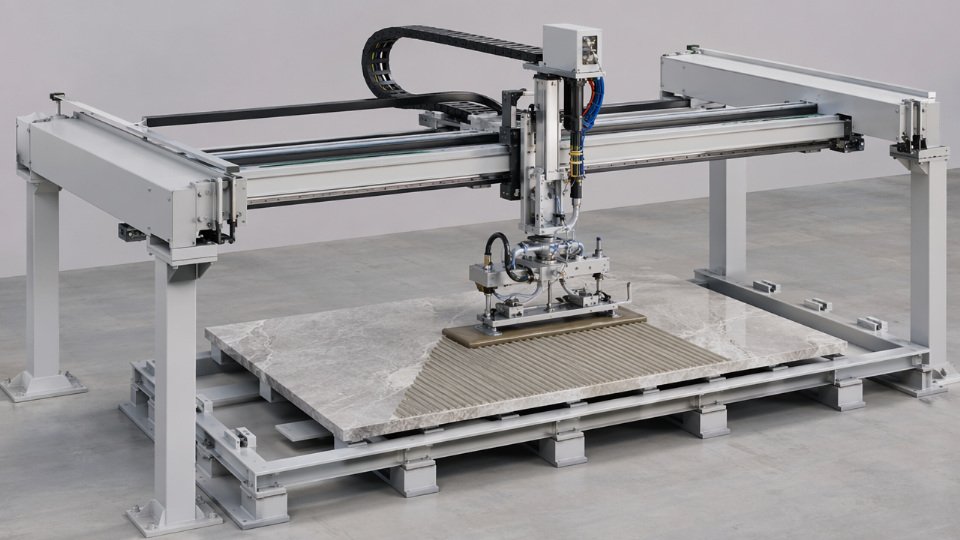
Large-scale installation contractors in Germany, the UAE, and China are deploying gantry-mounted robots with programmed trowel heads capable of applying adhesive at controlled coverage rates within ±2 g/m². That level of consistency is simply not achievable with a manual trowel operator working across a 10-hour shift. Contact-coverage failure — adhesive applied but not transferring uniformly to the slab back — is responsible for a significant share of debonding callbacks on large-format projects. Robotic systems eliminate that variability. The current technical challenge is silane primer compatibility with high-speed spray-head application: some primer formulations foam or skin prematurely under robotic spray conditions, requiring viscosity and open-time reformulation. This is an active area of application engineering at SiliconChemicals.
Embedded Cure Sensors and Digital Construction Integration
Thin-film dielectric sensors laminated to the back of test slabs during installation can track adhesive cure state in real time via impedance change — as the polymer network crosslinks, ionic mobility drops measurably. Wireless data transmission feeds into project management platforms, giving site engineers an objective signal for when grouting or live loading can begin rather than relying on elapsed time estimates that assume a specific temperature and humidity that may not have held overnight. This integrates cleanly with ISO 19650 digital construction workflows where asset data continuity is required from installation through handover.
Isocyanate Regulation Driving STP Adhesive Growth
EU REACH restriction proposals targeting free MDI and TDI in consumer-accessible construction products are not speculative — they are in the regulatory pipeline. The practical consequence for the adhesive market is reformulation pressure away from two-component PU systems toward silane-terminated polymer platforms, which deliver comparable flexibility and green-strength without the isocyanate hazard classification. Every tonne of PU adhesive reformulated as STP adhesive requires silane-terminated prepolymer backbone, which traces directly to trialkoxysilane building blocks. For SiliconChemicals, this regulatory trajectory represents a structural demand increase for the silane monomer and oligomer product lines that serve adhesive formulators — not a future possibility, a directional certainty worth building supply agreements around now.