Specifying “silane” on a purchase order without knowing its synonyms or chemical aliases is a fast path to receiving the wrong product. A procurement manager who orders generic “silane” when the process actually requires monosilane (SiH4) at semiconductor-grade purity — 99.9999% or better — can halt a CVD line for days while the correct material clears customs and re-inspection. At USD 2.1–2.8 billion in annual global market value and growing at 6–8% per year through 2030, this chemical family is too commercially significant to navigate with imprecise language.
The most common alternative name for silane is monosilane, the systematic name for SiH4, the simplest silicon hydride. It is also called silicon tetrahydride, silicon hydride, and silicane. In industrial gas supply, “silane” nearly always refers to this same SiH4 compound. The broader silane family — organosilanes, chlorosilanes, and coupling agents — carries dozens of additional trade and IUPAC names depending on substituent groups and application.
What makes this naming question genuinely complex for engineers and buyers is that the word “silane” functions simultaneously as a specific compound name, a chemical class descriptor, and a commercial shorthand — and which meaning applies shifts depending on whether you are standing in a semiconductor fab, a rubber compounding plant, or a tire manufacturing line. Understanding exactly where each synonym comes from, and what it signals about purity grade and application, is what separates a clean procurement spec from an expensive mistake.
Complete Synonym Table: Every Accepted Name for SiH4 and the Broader Silane Family
The compound most procurement documents list as “silane” has at least six formally recognized names, each appearing in a different regulatory or technical context. Order the wrong one — or specify “silicone” when you mean “silane” — and you’re looking at rejected shipments, failed incoming inspection, or a dangerous mismatch between the SDS on file and the cylinder in the rack. The table below is built to eliminate that ambiguity.
SiH4: All Recognized Synonyms in One Reference
| Synonym | CAS No. | Molecular Formula | Recognizing Authority | Primary Use Context |
|---|---|---|---|---|
| Monosilane | 7803-62-5 | SiH₄ | IUPAC, CAS Registry | Semiconductor CVD, solar cell deposition |
| Silicane | 7803-62-5 | SiH₄ | IUPAC (PIN alternate) | Formal chemical literature, academic papers |
| Silicon tetrahydride | 7803-62-5 | SiH₄ | IUPAC systematic | Regulatory filings, transport classification |
| Silicon hydride | 7803-62-5 | SiH₄ | CAS, some national standards | Industrial safety datasheets, older trade docs |
| SiH₄ | — | SiH₄ | Universal (formula shorthand) | Engineering specs, process recipes |
| Silane gas | 7803-62-5 | SiH₄ | Trade / industrial usage | Cylinder supply contracts, procurement POs |
| Semiconductor-grade silane | 7803-62-5 | SiH₄ | SEMI F-series standards | Fab gas specifications (purity ≥ 99.9999%, 6N) |
The purity distinction on that last row is not cosmetic. Silicon tetrachloride hydrogenation routes can deliver SiH₄ at 6N purity when the process is properly controlled; standard industrial-grade cylinders typically run 99.9–99.999%, which is adequate for chemical vapor deposition in non-critical applications but will cause carrier lifetime degradation in advanced logic nodes. What grade you need depends on your node geometry and deposition temperature.
'Silicane' and 'monosilane' refer to the same compound, SiH₄, with the same CAS number 7803-62-5True
IUPAC recognizes both names; 'monosilane' is the preferred industrial and trade name, while 'silicane' is the IUPAC PIN (preferred IUPAC name) used in formal nomenclature. Both map to CAS 7803-62-5.
The Higher Silane Homologs: Greek-Prefix Series
Just as methane–ethane–propane follow a carbon-count logic, silicon hydrides follow the same pattern. Engineers who understand this series can decode supplier datasheets without guessing.
| Name | Formula | CAS No. | Notes |
|---|---|---|---|
| Monosilane | SiH₄ | 7803-62-5 | Base compound |
| Disilane | Si₂H₆ | 1590-87-0 | Used in low-temperature epitaxy |
| Trisilane | Si₃H₈ | 7783-26-8 | Emerging ALD precursor |
| Tetrasilane | Si₄H₁₀ | 7783-29-1 | Research-stage; limited commercial supply |
Disilane sees real production volumes because its lower decomposition temperature versus monosilane makes it attractive for certain low-thermal-budget processes. Trisilane is moving from lab to pilot scale at several specialty gas producers, though lead times remain long — typically 8–16 weeks depending on batch size and purity specification.
Organosilane Sub-Family Naming Conventions
The broader silane family branches into four industrially dominant sub-classes. These are not synonyms for SiH₄; they are named derivatives where silicon is bonded to organic or halogen groups.
| Sub-class | Representative Example | CAS (Example) | Recognizing Naming System | Typical Loading / Use |
|---|---|---|---|---|
| Chlorosilanes | Trichlorosilane (HSiCl₃) | 10025-78-2 | IUPAC substitutive | Polysilicon feedstock, surface functionalization |
| Alkoxysilanes | APTES (3-aminopropyltriethoxysilane) | 919-30-2 | IUPAC, CAS | Coupling agent, 0.1–2.0 wt% in composites |
| Silazanes | Hexamethyldisilazane (HMDS) | 999-97-3 | IUPAC | Photoresist adhesion promoter |
| Siloxanes | Octamethylcyclotetrasiloxane (D4) | 556-67-2 | IUPAC, ISO 1629 | Polymer intermediate, release coatings |
Procurement Errors Caused by Near-Synonyms and Misspellings
This is where specification mistakes become expensive. Four confusions appear repeatedly in import documentation and purchase orders:
“Silane” vs. “silicone” — Silicone is a polymerized siloxane network (–Si–O– backbone with organic side chains). Silane is SiH₄ or an organosilane monomer. A PO listing “silicone coupling agent” instead of “silane coupling agent” will either be rejected by a competent supplier or, worse, fulfilled incorrectly.
“Silicane” vs. “silicon” — Silicon is the elemental solid (CAS 7440-21-3). Silicane is SiH₄ gas. Confusing these in a customs HS code declaration can trigger a reclassification audit.
“Silan” — Common in German, Dutch, and some Eastern European trade documents. It means silane (SiH₄ or the organosilane class). When reviewing European supplier quotes, treat “silan” as a direct equivalent, but verify CAS and grade before countersigning.
“Silicon hydride” as a group term — Some legacy SDS documents use “silicon hydride” loosely to cover any SiₙH₂ₙ₊₂ species. If an SDS says “silicon hydride” without a CAS number, request clarification before accepting the material into a regulated storage area.
Always cross-reference the CAS number, not just the trade name, when qualifying a new supplier or filing a regulatory submission. Names drift across regions and decades; the CAS number does not.
Molecular Structure, Bonding, and Physical Properties That Define Silane’s Identity
Understanding why SiH₄ behaves the way it does on the plant floor starts with its geometry. The silicon atom adopts a perfect tetrahedral sp³ configuration, with four equivalent Si–H bonds radiating outward at bond angles of 109.5° and bond lengths of 1.480 Å. That structure looks superficially like methane, and the analogy is tempting — but it misleads engineers who assume similar handling or reactivity profiles.
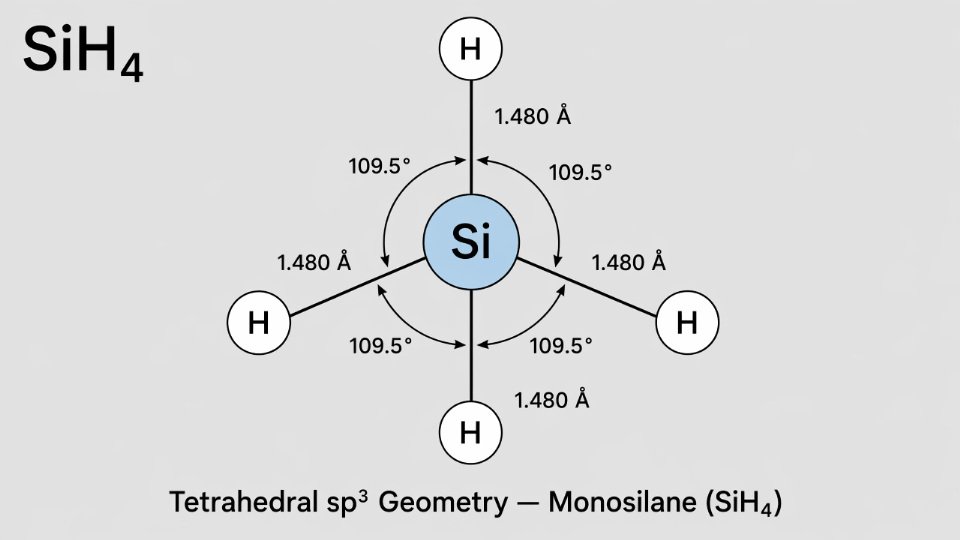
Why Geometry Matters Beyond Textbook Symmetry
The tetrahedral symmetry gives SiH₄ zero net dipole moment, which partly explains its low boiling point and weak intermolecular forces. In CVD reactor design, this translates to predictable gas-phase transport behavior with minimal wall-adsorption artifacts at process temperatures. The clean geometry also means that when silane decomposes on a substrate surface, the silicon atom deposits without steric complications from bulky ligands — a property that makes SiH₄ the baseline precursor against which all chlorosilane and organosilane alternatives are benchmarked.
Physical Property Reference for Procurement and Process Verification
These are the numbers you should use to verify you have received the correct compound rather than a misidentified or contaminated cylinder:
| Property | Value / Range | Key Dependencies |
|---|---|---|
| Molecular weight | 32.12 g/mol | Fixed; use to cross-check GC-MS results |
| Boiling point | −112 °C | At 1 atm; shifts ~2–4 °C with trace impurities |
| Melting point | −185 °C | At 1 atm |
| Vapor pressure at 20 °C | ~48–52 bar | Varies with cylinder temperature; confirm with supplier CoA |
| Gas-phase density at STP | ~1.44 g/L | Roughly 1.1× air density |
| Liquid density (at BP) | ~0.68 g/mL | Relevant for cryogenic storage sizing |
The vapor pressure figure deserves a specific operational note. At ambient temperature, SiH₄ exists entirely as a pressurized gas inside the cylinder. Any cylinder pressure reading significantly below the 48–52 bar range at 20 °C — after accounting for actual cylinder temperature — signals either depletion or a leak condition, not a safe “low pressure” state. Facilities that mistake low gauge readings for a harmless situation have triggered costly reactor downtime when the process gas runs out mid-deposition run.
Pyrophoricity and Explosive Behavior: Numbers Safety Engineers Must Know
Silane (SiH4) has an explosive concentration range in air of approximately 1.37–96 vol%, one of the widest flammable ranges of any industrial gas.True
Published experimental data and SEMI S2 guidelines consistently report the Lower Explosive Limit (LEL) at approximately 1.37 vol% and the Upper Explosive Limit (UEL) approaching 96 vol%, making the explosive window far broader than hydrogen (4–75 vol%) or methane (5–15 vol%).
That 1.37 vol% LEL is the number that drives ventilation design. A semiconductor fab or solar panel plant handling SiH₄ typically targets continuous dilution to keep ambient concentrations below 10–25% of LEL, which means detection systems must alarm reliably at 0.14–0.34 vol% — well below what human senses detect. Silane ignites spontaneously on contact with air at concentrations above roughly 2–3 vol%, with no ignition source required. SDS writers and facility safety planners who list it as merely “flammable” rather than “pyrophoric” understate the hazard and create liability.
Si–H Bond Strength Versus C–H: The Reactivity Explanation
The Si–H bond dissociation energy runs approximately 310–320 kJ/mol. The C–H bond in methane sits around 410–415 kJ/mol. That roughly 30% lower bond energy is the fundamental reason silane activates at lower temperatures in CVD processes, reacts readily with surface hydroxyl groups during functionalization, and hydrolyzes far faster than carbon analogues under ambient moisture. For engineers specifying surface coupling agents at 0.1–2.0 wt% loading in composite formulations, this reactivity difference explains why open-air pot life of silane-based primers is measured in hours, not days.
Isotopically Labeled Variants and Why Precise Naming Matters in Research
Deuterosilane — SiD₄, sometimes written silicon-d4 or tetradeuterosilane — replaces all four protium atoms with deuterium. It carries CAS number 13537-07-0. Researchers use it in semiconductor thin-film studies as a kinetic tracer: the deuterium kinetic isotope effect (typically a factor of 2–7× slower Si–D bond cleavage compared to Si–H) allows direct mechanistic investigation of surface decomposition pathways without changing the molecule’s geometry or electronic character in any meaningful way. Procurement teams ordering SiD₄ for the first time frequently misroute purchase orders under generic “silane” catalog entries, delaying research programs by weeks. Specifying the full IUPAC name, the CAS number, and the isotopic purity grade (typically ≥98 atom% D) on the purchase order eliminates that ambiguity entirely.
Industrial Manufacturing Routes: How Monosilane Is Produced at Commercial Scale
Understanding where SiH4 comes from is not an academic exercise. The synthesis route determines purity ceiling, achievable throughput, cost structure, and ultimately whether a given supply source can meet your application spec. Three commercially relevant pathways exist, and they are not interchangeable.
Route 1 — Chlorosilane Redistribution (Siemens/Union Carbide Process)
This is the dominant industrial route for high-purity monosilane destined for semiconductor and photovoltaic deposition. The chemistry proceeds stepwise: silicon tetrachloride (SiCl4) is hydrogenated with hydrogen gas to produce trichlorosilane (SiHCl3), which then undergoes catalytic redistribution through dichlorosilane (SiH2Cl2) and monochlorosilane (SiH3Cl) before yielding SiH4. Each redistribution stage uses fixed-bed copper or amine-functionalized catalyst systems operating at 500–650 °C; the exact temperature window depends on catalyst formulation and target intermediate.
Fractional distillation after each stage is non-negotiable. Skimping on separation capacity here — a temptation when capital budgets are tight — contaminates downstream stages and degrades final purity. Well-designed plants running this route achieve 99.9999% (6N) purity routinely. That figure assumes tight control of phosphine and arsine impurities, which originate from SiCl4 feedstock quality and can survive redistribution if inlet specs are loose.
Chlorosilane redistribution is the only established industrial route capable of reaching 6N purity SiH4 at multi-tonne annual scale.True
Lab-scale reduction methods can achieve high purity but are cost-prohibitive at tonnage scale; the redistribution process combined with multi-stage distillation is the industry-accepted pathway for semiconductor-grade monosilane production.
Capacity at a single-train facility typically runs 200–2,000 tonnes per year depending on reactor sizing and downstream purification train count. Semiconductor fabs and solar cell manufacturers are the primary end users.
Route 2 — Metallurgical Silicon + HCl, Then Disproportionation
Here, metallurgical-grade silicon (MG-Si, typically 98–99% Si) reacts with anhydrous HCl in a fluidized-bed reactor at 280–320 °C to produce trichlorosilane as the primary product, with SiCl4 as a significant co-product. The trichlorosilane is then catalytically disproportionated in successive stages to yield SiH4.
The feedstock economics of this route are tied directly to MG-Si pricing, which is itself anchored to electricity costs. China’s silicon metal production belt — concentrated in Yunnan province (hydropower-advantaged) and Xinjiang (coal-based power) — delivers MG-Si at costs that are structurally difficult to replicate elsewhere. A plant integrated within or near these clusters has a raw-material cost position that standalone converters in Europe or North America simply cannot match at equivalent scale.
Purity ceiling via this route is slightly lower than pure redistribution unless additional purification stages are added, typically landing at 5N to 6N with proper design. It suits both electronic-grade and solar-grade applications, with the latter tolerating a somewhat broader impurity budget.
Route 3 — Chemical Reduction (NaBH4 / LiAlH4)
Sodium borohydride or lithium aluminum hydride reduction of silicon halides produces SiH4 under mild conditions and at high purity in small batches. Research labs and specialty chemical suppliers use these routes when quantities are measured in kilograms, not tonnes. Reagent costs alone — LiAlH4 runs roughly 20–60× the per-unit cost of the chlorosilane intermediates used in Route 1 — make tonnage-scale production economically indefensible.
Operational warning: procurement teams occasionally encounter small-lot SiH4 from reduction-route suppliers quoted at attractive per-cylinder prices. Verify total annual volume capability before qualifying. A supplier who cannot guarantee consistent multi-cylinder monthly supply creates scheduling risk in continuous deposition processes.
Comparative Route Summary
| Route | Primary Feedstock | Purity Ceiling | Typical Capacity (tonnes/yr) | Best-Fit Application |
|---|---|---|---|---|
| Chlorosilane redistribution | SiCl4 + H2 | 6N (99.9999%) | 200–2,000 | Semiconductor CVD, solar PV |
| MG-Si + HCl disproportionation | MG-Si, HCl | 5N–6N | 500–5,000+ | Solar-grade, general electronic |
| NaBH4 / LiAlH4 reduction | Silicon halides, hydride reagents | 5N–6N (batch) | <5 | R&D, specialty lab use |
Capacity ranges depend on reactor train count, purification stage depth, and site utility availability.
Supply Chain Integration and What It Means for Buyers
SiliconChemicals sources trichlorosilane intermediates from within China’s established organosilicon industrial clusters, where co-located SiCl4 producers, HCl recovery systems, and hydrogen supply infrastructure reduce both unit cost and logistics exposure. For a global buyer, this integration matters in two concrete ways: first, the intermediate feedstock does not travel far before conversion, which limits moisture ingress risk and handling losses; second, multi-supplier redundancy within the same cluster provides a buffer against single-point disruptions that affect isolated producers.
When qualifying a SiH4 supplier, ask for the specific route in writing, the intermediate purification step count, and impurity certificates covering phosphine, arsine, moisture, and oxygen — not just total purity percentage. The route tells you the theoretical ceiling; the certificate tells you what actually shipped.
How Silane’s Many Names Appear Across Its Five Major Application Sectors
The same silicon-hydrogen chemistry shows up under half a dozen different names depending on which industry you’re standing in. That isn’t sloppy terminology — it reflects how each sector developed its own documentation culture, regulatory vocabulary, and supply chain shorthand. Understanding which name governs in which context keeps purchase orders, safety data sheets, and process specifications aligned with each other.
Semiconductor CVD: Where “Monosilane” Is the Only Acceptable Term
In wafer fabrication and epitaxial deposition, the compound SiH₄ is almost universally called monosilane or semiconductor-grade silane. The prefix “mono” exists to distinguish it unambiguously from disilane (Si₂H₆) and higher homologs that can appear as trace impurities or be intentionally dosed in advanced node processes. Process gas specifications written to SEMI F20 classify silane across purity grades from 4.0 (99.99%) up to 6.0 (99.9999%), and a supplier quoting “silane 5N5” without specifying monosilane creates immediate ambiguity during incoming QC. Dopant and metallic impurity limits — arsenic, phosphorus, iron — are specified in parts per billion or trillion, so a name mismatch on a certificate of analysis can trigger a lot hold even when the chemistry is correct.
Photovoltaic Thin-Film Deposition: “Silane Gas” in Equipment Manuals
PECVD lines depositing amorphous silicon (a-Si:H) for thin-film solar panels almost always refer to the feedstock as silane gas in OEM equipment documentation, flow controller calibration sheets, and process recipes. The reason is partly historical — thin-film PV tooling was designed by equipment engineers who carried gas-handling terminology directly from flat-panel display manufacturing. Purity requirements here typically sit at 4.5 to 5.0 grade, lower than semiconductor wafer work but still tightly controlled for moisture and oxygen.
China produces more than 80% of the world's solar-grade silicon feedstock for photovoltaic manufacturingTrue
China's dominance in polysilicon and downstream solar module production is well-documented by industry bodies including IRENA and BloombergNEF; the figure reflects integrated capacity across the Xinjiang, Sichuan, and Inner Mongolia production clusters as of 2022–2023.
This supply chain concentration means that when a European or North American module manufacturer writes a silane gas procurement spec, it is almost always sourced through a Chinese integrated supplier chain — which makes consistent English-language CAS and IUPAC identification on documentation non-negotiable for customs and chemical import compliance.
Rubber and Plastics Compounding: “[Silane Coupling Agent](https://siliconchemicals.com/silane-coupling-agents/)” or “Silane Crosslinker”
In rubber compounding data sheets, particularly for tire tread compounds using precipitated silica, SiH₄ itself is irrelevant — the working chemistry belongs to organosilane derivatives. Vinyltrimethoxysilane (VTMS) is labeled a silane coupling agent or silane crosslinker depending on whether the formulator is emphasizing filler-matrix adhesion or polymer network formation. Bis-silane sulfur-containing agents (the TESPT/Si-69 class) appear under both their trade designations and their systematic names in technical data sheets, but safety data sheets must carry the IUPAC name for REACH and GHS compliance. Loading levels run 0.1–2.0 wt% relative to filler content, where the upper bound is constrained by cost and the risk of premature scorch during mixing.
Construction Sealants and Adhesives: STP and SMP Labeling
Alkoxysilane moisture-cure polymer systems — widely used in construction joints, facade glazing, and structural bonding — are sold under the designations silane-terminated polymer (STP) or silane-modified polymer (SMP) in formulation guides and technical bulletins. Neither label tells you the specific alkoxysilane end-group chemistry without reading deeper into the TDS. A specifier selecting an STP sealant for low-VOC compliance needs to confirm whether the curing silane releases methanol (trimethoxysilane end groups) or ethanol (triethoxysilane end groups) — a distinction that directly affects indoor air quality certification and influences which regulatory pathway applies in California versus the EU.
Surface Treatment and Waterproofing: Trade Names Over IUPAC, Until REACH Steps In
Alkylalkoxysilanes such as isobutyltriethoxysilane (IBTEO) and n-octyltriethoxysilane are routinely marketed under proprietary trade names by surface treatment chemical companies. On a product label you might see a descriptive commercial name with no systematic chemistry visible at all. That works fine for a contractor buying off a shelf. But under REACH Article 31, the full SDS must disclose the IUPAC name and CAS number when the substance is classified as hazardous — and most alkylalkoxysilanes carry flammability or skin-sensitization classifications. Procurement teams importing these materials into the EU need both identifiers on every shipment document, regardless of what the trade name says on the drum.
The pattern across all five sectors is consistent: the working name tracks the documentation culture of the end-use industry, but the IUPAC name and CAS number remain the universal anchors for regulatory compliance and supply chain verification.
Regulatory Naming Requirements: IUPAC, CAS, REACH, GHS, and HS Code Compliance
Getting the name right on a technical datasheet is one thing. Getting it right on a customs declaration, an SDS, or a REACH registration dossier is another matter entirely — one where a wrong call can freeze a shipment at port, trigger a regulatory inquiry, or invalidate a safety document that workers depend on.
IUPAC 2013 Nomenclature: Retained Name vs. Systematic Name
The 2013 IUPAC recommendations for inorganic nomenclature recognize two fully legitimate designations for SiH₄. “Silane” is the retained name — acceptable in general technical communication, trade documentation, and most regulatory filings. “Silicon tetrahydride” is the preferred systematic name, constructed by the substitutive nomenclature rules that IUPAC applies uniformly across the hydrides of Group 14. Neither name is wrong, but the context governs which one you should reach for. Regulatory agencies within the EU, particularly ECHA under REACH, prefer or require the systematic IUPAC name in substance identification sections of a registration dossier. If your technical team drafts a SDS using only the trade shorthand “monosilane” and omits the IUPAC systematic form entirely, an EU compliance reviewer has legitimate grounds to flag the document as incomplete.
CAS Numbers: The Actual Lingua Franca
Across every regulatory system — REACH, TSCA, GHS, national chemical inventories — the CAS Registry number functions as the unambiguous identifier that cuts through translation problems and synonym confusion. For SiH₄, that number is CAS 7803-62-5. The five most commercially traded silane derivatives each carry their own CAS identifiers, and procurement teams should treat these numbers as non-negotiable line items on purchase orders and import declarations:
| Compound | CAS Number | Common Trade Name |
|---|---|---|
| Monosilane (SiH₄) | 7803-62-5 | Silane, silicon tetrahydride |
| APTES | 919-30-2 | 3-Aminopropyltriethoxysilane |
| VTMS | 78-08-0 | Vinyltrimethoxysilane |
| MPTMS | 4420-74-0 | 3-Mercaptopropyltrimethoxysilane |
| TEOS | 78-10-4 | Tetraethyl orthosilicate |
| HMDS | 999-97-3 | Hexamethyldisilazane |
A mismatched CAS number between your invoice and your safety dossier is one of the most common triggers for customs query letters. The fix costs a week of back-and-forth; the prevention costs thirty seconds of verification.
REACH Compliance and Supplier Support
Under EU Regulation 1907/2006 (REACH), any substance imported into the EU above one tonne per year must be registered, and that registration must identify the substance by IUPAC name and CAS number. For SiliconChemicals’ EU-based customers, this means receiving not just the product but a pre-registered substance dossier and multilingual SDS aligned to the current SDS format under EU Regulation 2020/878. Where a customer’s downstream formulation incorporates an organosilane coupling agent such as APTES at loading levels of 0.1–2.0 wt% (the range varies with matrix type and surface chemistry target), accurate substance identification in the SDS is also a downstream user obligation, not just the supplier’s problem.
GHS Classification and SDS Section 1 Requirements
SiH₄ is classified under the UN Model Regulations as UN 2203, flammable gas, Class 2.1, and carries pyrophoric gas classification under GHS. A compliant SDS must populate Section 1 — Product Identifier — with all synonyms in active use: silane, monosilane, silicon tetrahydride, and CAS 7803-62-5 at minimum. Omitting “monosilane” when that is the term appearing on your delivery note creates a document traceability gap that an auditor will catch.
HS Tariff Codes: Where a Wrong Name Costs Real Money
SiH₄ in bulk cylinder supply falls under HS code 2850.00 (hydrides of non-metals). Organosilane coupling agents — APTES, VTMS, MPTMS and their peers — fall under HS 2931.90 (other organo-inorganic compounds). Using the wrong HS code is not a minor clerical error. Customs systems in the EU, US, and major Asian markets perform automated cross-checks against declared chemical names and CAS numbers. A shipment of vinyltrimethoxysilane declared under the monosilane HS code will generate a mismatch flag, potentially triggering physical inspection, re-examination fees running USD 500–3,000 per incident depending on port and jurisdiction, and in repeat cases, heightened scrutiny on all future shipments from that importer of record.
Silane SiH4 is classified as UN 2203 under the UN Model Regulations for the Transport of Dangerous Goods.True
UN 2203 is the correct UN number assigned to silane (SiH4) as a flammable, pyrophoric compressed gas under the UN Model Regulations, confirmed in the UN Recommendations on the Transport of Dangerous Goods.
The practical discipline here is straightforward: build a master substance identification sheet for every silane product you buy or sell, listing the IUPAC systematic name, retained name, all recognized synonyms, CAS number, GHS classification, UN number, and applicable HS code. Circulate it to procurement, logistics, and EHS simultaneously. That one internal document eliminates the majority of regulatory naming errors before they reach a customs terminal or an ECHA dossier reviewer.
Silane vs. Silicone vs. [Silica](https://siliconchemicals.com/silica/) vs. Silicon: Resolving the Four Most Confused Names in the Industry
Few naming confusions in industrial chemistry cost more time and money than conflating these four terms. A misdirected RFQ — asking a silicone supplier for “silane” when you need a coupling agent, or specifying “silicon” on a datasheet when the formulation calls for fumed silica — can delay a production launch by weeks and generate scrap batches that trace back to nothing more than a vocabulary error. Here is exactly what each term means, where it sits in the supply chain, and how to tell them apart at the point of procurement.
Silicon (Si): The Elemental Starting Point
Silicon is a chemical element, atomic number 14, traded in metallurgical-grade and electronic-grade forms under HS codes 2804.61 (containing by weight not less than 99.99% of silicon) and 2804.69 (other). It is the raw feedstock from which everything else in this family is eventually derived, but it is not a reagent you dissolve in a solvent, mix into a rubber compound, or flow into a CVD chamber. Semiconductor wafers, solar cell substrates, and silicon metal alloys are silicon applications. If a process engineer calls for “silicon” on a bill of materials for a rubber formulation, that is an error — the intended material is almost certainly silica or an organosilane coupling agent.
Silica (SiO₂): Filler, Reinforcement, and Precursor
Silica is silicon dioxide, and it exists in several industrially distinct forms: fumed silica (pyrogenic, surface area typically 100–380 m² /g depending on grade), precipitated silica (used heavily in tire compounding and food applications), and crystalline quartz (refractory and optical uses). It functions as a filler, a rheology modifier, and a reinforcing agent — not as a reactive functional molecule. Fumed silica is also a precursor in certain silane synthesis routes. Specifying “silica” when a formulation requires a silane coupling agent will produce a compound with zero interfacial bonding activity; the filler simply will not wet the polymer matrix properly, and mechanical properties will fall short of design targets.
Silane (SiH₄ or Organosilane R–Si–X): The Reactive Bridge
This is the material class this article addresses throughout. Monosilane (SiH₄) is the inorganic hydride — a pyrophoric gas used as a CVD precursor in semiconductor deposition and thin-film photovoltaics. Organosilanes carry at least one silicon–carbon bond and typically one or more hydrolyzable groups (alkoxy, chloro, acetoxy), making them reactive at both the inorganic substrate surface and the organic polymer interface. That dual reactivity is precisely what makes them irreplaceable as coupling agents in glass fiber composites, rubber compounds, and adhesive primers. Loading levels for coupling agents such as APTES typically run 0.1–2.0 wt% in composite formulations, with the optimum depending on filler surface area and the specific polymer system.
Organosilane coupling agents form covalent bonds at both the inorganic filler surface and the organic polymer matrix.True
Hydrolyzable groups (e.g., alkoxy) react with surface hydroxyl groups on silica or glass, while the organofunctional group (e.g., amino, vinyl, epoxy) reacts with or compatibilizes the polymer chain — this dual bonding mechanism is well established in the coupling agent literature and is the basis for their use in fiber-reinforced composites.
Silicone (Polysiloxane, –[Si(R₂)–O–]ₙ–): The Polymer End Product
Silicones are polymers built on a repeating Si–O backbone with organic substituents on silicon. They are manufactured by hydrolyzing chlorosilanes — themselves produced from silicon metal and methyl chloride via the Müller–Rochow direct process — to yield silanols that condense into polysiloxane chains. The conversion pathway runs: silicon metal → chlorosilane intermediate → hydrolysis → polysiloxane. Silicone sealants, elastomers, fluids, and release coatings are the commercial endpoint. Ordering “silane” from a silicone supplier, or vice versa, indicates a breakdown in the specification handoff between R&D and procurement — it happens more often than most engineers admit.
The decision logic for procurement is straightforward once the chemistry is clear:
| Application need | Correct material class | Typical form |
|---|---|---|
| Polymer sealant, elastomer, fluid | Silicone (polysiloxane) | Gum, fluid, dispersion |
| Coupling agent, adhesion promoter | Organosilane | Liquid monomer |
| CVD thin-film deposition | Monosilane (SiH₄) | Compressed gas |
| Reinforcing filler, rheology control | Silica (SiO₂) | Powder, dispersion |
| Semiconductor substrate, solar wafer | Silicon (Si) | Wafer, ingot, metal |
Working across more than one of these material classes simultaneously — as formulators of filled silicone elastomers routinely do, using both a silica filler and an organosilane coupling agent in the same compound — creates real vendor management complexity. Sourcing silicon chemistry from a supplier with genuine capability across all four classes eliminates the version-control problem that arises when separate suppliers use different grade designations for nominally the same intermediate. SiliconChemicals manufactures and supplies silanes, silicone polymers, and specialty organosilicon materials from an integrated production base, which means a formulator can align specifications across the full material chain without reconciling conflicting technical datasheets from multiple vendors.
Selecting the Right Silane Grade: Purity Specifications, Packaging, and Storage Naming Conventions
Procurement engineers who write an RFQ that simply asks for “silane” will receive quotes ranging from pipeline-grade industrial hydride to semiconductor-process gas — compounds sharing the same molecular formula but separated by orders-of-magnitude differences in impurity content, price, and handling infrastructure. Getting the grade designation right before the purchase order is issued prevents weeks of back-and-forth, incoming inspection failures, and, in semiconductor or solar applications, entire batch losses.
Purity Naming Tiers and What Each Label Actually Means Analytically
The shorthand notation used across the industry counts the nines in the purity percentage. Each tier has defined analytical thresholds, not just a headline number.
Electronics grade (5N to 6N, ≥99.999–99.9999%) targets CVD and LPCVD deposition in semiconductor fabs. Specifications at this level require total hydride-related impurities below 1–10 ppmv, moisture ≤ 0.5 ppmv by electrolytic hygrometer or tunable diode laser absorption, oxygen ≤ 0.5 ppmv, and metallic contaminants (As, P, B) typically ≤ 1 ppbv by ICP-MS. Silicon tetrachloride hydrogenation followed by fractional distillation and catalytic purification routinely achieves 6N when the upstream SiCl₄ feedstock is itself electronic grade. The purity achievable depends heavily on feedstock purity and the number of distillation stages — single-pass distillation will not reach 6N regardless of reactor efficiency.
Solar grade (4N, ≥99.99%) is the workhorse specification for PECVD amorphous silicon and thin-film PV deposition. Moisture and oxygen limits relax to roughly 5–20 ppmv, and metallic impurity budgets are wider, reflecting the less stringent minority-carrier lifetime requirements of thin-film cells compared to single-crystal wafers. Sourcing solar-grade silane from an electronics-grade supplier without specifying this tier explicitly typically adds 30–60% to unit cost without process benefit.
Industrial grade (3N, ≥99.9%) covers surface treatment applications, silane coupling agent synthesis intermediates, and certain rubber and adhesive formulations where the active chemistry is far more tolerant of trace hydride impurities. Moisture content here may be specified only at the hundreds-of-ppmv level, and ICP-MS is often replaced by ICP-OES.
Reagent grade is a laboratory designation — not a production specification — governed by the issuing supplier’s internal standard or a pharmacopeial monograph equivalent. Avoid using “reagent grade” on a production purchase order; it carries no enforceable impurity ceiling.
Packaging and Container Naming: UN Specifications Matter on Purchase Orders
Silane is shipped as a liquefied flammable gas. UN 2203 covers the classification. DOT packaging group I applies.
T-cylinders (also called ton cylinders or high-pressure lecture cylinders depending on volume) hold 10–50 L water capacity and are the standard for semiconductor and solar tool-direct supply. Specify DOT-3AA or ISO 9809-1 compliance and valve outlet CGA-350 (for US) or DIN 477 equivalents on the PO. Cylinder tare weight and hydrostatic test date must appear on the CoA.
ISO tank containers (T50) serve bulk liquid silane logistics for large photovoltaic manufacturers and gas distributors. A T50 tank has a working pressure of 1.75 MPa minimum. Requiring UN portable tank instruction T50 on the shipping document prevents a carrier from substituting a lower-rated container.
Lecture bottles (small cylinders, typically 0.5–1.0 L) are a research designation only. Never specify lecture bottle supply for production quantities — the unit cost premium is 10x or more compared to cylinder supply, and the valve fittings are not interchangeable with process piping.
Storage Infrastructure Terminology for Facility Design and Insurance
Facility designers and insurers use specific terminology that must match your purchase orders and safety documentation to avoid coverage disputes.
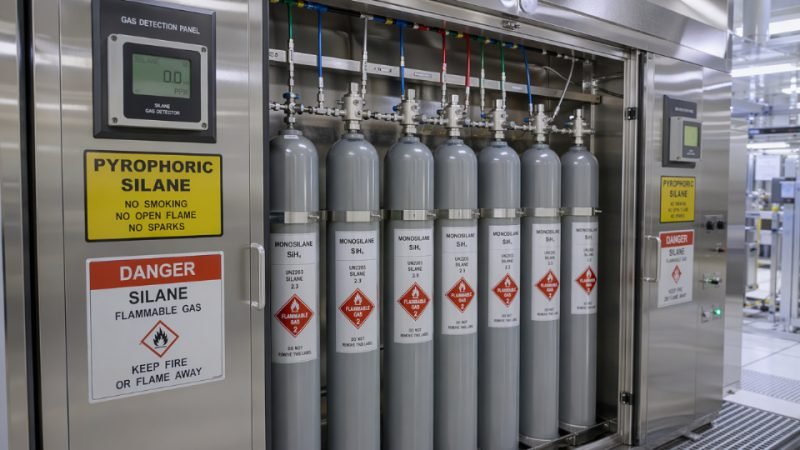
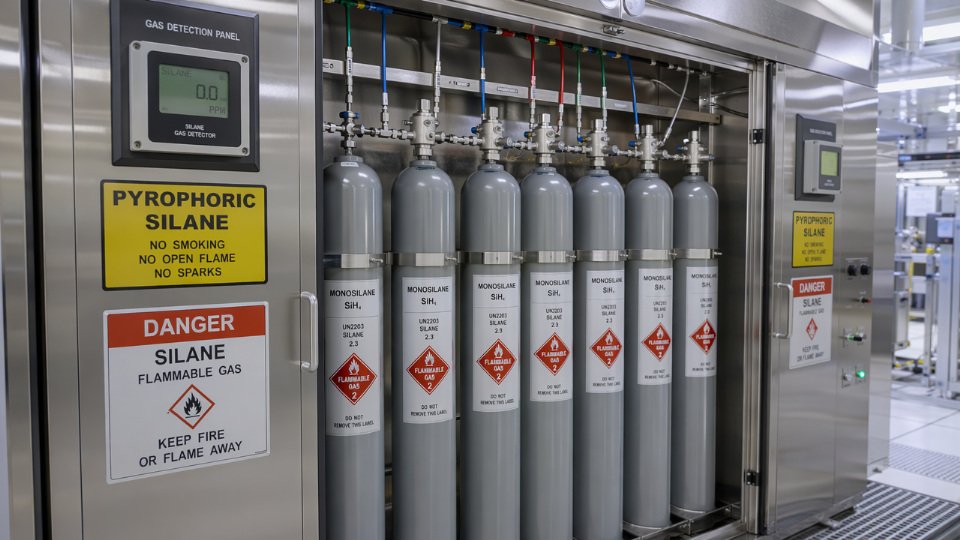
A silane gas cabinet is a ventilated, fire-rated enclosure housing one or two cylinders with automated leak detection and purge capability — the standard installation point-of-use in semiconductor fabs. A gas distribution panel (GDP) or valve manifold cabinet (VMC) refers to the downstream pressure-regulation and switching assembly. A hydride storage vault is a dedicated, separated room or building-section for bulk hydride cylinder inventory, required when stored quantities exceed the Maximum Allowable Quantity (MAQ) thresholds under NFPA 55 or local fire codes. Using “storage room” instead of “hydride storage vault” in insurance documentation can trigger a coverage gap if a loss event occurs.
Silane (SiH₄) stored in a standard flammable gas cabinet without automated purge-on-leak capability meets NFPA 55 requirements for semiconductor fabs.False
NFPA 55 and SEMI S2 both require gas cabinets for silane to include continuous atmospheric monitoring with automatic cylinder valve shutoff and purge-on-alarm capability. A standard flammable gas cabinet without these features does not satisfy the code requirements for pyrophoric or highly toxic hydride gases.
Certificate of Analysis Fields Every Purchaser Should Require
A complete CoA for production-grade silane should include: assay by GC (carrier gas helium, TCD or FID detector, reporting all identified impurities individually rather than as a lumped total); moisture by Karl Fischer coulometric titration or TDLAS with a detection limit ≤ 0.1 ppmv for electronics grade; metallic impurities by ICP-MS with a minimum of 15 elements reported; and particulate count per cubic meter at 0.1 µm threshold for electronics-grade cylinder supply. If a supplier’s CoA omits ICP-MS data and substitutes only a visual inspection notation, treat that as a disqualifying condition for electronics or solar applications.
How SiliconChemicals Codes Its Silane Supply Catalog
SiliconChemicals structures its product codes to carry both the IUPAC identity and the application-grade designation in a single reference string — for example, a code segment might encode the compound class (monosilane), purity tier (4N), packaging type (cylinder or ISO tank), and valve specification. This structure lets a customer’s procurement team enter either the IUPAC name “silane,” the CAS number 7803-62-5, or the trade shorthand “SiH₄ Solar” into their ERP and resolve to the same SKU, eliminating mismatches between the specification sheet and the purchase order line. When placing orders, requesting that your supplier align CoA header fields to your internal material master description — including the full IUPAC name — eliminates incoming QC holds caused by name-field mismatches.
Frequently Asked Questions About Silane Names, Identity, and Industrial Use
Is monosilane the same as silane?
Yes, monosilane and silane refer to the same compound: SiH₄, CAS 7803-62-5. The “mono” prefix exists for a practical reason. Industrial gas suppliers and semiconductor fabs use “monosilane” specifically to distinguish SiH₄ from disilane (Si₂H₆), trisilane (Si₃H₈), and higher homologs, all of which belong to the silane family but carry meaningfully different reactivity profiles and hazard classifications. On a cylinder label or a gas-supply contract, “monosilane” leaves no ambiguity. In a general chemistry context, “silane” is perfectly correct. When writing a purchase specification for CVD-grade material, default to “monosilane” and anchor it with the CAS number — that combination eliminates misidentification even across language barriers.
What is the IUPAC name for silane?
The preferred IUPAC systematic name is silicon tetrahydride, derived by naming the central element followed by the hydrogen ligands. However, IUPAC’s 2013 recommendations for inorganic nomenclature explicitly retain “silane” as an acceptable trivial name, so you will see both forms in peer-reviewed literature and regulatory filings. For SDS authoring under GHS, either name is defensible provided the CAS number appears alongside it. Regulatory databases such as ECHA’s C&L Inventory use “silane” as the index name, which matters when cross-referencing REACH registration dossiers.
Is silane the same as silicone?
No — and confusing the two causes real procurement errors. Silane (SiH₄ or an organosilane monomer) is a reactive small molecule; silicone is a crosslinked or high-molecular-weight polymer built on a silicon-oxygen backbone. The relationship is roughly analogous to ethylene versus polyethylene: the monomer and the polymer share elemental origins but are entirely different materials with different handling requirements, specifications, and end uses.
Silane and silicone are chemically interchangeable materialsFalse
Silane is a small-molecule precursor or reactive monomer; silicone is a polymerized silicon-oxygen polymer. They are not interchangeable in formulation, handling, or regulatory classification.
What is the CAS number for silane?
SiH₄ carries CAS 7803-62-5. To verify independently, search that number directly in PubChem (free) or SciFinder (subscription). CAS numbers are more reliable than common names for procurement because a single compound can have dozens of synonyms across supplier catalogs, country-specific standards, and legacy documentation. When issuing an RFQ, including the CAS number alongside the common name cuts the back-and-forth cycle with suppliers by a meaningful margin — particularly for shipments crossing multiple customs jurisdictions where translated trade names introduce uncertainty.
Why is silane called a coupling agent?
The term applies specifically to organosilane derivatives, not to SiH₄ itself. An organosilane coupling agent carries two chemically distinct functional ends on the same molecule: hydrolyzable groups (typically methoxy or ethoxy) that react with hydroxyl-rich inorganic surfaces such as glass, silica, or metal oxides, and an organofunctional group (amino, epoxy, methacryloxy, vinyl, etc.) that reacts with or is compatible with the organic polymer matrix. This dual reactivity creates a covalent or strong adhesive bridge at the interface — hence “coupling.” At typical loading levels of 0.1–2.0 wt% (the optimum depending on filler surface area and the specific organosilane grade), coupling agents measurably improve tensile strength retention in humid conditions, which is why they appear in glass-fiber-reinforced composites, filled rubber compounds, and moisture-cure adhesives.
What HS code should I use when importing silane?
For SiH₄ and other inorganic silicon hydrides, HS heading 2850.00 covers hydrides of non-metals including silicon. Organosilane compounds — APTES, VTMS, MPTMS, and similar — typically fall under HS 2931.90, the residual category for other organosilicon compounds. These headings carry different duty rates and may trigger different import-license requirements depending on the destination country. Always confirm the final classification with your customs broker or the relevant national customs authority before filing, because misclassification on inorganic versus organic silicon compounds is a documented audit trigger in EU and US import reviews.
Can silane be used in food-contact or medical applications?
SiH₄ itself is not used directly in food-contact or medical contexts — it is a pyrophoric industrial gas consumed as a precursor or surface-treatment reagent during manufacturing. Silicones derived from silane chemistry, however, do have broad food-contact and medical clearances: many platinum-cured silicone elastomers comply with FDA 21 CFR and EU Regulation 10/2011. Organosilane surface treatments applied to packaging, glass containers, or medical device components require specific substance-level regulatory approval and migration testing. The distinction matters enormously for formulators writing compliance documentation: the finished silane-treated article and the silane reagent itself sit in entirely different regulatory categories.
How does SiliconChemicals ensure consistent naming across global shipments?
Standardized SDS packages issued in English, German, and Korean accompany every shipment, with each document anchored to the CAS number rather than relying solely on trade names that can vary by region. Certificates of Analysis use CAS-number-referenced product identifiers so incoming QC teams can match documents to specifications without translation risk. A dedicated regulatory affairs team supports customers through REACH substance inquiries, RoHS confirmations, and country-specific import documentation — reducing the administrative load that procurement managers typically absorb when sourcing specialty chemicals across multiple jurisdictions.
Sourcing Silane From China: Why SiliconChemicals’ Integrated Supply Model Delivers Quality and Cost Certainty
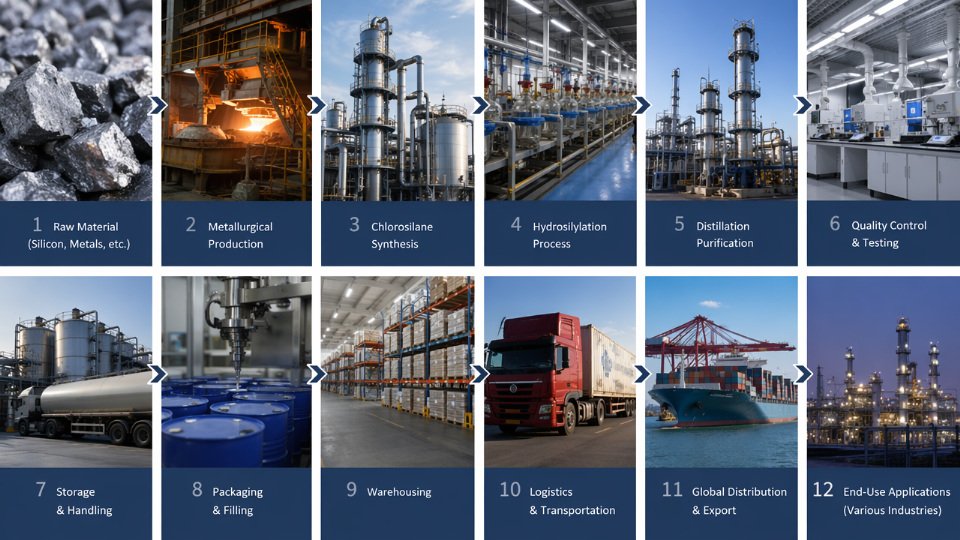
China’s organosilicon industry didn’t become the world’s largest by accident. The production clusters anchored in Zhejiang, Shandong, Jiangsu, and Xinjiang provinces represent something that Western suppliers genuinely cannot replicate quickly: a fully vertical feedstock chain running from quartzite mining and metallurgical-grade silicon smelting through trichlorosilane synthesis, redistribution, and finished specialty silane packaging — all within a few hundred kilometers. When every step of that chain sits inside one regional industrial ecosystem, the cost arithmetic is different. Landed cost advantages of 15–25% versus equivalent European or North American sources are realistic for bulk organosilane coupling agents and monosilane precursors, though the actual figure depends on order volume, cylinder return logistics, and the complexity of the product grade. For a procurement manager writing a three-year supply contract, that range is meaningful.
How the Industrial Cluster Translates to Supply Reliability
Feedstock integration is the part most buyers underestimate. When a Western silane producer faces a trichlorosilane shortage, their options are limited. A manufacturer embedded in a Zhejiang or Shandong cluster can draw on multiple local TCS producers, adjust redistribution ratios in-house, and protect delivery schedules in ways that an isolated Western plant cannot. SiliconChemicals sources metallurgical silicon and chlorosilane intermediates from within these clusters, which shortens the supply chain by at least two tiers and removes the exposure to trans-Pacific or trans-Atlantic intermediate freight that periodically disrupts spot availability.
Manufacturing Credentials That Hold Up Under Audit
SiliconChemicals operates under ISO 9001:2015 certification — not as a wall decoration but as a live system that customers audit directly. Automotive-tier customers additionally require IATF 16949 approval, which demands documented process controls, traceability to raw material lot, and statistical process monitoring at production checkpoints. Both certifications are current and available for review during supplier qualification. For customers selling into European markets, REACH pre-registration coverage across 40+ silane compounds in the catalog removes one of the most common procurement friction points: the risk of a product arriving at a European customs point without adequate regulatory standing.
Analytical Capability That Customers Actually Reference in Their Incoming QC Protocols
The in-house analytical laboratory runs GC-FID for organic purity and by-product profiling, ICP-MS for trace metal quantification down to sub-ppb levels — critical for semiconductor-adjacent applications where iron, sodium, or aluminum contamination causes yield loss — Karl Fischer titration for moisture content, and FTIR for functional group identity confirmation. These are not aspirational capabilities. They are the specific methods that quality engineers at composite manufacturers, adhesive formulators, and coating producers name in their incoming inspection procedures. Receiving a certificate of analysis that references the same instrument methods your own QC lab uses eliminates the interpretive gap that slows goods receipt.
SiliconChemicals' ICP-MS analysis supports trace metal certification to sub-ppb levels suitable for semiconductor precursor applications.True
ICP-MS is an established analytical method capable of quantifying metal contaminants at parts-per-trillion levels; this is standard practice for electronic-grade silane qualification and is not an inflated capability claim.
Logistics That Match the Product’s Hazard Classification
Monosilane (UN2203, pyrophoric compressed gas) and mixed silane preparations classified under UN3827 require UN-certified cylinders, pressure-tested valve assemblies, and carriers with hazmat-trained handling procedures. SiliconChemicals maintains a cylinder fleet built to these specifications and ships under FCA, CIF, and DAP Incoterms depending on customer preference and destination port. Customers in Germany, the United States, Vietnam, and Saudi Arabia have received on-schedule deliveries under each Incoterm structure. The packaging documentation — including the correct UN number, proper shipping name, and GHS-compliant SDS — ships with every order.
A Technical Partner, Not a Price Sheet
Where SiliconChemicals differs from a commodity distributor is in application engineering support. Dedicated application engineers help customers map an IUPAC name, a trade name, or an ambiguous internal specification code to the correct product SKU before an order is placed — preventing the wrong-grade purchase that shows up as adhesion failure three weeks into a production run. They assist with SDS language for local regulatory submissions, support formulation trials when a customer is qualifying a new coupling agent loading level, and can translate between the naming conventions used in semiconductor, rubber, and coatings contexts. That kind of front-end technical investment costs a supplier real resources. It also prevents the far more expensive scenario where a mislabeled or misidentified silane reaches a mixing line.