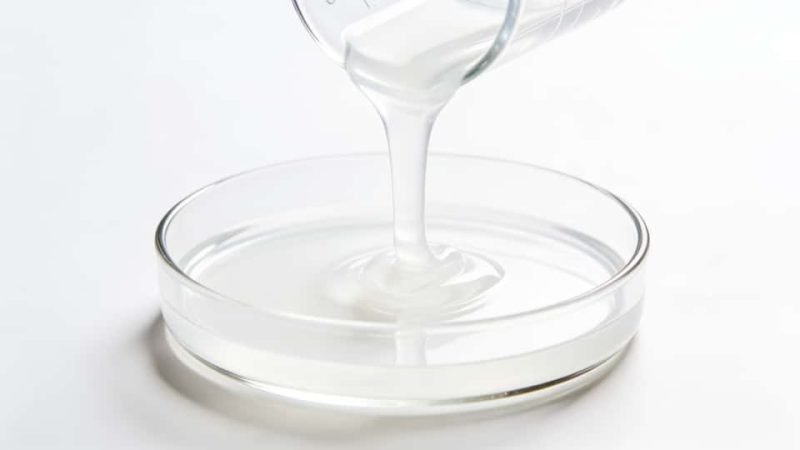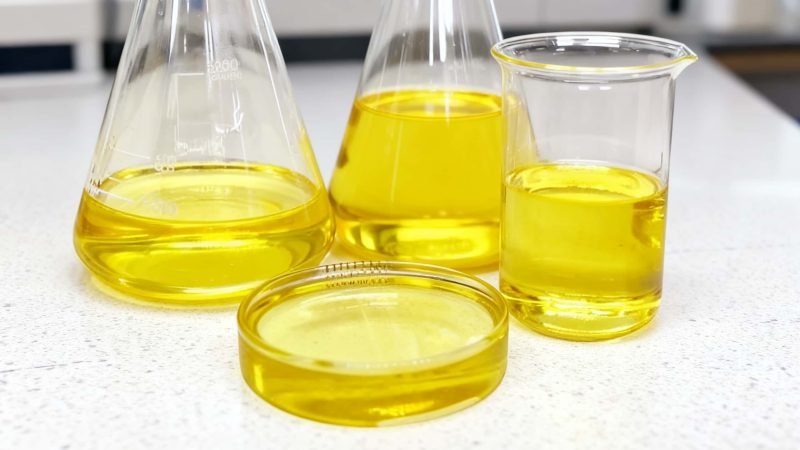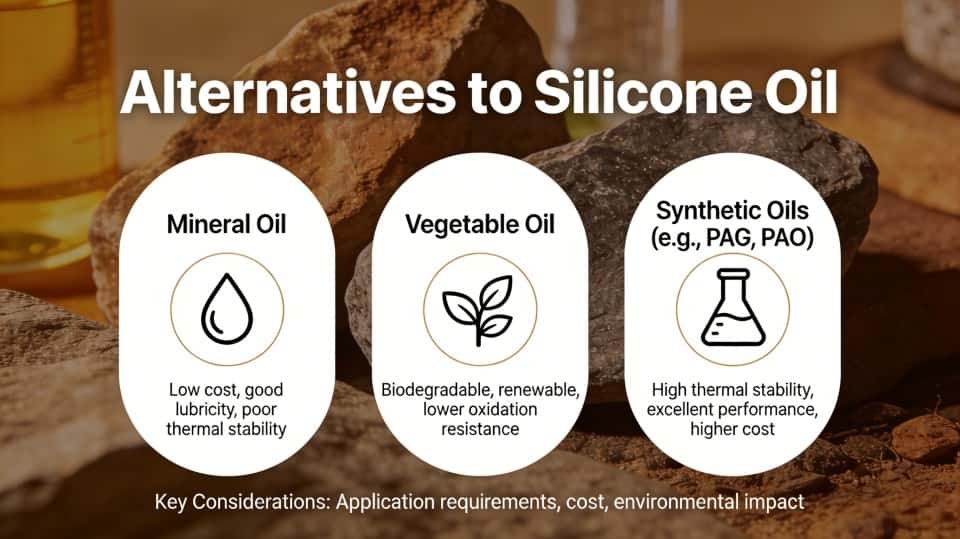
Many industrial processes and consumer products rely on fluids that must perform under extreme conditions. Traditional mineral oils often fail when exposed to high temperatures, oxidation, moisture, or electrical stress. Engineers frequently encounter issues such as lubricants breaking down in high-temperature machinery, cosmetic oils turning rancid, hydraulic fluids losing viscosity stability, or insulating fluids degrading in electrical equipment. When these failures occur, machines overheat, products degrade, and maintenance costs increase significantly. Silicone oil provides a unique solution to these challenges by offering exceptional thermal stability, chemical inertness, dielectric strength, and long-term performance across a wide temperature range.
Silicone oil is primarily used as a lubricant, heat transfer fluid, dielectric insulating fluid, antifoaming agent, cosmetic ingredient, release agent, and surface treatment material. Because of its unique molecular structure based on a silicon-oxygen backbone, silicone oil exhibits remarkable stability across extreme temperatures, excellent oxidation resistance, low surface tension, and high dielectric strength. These properties make silicone oil widely used in industries such as cosmetics, electronics, medical devices, automotive engineering, textiles, food processing, coatings, and industrial manufacturing.
Understanding the wide range of silicone oil applications requires examining its chemical structure, functional characteristics, viscosity variations, and the industries that depend on it. From cosmetics and pharmaceuticals to aerospace engineering and high-voltage electrical systems, silicone oil has become one of the most versatile specialty fluids in modern industrial chemistry.
Silicone oil maintains stable viscosity across extremely wide temperature ranges.True
The Si–O backbone structure of silicone oils provides exceptional thermal stability and flexibility, allowing them to maintain relatively constant viscosity from approximately −50°C to over 200°C depending on formulation.
Understanding What Silicone Oil Is
Silicone oil refers to a family of polysiloxane fluids, most commonly based on polydimethylsiloxane (PDMS) chemistry. These fluids consist of repeating silicon-oxygen (Si–O–Si) backbone units with organic side groups attached to the silicon atoms.
The general molecular structure of silicone oil provides several unique characteristics that differentiate it from hydrocarbon oils.
Key molecular features include:
• Flexible Si–O backbone
• Low intermolecular attraction
• Strong bond energy in Si–O bonds
• Hydrophobic methyl groups surrounding the backbone
These characteristics result in a fluid with extraordinary physical and chemical properties.
Table: Fundamental Properties of Silicone Oil
| Property | Typical Performance | Industrial Importance |
|---|---|---|
| Thermal Stability | −50°C to 250°C range | High-temperature lubrication |
| Oxidation Resistance | Excellent | Long service life |
| Surface Tension | Very low | Wetting and spreading ability |
| Dielectric Strength | High | Electrical insulation |
| Chemical Inertness | Very stable | Safe for cosmetics and medical uses |
These properties allow silicone oil to perform reliably where conventional oils cannot.
Types of Silicone Oils Used in Industry
Silicone oils are not a single material but a large family of fluids with different molecular structures and viscosities. Their performance can be tailored by adjusting molecular weight, functional groups, and polymer architecture.
Table: Major Categories of Silicone Oils
| Silicone Oil Type | Chemical Structure | Key Feature | Typical Applications |
|---|---|---|---|
| PDMS (Dimethyl Silicone Oil) | –Si(CH₃)₂–O– | General purpose | Cosmetics, lubricants |
| Phenyl Silicone Oil | Phenyl-modified PDMS | High temperature stability | Aerospace |
| Amino Silicone Oil | Amino-functional PDMS | Fabric softening | Textile finishing |
| Vinyl Silicone Oil | Vinyl functional groups | Crosslinking reactions | RTV silicone |
| Fluoro Silicone Oil | Fluorinated PDMS | Chemical resistance | Aerospace seals |
Each type of silicone oil is optimized for specific industrial requirements.
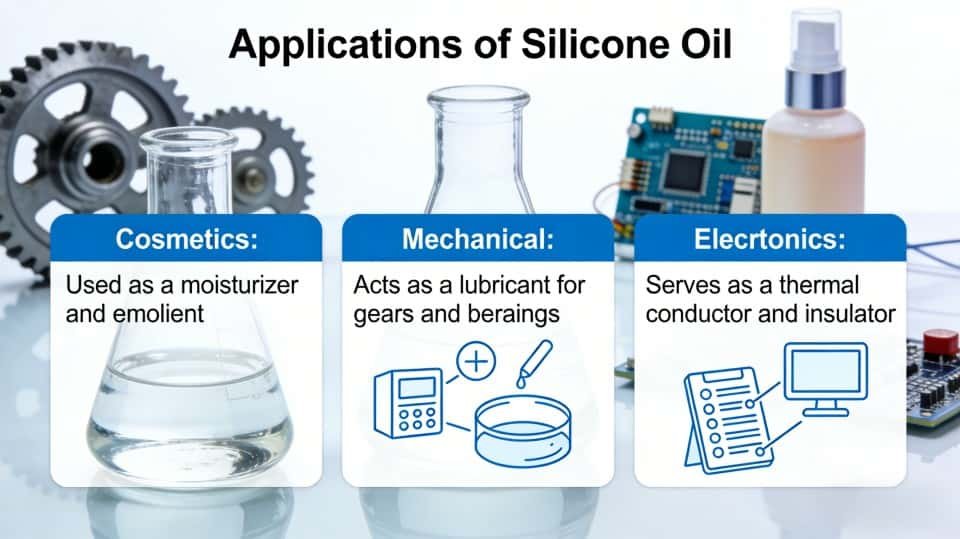
Silicone Oil as an Industrial Lubricant
One of the most common uses of silicone oil is lubrication in environments where conventional oils degrade. Silicone oil maintains stable viscosity across wide temperature ranges and resists oxidation even at high temperatures.
Industrial lubrication applications include:
• Precision instruments
• Plastic gears
• Rubber seals
• High-temperature bearings
• Optical equipment
Unlike petroleum lubricants, silicone oils do not easily evaporate or oxidize, making them ideal for long-term lubrication.
Table: Silicone Oil vs Mineral Oil Lubrication
| Property | Silicone Oil | Mineral Oil |
|---|---|---|
| Temperature Stability | Excellent | Moderate |
| Oxidation Resistance | Very High | Low |
| Service Life | Long | Shorter |
| Compatibility | Wide | Limited |
Because of these advantages, silicone oils are widely used in high-precision engineering applications.
Silicone Oil in Cosmetics and Personal Care
The cosmetics industry is one of the largest consumers of silicone oil. Silicone oils are widely used in skin care products, hair conditioners, makeup formulations, and personal care formulations.
In cosmetics, silicone oil provides several desirable properties:
• Smooth silky texture
• Non-greasy feel
• Improved spreadability
• Water resistance
• Enhanced product stability
Dimethicone, one of the most common silicone oils, is widely used in moisturizers, foundations, and hair care products.
Table: Silicone Oil Uses in Cosmetics
| Product Category | Silicone Function |
|---|---|
| Skin creams | Moisturizing agent |
| Hair conditioners | Shine and softness |
| Makeup products | Smooth application |
| Sunscreens | Water resistance |
Because silicone oil is chemically inert and hypoallergenic, it is considered safe for use in many cosmetic formulations.
Silicone Oil as an Antifoaming Agent
Foam formation is a major problem in industrial processes such as fermentation, wastewater treatment, food processing, and chemical manufacturing.
Silicone oils are highly effective antifoaming agents because of their extremely low surface tension and ability to destabilize foam bubbles.
Industries that rely heavily on silicone antifoams include:
• Food processing
• Pharmaceutical fermentation
• Chemical reactors
• Wastewater treatment plants
Even very small concentrations of silicone oil can effectively suppress foam formation.
Silicone Oil in Electrical Insulation
Silicone oil is widely used as a dielectric fluid in electrical equipment because of its high dielectric strength and thermal stability.
Applications include:
• Transformers
• High-voltage capacitors
• Electrical switchgear
• Cooling systems for electronics
Compared with mineral insulating oils, silicone oils provide superior fire resistance and thermal stability.
Table: Electrical Properties of Silicone Oil
| Property | Typical Value |
|---|---|
| Dielectric Strength | 15–20 kV/mm |
| Electrical Resistivity | Very High |
| Thermal Stability | Up to 250°C |
These properties make silicone oil particularly useful in high-reliability electrical systems.
Silicone Oil as a Heat Transfer Fluid
Many industrial systems require fluids capable of transferring heat efficiently without degrading at high temperatures.
Silicone oils are widely used as heat transfer fluids in:
• Chemical reactors
• Solar thermal systems
• Laboratory heating baths
• Plastic processing equipment
Because silicone oils maintain stable viscosity at high temperatures, they provide reliable heat transfer performance.
Silicone Oil in Textile Processing
In the textile industry, specialized silicone oils are used as fabric softeners and finishing agents. Amino-functional silicone oils interact with textile fibers to improve softness, flexibility, and durability.
Benefits include:
• Improved fabric softness
• Reduced friction
• Increased wrinkle resistance
• Enhanced fabric durability
Silicone-treated textiles are commonly used in clothing, upholstery, and industrial fabrics.
Silicone Oil in Medical and Pharmaceutical Applications
Medical-grade silicone oils are widely used because of their chemical inertness and biocompatibility.
Applications include:
• Ophthalmic surgery (retinal tamponade)
• Medical lubricants
• Drug delivery systems
• Medical device coatings
The stability and safety profile of silicone oil make it suitable for sensitive biomedical applications.
Silicone Oil in Mold Release Agents
Manufacturing processes involving rubber, plastic, or composite materials often require mold release agents to prevent products from sticking to molds.
Silicone oil is widely used as a mold release agent because it forms a thin lubricating film that prevents adhesion.
Industries using silicone mold release agents include:
• Rubber molding
• Plastic injection molding
• Composite manufacturing
Silicone Oil in Advanced Industrial Applications
Beyond traditional uses, silicone oil is increasingly used in advanced technologies such as:
• Aerospace lubricants
• Semiconductor processing
• Nanotechnology coatings
• Electric vehicle components
These applications demonstrate the growing importance of silicone oil in high-technology industries.
Advantages of Silicone Oil Compared With Conventional Oils
Silicone oil offers several major advantages over hydrocarbon-based oils.
Key benefits include:
• Wide operating temperature range
• Excellent oxidation resistance
• Low toxicity
• Chemical inertness
• High dielectric strength
• Long service life
These advantages make silicone oil one of the most versatile specialty fluids in modern industrial chemistry.
Selecting the Right Silicone Oil
Choosing the correct silicone oil requires evaluating several technical parameters.
Table: Key Selection Factors
| Parameter | Importance |
|---|---|
| Viscosity | Determines lubrication performance |
| Functional Groups | Determines compatibility |
| Thermal Stability | Determines operating temperature |
| Purity | Critical for electronics and medical uses |
Selecting the appropriate silicone oil formulation ensures optimal performance in specific applications.
Conclusion
Silicone oil is one of the most versatile specialty fluids used across modern industries. Its unique silicon-oxygen backbone structure provides exceptional thermal stability, chemical inertness, low surface tension, and outstanding dielectric properties. These characteristics allow silicone oil to function as a lubricant, heat transfer fluid, electrical insulating fluid, cosmetic ingredient, antifoaming agent, mold release agent, and surface treatment agent.
From cosmetics and textiles to aerospace engineering and semiconductor manufacturing, silicone oil enables high-performance materials and processes that would otherwise be impossible with conventional oils. As industries continue to demand materials capable of performing under extreme conditions, silicone oil will remain an essential component in advanced chemical formulations and industrial systems.
Talk to the Silicone Oil Specialists at Silicon Chemicals
If you are sourcing silicone oil for industrial manufacturing, cosmetics, coatings, electronics, or specialty chemical formulations, selecting the correct viscosity grade and functional modification is critical to achieving optimal performance.
At Silicon Chemicals, we supply a wide range of high-purity silicone oils, including PDMS fluids, functional silicone oils, and specialty formulations tailored for industrial, cosmetic, and high-technology applications.
If you are evaluating silicone oil options or need technical guidance for your formulation, the Silicon Chemicals team is ready to help you identify the right solution for your application.