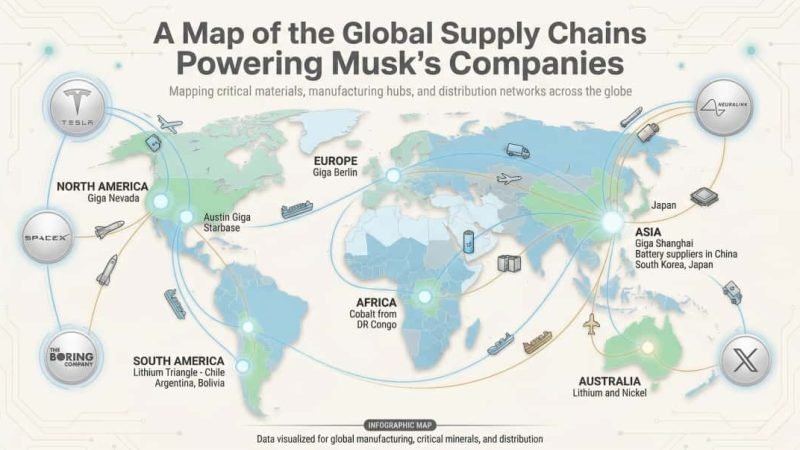
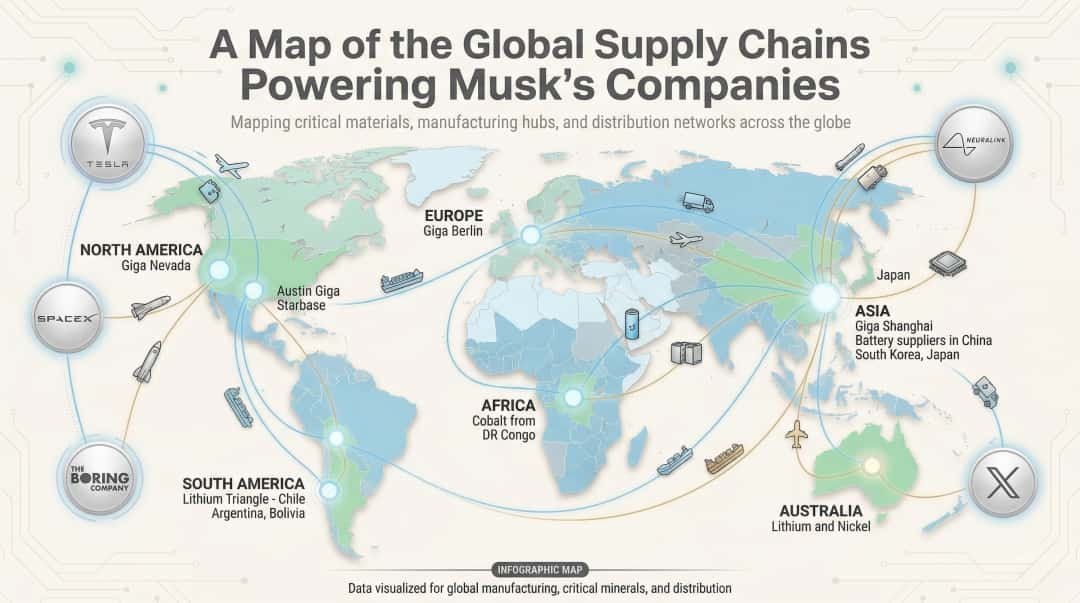
When people talk about Elon Musk’s companies—Tesla, SpaceX, Starlink, or xAI—they often focus on visionary technology: electric vehicles, reusable rockets, satellite internet, and artificial intelligence. However, behind every breakthrough product lies a far more complex reality: a vast global supply chain composed of mines, chemical plants, semiconductor fabs, advanced materials manufacturers, logistics networks, and precision engineering suppliers. Without these supply chains, even the most ambitious technology companies would be unable to scale their innovations. The real industrial power behind Musk’s companies therefore does not exist only in Silicon Valley laboratories or rocket launch sites, but across thousands of factories and resource extraction sites distributed around the world.
The hidden backbone of Elon Musk’s industrial ecosystem is a global supply chain network that spans raw material extraction, advanced chemical processing, semiconductor manufacturing, aerospace components, battery production, and high-precision industrial manufacturing. These interconnected supply chains enable companies like Tesla and SpaceX to build complex technologies at scale while maintaining strategic control over critical resources and components.
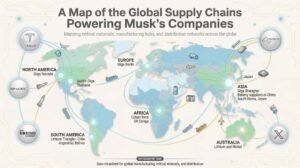
To understand how Musk’s industrial system truly functions, we must analyze the multi-layered supply chains that support its technologies. These supply chains extend from lithium mines in South America to semiconductor fabrication plants in Taiwan, from nickel processing facilities in Indonesia to advanced composite materials factories in Europe. The success of Musk’s companies depends not only on innovation but also on mastering these industrial networks.
High-technology companies operate independently from global supply chains.False
Advanced technologies rely heavily on complex international supply chains involving raw materials, precision components, and industrial manufacturing.
Supply chain control is a strategic advantage for companies like Tesla and SpaceX.True
Vertical integration and supplier partnerships allow these companies to secure critical materials and reduce production risks.
Understanding the Structure of Global Industrial Supply Chains
Modern industrial production is organized into layered supply chains that transform raw materials into finished technological products. For complex technologies such as electric vehicles or rockets, the supply chain typically includes several major stages: resource extraction, materials processing, component manufacturing, system integration, and final product assembly.
Core Supply Chain Layers
| Supply Chain Layer | Industrial Activities | Typical Outputs |
|---|---|---|
| Resource Extraction | Mining and resource recovery | Lithium, nickel, cobalt |
| Material Processing | Chemical refining and metallurgy | Battery chemicals, alloys |
| Component Manufacturing | Precision engineering | Semiconductors, motors |
| System Integration | Assembly of subsystems | Battery packs, rocket engines |
| Final Manufacturing | Product assembly | EVs, satellites, rockets |
Each stage depends on the reliability and efficiency of the previous stage. If raw material supply becomes unstable, entire production chains may slow down or collapse. For this reason, strategic control over supply chains has become a major priority for technology companies.
Raw Material Supply: The Foundation of High-Tech Manufacturing
The first stage of the supply chain involves raw material extraction. Electric vehicles, rockets, and satellite systems require specialized materials that are often sourced from geographically concentrated regions.
Critical Raw Materials for Musk’s Technologies
| Material | Primary Use | Major Producing Regions |
|---|---|---|
| Lithium | Battery cells | Chile, Argentina, Australia |
| Nickel | High-energy batteries | Indonesia, Canada |
| Cobalt | Battery stability | Democratic Republic of Congo |
| Graphite | Battery anodes | China |
| Rare Earth Elements | Motors and electronics | China, USA |
For example, lithium is a crucial ingredient in lithium-ion batteries used in electric vehicles and energy storage systems. The majority of the world’s lithium reserves are located in South America’s “Lithium Triangle,” which includes Chile, Argentina, and Bolivia. These resources are extracted from salt flats and processed into battery-grade chemicals before entering global manufacturing networks.
Nickel and cobalt are also essential battery materials. Nickel improves battery energy density, while cobalt enhances thermal stability. However, the geographic concentration of these materials introduces supply risks, making resource diversification and recycling technologies increasingly important.
Chemical Processing and Materials Engineering
After extraction, raw materials must undergo chemical processing and refining before they can be used in industrial manufacturing. This stage involves sophisticated chemical engineering processes that convert ores and raw materials into high-purity compounds suitable for advanced technologies.
Key Industrial Material Processing
| Processing Sector | Materials Produced |
|---|---|
| Battery Chemicals | Lithium carbonate, lithium hydroxide |
| Metallurgy | Nickel alloys, aluminum |
| Composite Materials | Carbon fiber |
| Semiconductor Materials | Silicon wafers |
Battery chemistry is particularly important for Tesla’s supply chain. Lithium compounds must be refined to extremely high purity levels before they can be used in battery cells. This processing often occurs in specialized chemical facilities that operate at industrial scale.
Composite materials also play a critical role in aerospace engineering. Carbon fiber composites are widely used in rockets and spacecraft because they combine high strength with low weight.
Semiconductor Supply Chains
Modern technological products rely heavily on semiconductors. Electric vehicles, autonomous driving systems, satellites, and artificial intelligence computing platforms all require advanced microchips.
Semiconductor Supply Network
| Stage | Example Companies |
|---|---|
| Chip Design | Nvidia, AMD |
| Fabrication | TSMC, Samsung |
| Packaging | ASE, Amkor |
| Integration | Tesla electronics systems |
Autonomous driving technology is particularly dependent on high-performance computing hardware. Tesla vehicles contain specialized processors that analyze sensor data and run neural network algorithms. These chips must be manufactured using advanced semiconductor fabrication processes that require extremely precise equipment.
The semiconductor industry itself represents one of the most complex supply chains in the world. Chip manufacturing requires thousands of process steps and highly specialized equipment, making it one of the most technologically sophisticated industries ever developed.
Aerospace Supply Chains
SpaceX operates within another highly specialized supply chain ecosystem: aerospace manufacturing. Rockets require precision engineering and materials capable of withstanding extreme temperatures and pressures.
Aerospace Manufacturing Components
| Component | Function |
|---|---|
| Rocket Engines | Generate propulsion |
| Cryogenic Tanks | Store liquid fuels |
| Avionics Systems | Navigation and control |
| Composite Structures | Lightweight rocket bodies |
SpaceX has pursued a strategy of vertical integration by manufacturing many rocket components internally. This reduces dependence on external suppliers and accelerates design improvements.
Reusable rocket technology further complicates supply chains because components must survive multiple launch cycles while maintaining structural integrity.
Battery Manufacturing Supply Chains
Battery manufacturing represents one of the most critical supply chains for Tesla’s ecosystem. The production of lithium-ion batteries involves several stages, including cathode and anode material production, electrolyte formulation, cell assembly, and battery pack integration.
Battery Production Workflow
| Stage | Description |
|---|---|
| Material Refining | Produce battery-grade chemicals |
| Electrode Manufacturing | Create cathodes and anodes |
| Cell Assembly | Construct battery cells |
| Pack Integration | Assemble cells into battery packs |
Gigafactories are designed to integrate several of these steps into a single facility, reducing transportation costs and improving production efficiency.
Logistics and Global Distribution
Once components and systems are manufactured, they must be transported through global logistics networks. Shipping routes, ports, rail networks, and trucking systems play a critical role in ensuring that materials and components arrive at factories on time.
Global Logistics Infrastructure
| Logistics Mode | Typical Role |
|---|---|
| Maritime Shipping | Bulk material transport |
| Air Freight | High-value electronics |
| Rail | Regional industrial transport |
| Trucking | Final delivery to factories |
Efficient logistics are particularly important for industries operating at gigafactory scale. Even small disruptions can affect production timelines.
Supply Chain Resilience and Vertical Integration
One of the defining characteristics of Musk’s companies is their emphasis on supply chain control. Instead of relying entirely on external suppliers, companies like Tesla and SpaceX often internalize critical manufacturing processes.
Strategic Advantages of Vertical Integration
| Advantage | Description |
|---|---|
| Cost Reduction | Eliminates supplier margins |
| Faster Innovation | Rapid design iteration |
| Supply Security | Reduced dependency on external vendors |
| Quality Control | Direct manufacturing oversight |
This strategy became particularly important during global supply chain disruptions in recent years. Companies with strong internal manufacturing capabilities were better positioned to maintain production during shortages.
The Global Industrial Network Behind Musk’s Ecosystem
When viewed as a whole, the supply chains supporting Musk’s companies form a vast industrial network spanning multiple continents. Mines in South America supply lithium for batteries. Semiconductor factories in East Asia produce advanced microchips. Chemical processing plants refine raw materials into high-performance compounds. Aerospace facilities manufacture rocket components. Gigafactories assemble vehicles and energy systems at massive scale.
This global industrial network functions as the hidden backbone behind Musk’s technological empire. While public attention often focuses on visionary products and ambitious missions, the real foundation of these achievements lies in the industrial supply chains that transform raw materials into advanced technologies.
Conclusion
Elon Musk’s companies operate at the intersection of several highly complex global supply chains. From lithium extraction and chemical processing to semiconductor fabrication and aerospace manufacturing, these networks provide the materials, components, and infrastructure required to build electric vehicles, rockets, satellites, and artificial intelligence systems. Understanding these supply chains reveals the true industrial scale behind Musk’s ecosystem and highlights the importance of strategic resource management in modern technology industries.
Contact Silicon Chemical
If your organization is seeking reliable chemical materials, industrial supply chain solutions, or specialized chemical technologies for emerging industries such as energy storage, electronics, or advanced manufacturing, Silicon Chemical is ready to support your business.
Silicon Chemical
Website: www.siliconchemicals.com
Email: Inquiry@siliconchemicals.com