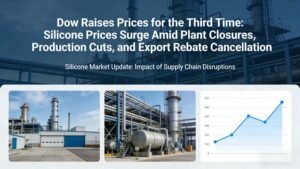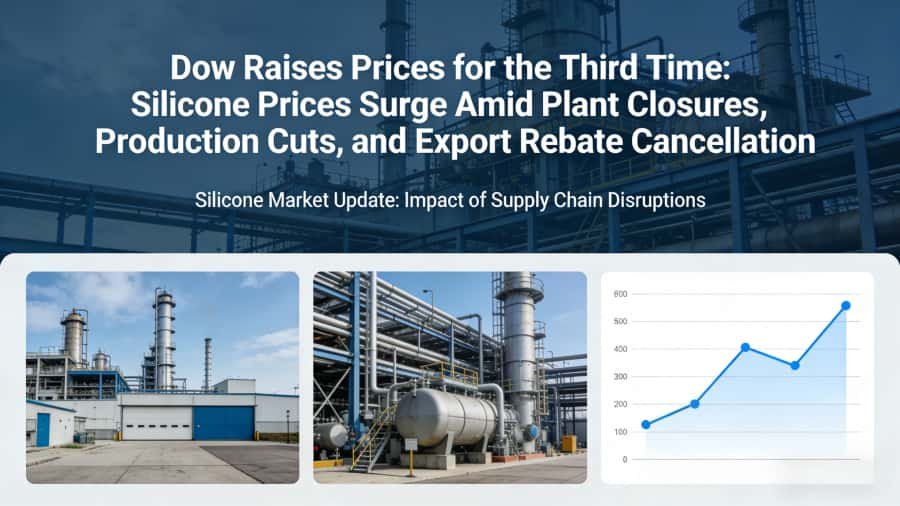
Dow Raises Prices for the Third Time: Silicone Prices Surge Amid Plant Closures, Production Cuts, and Export Rebate Cancellation
On March 3, 2026, Dow’s Consumer Solutions business unit issued a price adjustment notice to partners in Greater China, announcing a new round of price increases for its silicone product portfolio. The new pricing will take effect on March 27, 2026, with expected increases ranging from 5% to 15%.
This marks the third price increase within five months, following earlier adjustments in November 2025 and January 2026.
The latest price adjustment covers a wide range of core silicone products, including:
- Dimethyl silicone oil
- D4 (Octamethylcyclotetrasiloxane)
- Linear siloxanes
- High-consistency rubber
- Vinyl silicone oil
- 107 silicone rubber
- Bulk silicone gum
These products represent key intermediate materials across most downstream silicone applications, meaning the adjustment will likely influence prices across multiple sectors including electronics, automotive, textiles, personal care, and industrial manufacturing.
Mounting Cost Pressures: Even Industry Giants Cannot Escape
In its price adjustment notice, Dow described the move as a “necessary measure under current market conditions.” This explanation reflects a broader reality faced by the global silicone industry rather than a simple pricing strategy.
Multiple structural pressures are simultaneously pushing production costs higher.
Raw Material Volatility
One of the most significant pressures comes from fluctuations in upstream raw material markets.
The key upstream raw material for silicone production is industrial silicon (metal silicon). Although the silicon metal market has recently remained relatively stable, broader geopolitical tensions have begun to affect related chemical supply chains.
Ongoing conflicts in the Middle East have disrupted shipping routes through the Strait of Hormuz, a critical corridor for global energy trade. Shipping disruptions in the region have pushed crude oil and petroleum coke prices higher, increasing the production costs for energy-intensive chemical processes.
Additionally, methanol, an important auxiliary raw material used in silicone monomer production, has experienced a sharp price surge recently due to strong futures market activity. Rising methanol costs have further intensified cost pressures on silicone monomer manufacturers.
Capacity Reductions in Europe
Supply-side changes are also reshaping the global silicone market.
Dow has announced plans to close its basic siloxane facility in Barry, United Kingdom, with an annual capacity of approximately 145,000 tons, by mid-2026.
This closure is expected to reduce European siloxane capacity by nearly one-third, significantly tightening regional supply.
The plant closure reflects a broader structural shift in the global chemical industry. Many traditional Western chemical companies are gradually reducing production capacity in high-cost regions, while production continues to expand in lower-cost manufacturing hubs such as China.
As overseas production declines, the global silicone supply chain becomes more concentrated, which can amplify price volatility and increase the cost of supply chain coordination.
Rising Logistics Costs
Logistics costs remain another major challenge for the global chemical industry.
Several factors have contributed to persistently high transportation costs:
- Global supply chain restructuring
- Shipping disruptions caused by geopolitical tensions
- Congestion at major international ports
- Higher fuel prices
Industry data indicates that international freight rates remain significantly higher than pre-pandemic levels, maintaining long-term pressure on chemical manufacturers that rely on global supply networks.
For silicone producers—whose raw materials, intermediates, and downstream products often move across multiple continents—logistics costs represent a substantial component of total operating expenses.
Dual Supply Contraction: From Price Wars to Value Competition
While global supply pressures are intensifying, structural changes are also occurring within the Chinese silicone industry.
Recently, the Silicone High-Quality Development Conference was held in Ningbo, Zhejiang, where industry participants reached two important consensus decisions regarding market coordination and production management.
Industry-Wide Price Adjustment
Beginning March 2, 2026, the industry agreed to implement a uniform price increase of 300 RMB per ton across the entire silicone product range.
Following the adjustment:
- The mainstream price of DMC (Dimethylcyclosiloxane) rose to approximately 14,300 RMB per ton
- Prices of 107 silicone rubber and high-consistency rubber increased simultaneously
Since November 2025, DMC prices have already been raised five times, with a cumulative increase reaching up to 3,300 RMB per ton.
Interestingly, the magnitude of each increase has gradually decreased:
- Early adjustments reached 1,500 RMB per ton
- Recent increases have narrowed to around 300 RMB per ton
This shift suggests that the industry may be moving away from disorderly price competition toward a more stable price recovery cycle.
Instead of aggressive price hikes, companies appear to be adopting a gradual price repair strategy, allowing the market to stabilize while restoring profitability.
Structural Shift in Industry Competition
The recent developments indicate a broader transformation within the silicone industry.
For years, the sector has been characterized by intense price wars driven by rapid capacity expansion, particularly in China. Large-scale production increases pushed prices down and compressed margins across the entire value chain.
However, several factors are now reshaping the competitive landscape:
- Production reduction measures within China
- Capacity closures in Europe
- Rising global production costs
- Policy adjustments affecting exports
These changes are encouraging the industry to shift from price-based competition toward value-based competition.
Companies are increasingly focusing on:
- Higher value-added silicone materials
- Specialty functional silicones
- Advanced applications in electronics, medical technology, and renewable energy
A New Phase for the Global Silicone Market
The combination of price increases by global leaders such as Dow, capacity reductions in Europe, and industry-wide price adjustments in China signals that the silicone industry may be entering a new stage of structural rebalancing.
In this new phase:
- Supply growth is becoming more controlled
- Prices are gradually stabilizing
- Competition is shifting from low-cost expansion to technological differentiation
For downstream industries—from electric vehicles and renewable energy to textiles and consumer goods—the ongoing adjustment in silicone prices could mark the beginning of a longer-term price normalization cycle after several years of extreme volatility.