Porcelain is notoriously difficult to bond. Its smooth, inert, glass-like surface resists adhesion, leading to weak bonding, delamination, or premature failure in applications ranging from dental restorations to industrial coatings. Without proper surface chemistry, adhesives simply sit on the surface instead of forming durable bonds—causing costly defects, reduced product lifespan, and reliability risks. This is where silane coupling agents become critical. They act as molecular bridges, transforming an inert porcelain surface into a chemically active interface capable of forming strong, durable, and long-lasting bonds with organic materials.
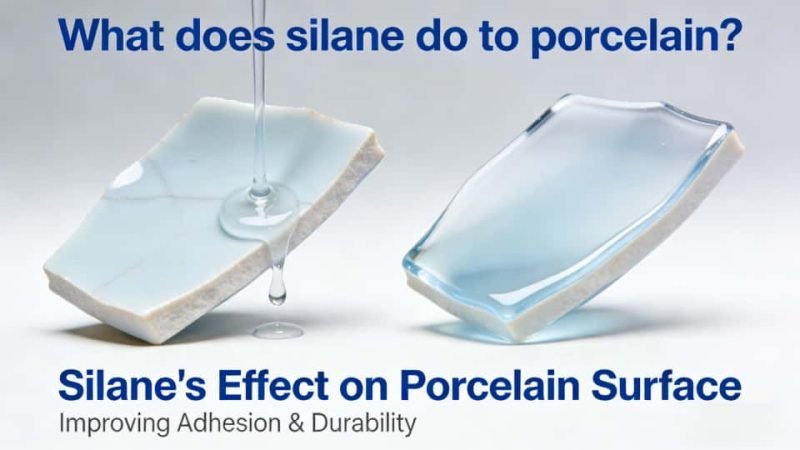
Silane chemically modifies porcelain surfaces by forming covalent bonds with the silica-rich ceramic structure while simultaneously creating reactive functional groups that bond with organic resins or polymers, dramatically improving adhesion strength, durability, and moisture resistance.
If you are working with porcelain—whether in dental materials, coatings, electronics, or advanced composites—understanding how silane works at a molecular level is essential. This guide will walk you through the mechanisms, performance impact, selection strategies, and real-world engineering considerations in a highly structured and practical way.
Silane coupling agents can significantly increase adhesion between porcelain and organic polymers.True
Silane forms chemical bonds with both inorganic porcelain and organic resins, acting as a molecular bridge that enhances adhesion strength and durability.
The Core Function of Silane on Porcelain Surfaces
Silane coupling agents are organosilicon compounds with dual functionality. This duality is what makes them uniquely effective for modifying porcelain surfaces. Porcelain is primarily composed of silica (SiO₂) and aluminosilicate structures, which naturally contain hydroxyl (-OH) groups on their surface. Silane reacts with these groups to form stable siloxane bonds (Si–O–Si), anchoring itself to the ceramic.
Key Functional Roles of Silane
- Surface Activation: Converts inert porcelain into a reactive surface
- Adhesion Promotion: Bridges inorganic ceramic and organic resin systems
- Hydrophobic Modification: Improves water resistance
- Stress Distribution: Enhances mechanical durability under load
Mechanism Overview
| Stage | Description | Chemical Action |
|---|---|---|
| Hydrolysis | Silane reacts with water | Si–OR → Si–OH |
| Condensation | Silanol bonds to porcelain | Si–OH + HO–Surface → Si–O–Surface |
| Polymerization | Crosslink network forms | Si–O–Si network |
| Coupling | Organic group reacts with resin | Covalent bonding |
This sequence transforms the porcelain surface into a chemically integrated interface rather than a passive substrate.
Why Porcelain Needs Silane Treatment
Porcelain surfaces are fundamentally incompatible with most adhesives due to:
- Low surface energy
- Chemical inertness
- Smooth morphology
- Lack of reactive functional groups
Without silane, bonding relies purely on mechanical interlocking, which is weak and unreliable.
Adhesion Comparison
| Condition | Bond Strength | Failure Mode |
|---|---|---|
| Untreated Porcelain | Low | Adhesive failure |
| Acid Etched Only | Moderate | Mixed failure |
| Silane Treated | High | Cohesive failure |
Silane effectively transforms failure from interface-level (weak) to material-level (strong).
Molecular-Level Interaction Between Silane and Porcelain
At the microscopic scale, silane molecules orient themselves between the ceramic and the adhesive system.
Inorganic Side (Porcelain Interface)
- Silanol groups react with hydroxylated ceramic surface
- Formation of stable Si–O–Si covalent bonds
- Strong chemical anchoring
Organic Side (Adhesive Interface)
- Functional groups (amino, epoxy, methacrylate)
- React with resin matrix
- Enable polymer chain integration
Interface Structure
| Layer | Composition | Function |
|---|---|---|
| Porcelain | SiO₂ network | Substrate |
| Silane Layer | Si–O–Si bonds | Coupling bridge |
| Resin | Polymer chains | Load-bearing structure |
This tri-layer system is what enables high-performance adhesion.
Types of Silane Used for Porcelain Treatment
Different silanes are selected based on application requirements.
Common Silane Types
| Type | Functional Group | Application |
|---|---|---|
| Amino Silane | –NH₂ | Epoxy systems |
| Epoxy Silane | Epoxy ring | Coatings |
| Methacryloxy Silane | C=C | Dental composites |
| Vinyl Silane | Vinyl group | Polymer modification |
Selection Criteria
- Type of resin system
- Required bond strength
- Environmental exposure
- Processing conditions
Industrial and Dental Applications of Silane on Porcelain
Silane treatment is widely used across industries where porcelain bonding is critical.
Key Application Areas
- Dental restorations (crowns, veneers)
- Ceramic coatings
- Electronics encapsulation
- Composite materials
- Glass bonding systems
Application Comparison Table
| Industry | Purpose | Benefit |
|---|---|---|
| Dental | Bond ceramic to resin | Long-term durability |
| Electronics | Insulation coating | Moisture resistance |
| Construction | Coating adhesion | Weather stability |
| Automotive | Ceramic coatings | Wear resistance |
Performance Improvements from Silane Treatment
Measurable Benefits
- Adhesion strength increase: 2–10×
- Moisture resistance improvement
- Thermal stability enhancement
- Reduced delamination
Performance Metrics
| Property | Without Silane | With Silane |
|---|---|---|
| Adhesion Strength | Low | High |
| Water Resistance | Poor | Excellent |
| Durability | Limited | Long-term |
| Interface Stability | Weak | Strong |
Surface Preparation Requirements
Silane effectiveness depends heavily on proper surface preparation.
Critical Preparation Steps
- Cleaning (remove contaminants)
- Surface roughening (optional)
- Hydroxyl activation (via moisture)
- Controlled silane application
Preparation Impact Table
| Step | Effect on Bonding |
|---|---|
| Cleaning | Essential |
| Etching | Improves surface area |
| Drying | Prevents dilution |
| Silane curing | Ensures bonding |
Common Mistakes When Using Silane on Porcelain
Even experienced users often reduce effectiveness due to incorrect application.
Typical Errors
- Over-application (leads to weak layer)
- Improper drying
- Using expired silane
- Incorrect pH conditions
- Skipping surface cleaning
Problem vs Solution
| Problem | Cause | Solution |
|---|---|---|
| Weak bonding | Poor hydrolysis | Adjust pH |
| Delamination | Thick silane layer | Apply thin coat |
| Inconsistent results | Surface contamination | Improve cleaning |
Environmental and Durability Considerations
Silane-treated porcelain shows superior performance under harsh conditions.
Resistance Capabilities
- Water and humidity
- Thermal cycling
- Chemical exposure
- UV degradation
This makes silane essential in outdoor and high-reliability applications.
How to Choose the Right Silane for Porcelain
Selecting the correct silane is a critical engineering decision.
Key Factors
- Substrate composition
- Adhesive chemistry
- Environmental conditions
- Application method
Selection Guide
| Requirement | Recommended Silane |
|---|---|
| Dental bonding | Methacryloxy silane |
| Epoxy systems | Amino silane |
| High durability | Epoxy silane |
| Flexible systems | Vinyl silane |
Future Trends in Silane Technology for Porcelain
- Nano-silane coatings
- Hybrid coupling agents
- Environmentally friendly formulations
- Self-assembled monolayers
These innovations are pushing adhesion performance to new levels.
Conclusion
Silane fundamentally transforms porcelain from a passive, difficult-to-bond material into an active, high-performance interface capable of forming strong, durable chemical bonds with organic systems. Whether in dental restorations, industrial coatings, or advanced composites, silane acts as a molecular bridge—delivering superior adhesion, durability, and environmental resistance. Understanding its mechanism, selection, and application is essential for anyone working with ceramic materials.
Ready to Improve Your Porcelain Bonding Performance?
At Silicon Chemicals, we work closely with engineers, manufacturers, and material scientists to deliver high-performance silane coupling agents tailored for ceramic and porcelain applications. Whether you need standard grades or customized formulations, we can support your project with consistent quality, technical expertise, and global supply capability.
Contact us today to get the right silane solution for your application.